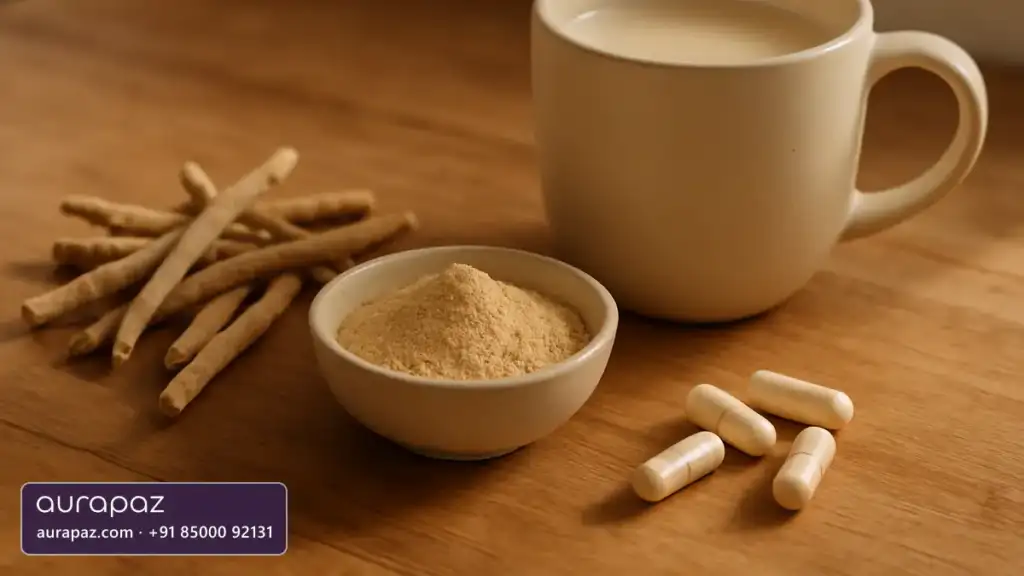
Ashwagandha used to sit quietly in the Ayurvedic corner of the chemist, as a powder an older relative might stir into warm milk at night. Now it comes as gummies, capsules, sleep blends and “stress support” drinks, usually with a promise that it lowers cortisol and calms a busy mind. If you are stretched thin or sleeping badly, it is natural to wonder whether a bottle would help.
That question deserves a straight answer. Ashwagandha has more clinical trials behind it than most herbal supplements, and some results are encouraging. But the trials are small and short, several used extracts supplied by their manufacturer, and the safety picture has shifted, with reports of liver injury, thyroid effects and restrictions by food safety authorities in Europe and India.
From Ayurvedic root to supplement aisle
Ashwagandha is Withania somnifera, an evergreen shrub whose root has long been used in Ayurvedic and Unani medicine. The name is Sanskrit for the smell of a horse, while somnifera is Latin for sleep-inducing. Today it is sold as an “adaptogen”, a loosely defined term for something said to help the body cope with stress.
The root contains compounds called withanolides, thought to explain many of its effects. A capsule labelled ashwagandha could hold plain root powder, a water or alcohol extract, or a root and leaf blend, at very different strengths. The trials you see quoted mostly used branded extracts such as KSM-66 (root) or Shoden and Sensoril (root and leaf), and the NIH Office of Dietary Supplements notes that with so many preparations and doses, it is hard to say which extract or amount does what. A result from one product does not automatically carry over to another.
Stress and anxiety: what the trials actually measured
Much of the excitement traces back to a 2012 trial in the Indian Journal of Psychological Medicine. Sixty-four adults with chronic stress took either a placebo or 300 mg of a root extract (KSM-66) twice a day for 60 days. People on ashwagandha scored lower on every stress questionnaire, and their blood cortisol fell further than in the placebo group.
The 27.9 per cent cortisol figure, read properly
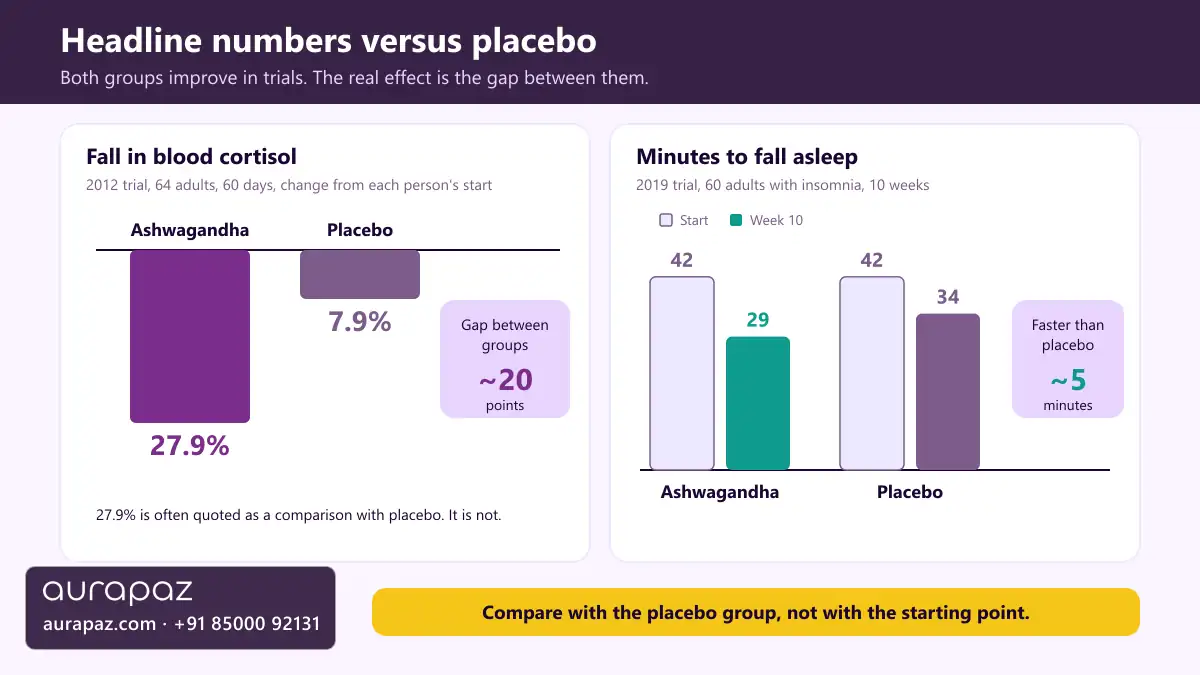
“Ashwagandha cuts cortisol by 27.9 per cent” appears on labels and posts everywhere, sometimes credited to the wrong journal and usually presented as a comparison with placebo. It is not one. In the paper, 27.9 per cent is how far cortisol fell from each person’s own starting level in the ashwagandha group. Cortisol in the placebo group fell too, by 7.9 per cent. So the gap between the groups was about 20 percentage points, in one single-centre trial that 61 people finished. Striking results from one small study are a reason to look further, not a settled fact.
What the pooled evidence says
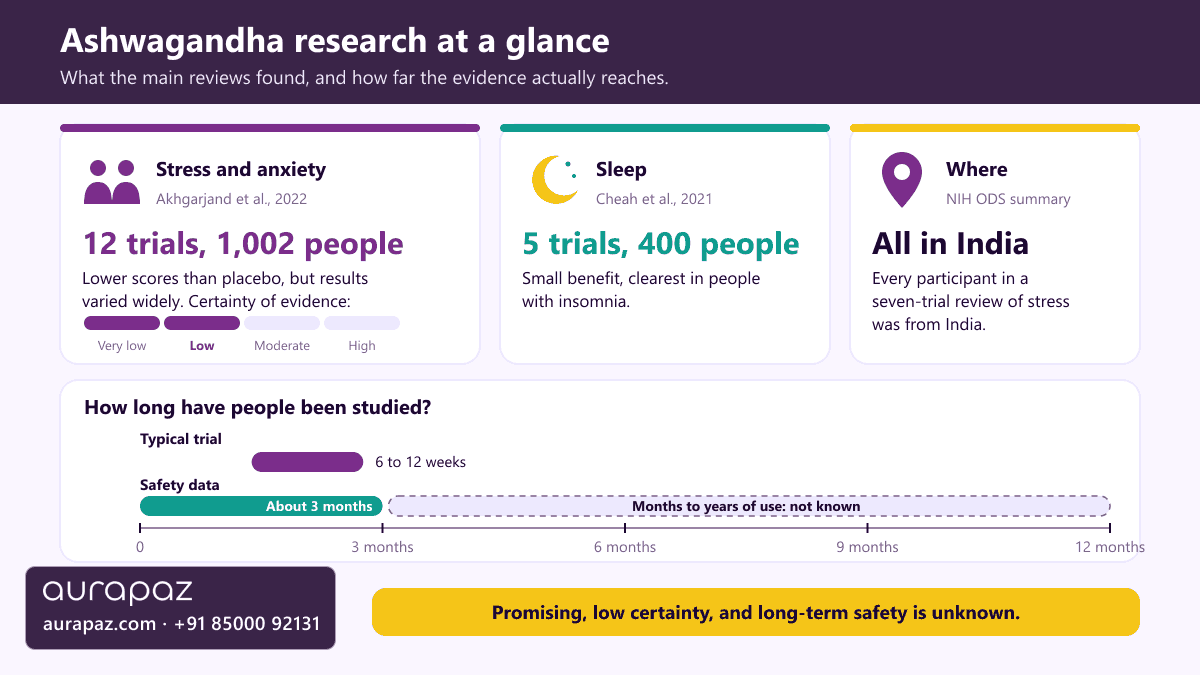
A 2022 meta-analysis led by Akhgarjand pooled 12 randomised trials with 1,002 participants aged 25 to 48. Ashwagandha lowered anxiety and stress scores compared with placebo, and on paper the effects looked large. But results varied enormously from trial to trial, and the authors rated the certainty of the evidence as low for both outcomes, calling for better-quality studies.
The NIH, describing an earlier review of seven trials, notes that all 491 participants were from India and the trials ran for 6 to 8 weeks, using 240 to 1,250 mg a day of extract. Not every trial is positive: in a 2023 study of 120 overweight adults with stress and fatigue, 12 weeks of a root extract eased fatigue but did not reduce perceived stress compared with placebo.
In 2022, a taskforce of two psychiatry bodies, the WFSBP and CANMAT, gave ashwagandha root extract a provisional recommendation for generalised anxiety disorder, while saying more research is needed. That is a cautious nod in guidelines written for clinicians, not a reason to manage an anxiety disorder on your own with a supplement.
Sleep: a small benefit, mostly for people with insomnia
Sleep claims are often credited to “a 2019 PLOS ONE study”. The PLOS ONE paper on this is actually a 2021 meta-analysis by Cheah and colleagues, pooling five randomised trials with 400 adults, all run in India. It found a small but significant effect on overall sleep, clearer in adults diagnosed with insomnia, at 600 mg a day or more, and after at least eight weeks. The authors noted that data on serious side effects were limited and more safety evidence is needed before long-term use can be judged.
What does “small” look like? In one 2019 trial, 60 adults with insomnia and anxiety took 300 mg of a root extract twice daily or a placebo for 10 weeks, wearing wrist monitors that tracked their sleep. Both groups were falling asleep faster by the end: the ashwagandha group went from about 42 minutes to 29, the placebo group from about 42 to 34. That is a difference of roughly five minutes. Total sleep time rose in both groups, and the gap between them was not statistically significant.
For persistent insomnia, the NHS points first to steady sleep habits and to cognitive behavioural therapy (CBT), face to face or through an online programme, and notes that sleeping pills are now rarely prescribed because of side effects and dependence. If social media has you trying every bedtime trick, my piece on sleepmaxxing sorts useful habits from gimmicks, and what the magnesium hype gets right covers another supplement sold heavily for sleep.
What the research cannot tell you yet
- Long-term safety. The NIH says ashwagandha appears well tolerated for up to about three months, but evidence on use over many months or years is lacking. The US National Center for Complementary and Integrative Health (NCCIH) agrees there is not enough information on long-term safety.
- Who was studied. Most trials were small, short and run in India, often within a traditional medical framework, so the NIH says effects as an everyday supplement are unclear.
- Who supplied the product. The 2012 cortisol study and the 2019 insomnia trial both used KSM-66 extract from its manufacturer, Ixoreal Biomed, as the papers state. The authors declared no competing interests, and this does not make the results wrong. It is why larger independent trials matter.
- Rare harms. A trial of 60 people for eight weeks cannot pick up a reaction that affects one person in thousands. Those show up later, in case reports, which is where the liver and thyroid concerns came from.
Who should avoid it, and the side effects that matter
Common side effects are usually mild: upset stomach, loose stools, nausea and drowsiness, with NCCIH also listing vomiting.
Liver injury
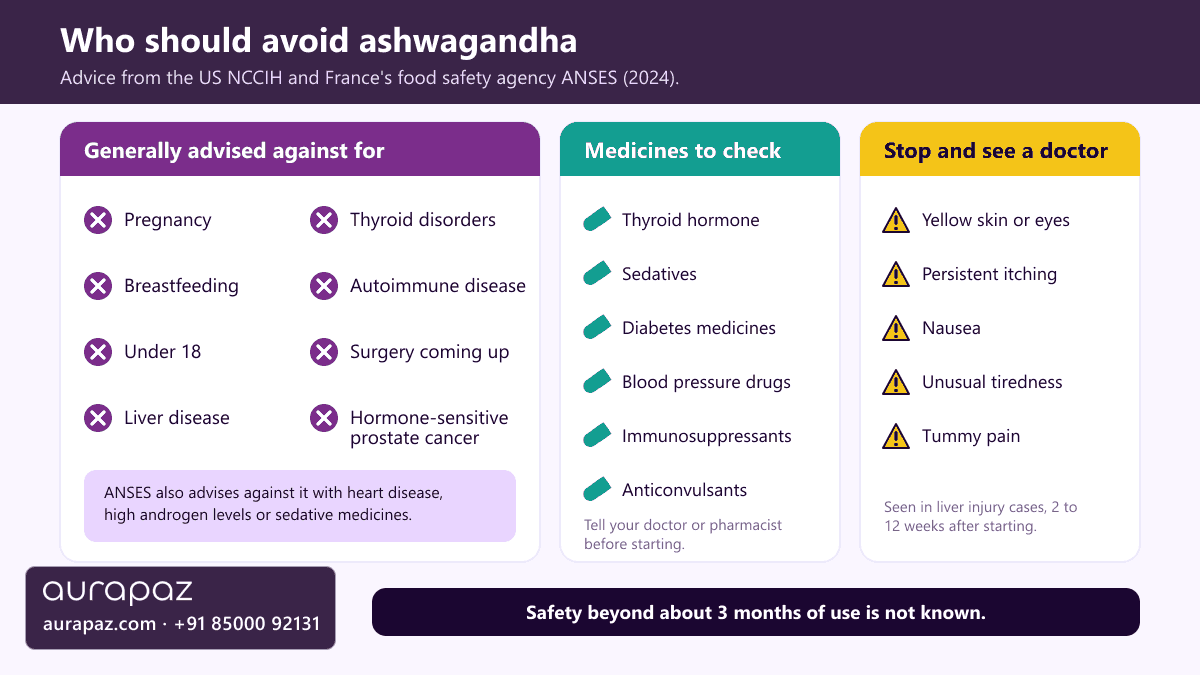
In 2020, doctors described five people in Iceland and the United States who developed jaundice, itching, nausea, tiredness and abdominal discomfort 2 to 12 weeks after starting ashwagandha supplements. None developed liver failure, and liver tests returned to normal within one to five months in the four who were followed up.
A 2023 series from three Indian hospitals is more sobering. Doctors identified 23 people with ashwagandha-linked liver injury between 2019 and 2022 and described eight who had taken single-ingredient products. Five of the eight already had chronic liver disease; three of those developed acute-on-chronic liver failure, and all three died. Tested products showed no adulterants, and only trace metals in one.
The NIH LiverTox database describes the same pattern: injury 2 to 12 weeks after starting, with jaundice and itching, usually mild to moderate and resolving, but with deaths described from acute or acute-on-chronic liver failure.
Stop and see a doctor promptly if you develop yellowing of the skin or eyes, persistent itching, nausea, unusual tiredness or abdominal pain while taking ashwagandha or any herbal product. If you have any liver condition, do not start it without your doctor’s agreement.
Thyroid effects
Ashwagandha is often sold as something that “balances” the thyroid. The research shows it can push thyroid hormones up. In a 2018 trial of 50 adults with mildly underactive thyroid, eight weeks of root extract lowered TSH and raised T3 and T4 compared with placebo. The NIH also describes three case reports of thyrotoxicosis, an excess of thyroid hormone, in women taking ashwagandha, which settled once they stopped. If you have an overactive thyroid or take thyroid tablets, an unplanned rise is a risk, not a benefit.
Pregnancy, breastfeeding and children
NCCIH advises avoiding ashwagandha in pregnancy and while breastfeeding. The NIH notes reports suggesting a risk of miscarriage, though the American Herbal Pharmacopoeia says there is no evidence the root causes abortion. France’s food safety agency, ANSES, also advises against it for anyone under 18.
Autoimmune disease, surgery, prostate cancer and medicines
NCCIH says ashwagandha is not advised for people with autoimmune or thyroid disorders or those about to have surgery, and people with hormone-sensitive prostate cancer should avoid it because it may raise testosterone. It might also interact with medicines for diabetes and blood pressure, immunosuppressants, sedatives, anticonvulsants and thyroid hormone. If you take any regular medicine, speak to your doctor or pharmacist before starting it.
Why regulators in Europe and India have stepped in
In 2020, the Technical University of Denmark assessed ashwagandha for the Danish food authority, raised concerns about thyroid and sex hormones and possible miscarriage, and concluded that a safe intake could not be set. It cannot legally be sold in foods or supplements in Denmark. The stance has critics: McGill University’s Office for Science and Society called the concerns significant but not backed by strong clinical evidence.
France’s ANSES gave its opinion on 19 April 2024. It too could not define a risk-free intake, partly because study extracts are poorly characterised. It advised pregnant and breastfeeding women, under-18s, people with thyroid, liver or heart disease or hyperandrogenism (raised male-type hormones), and people on sedative medicines not to use ashwagandha supplements, and advised everyone to tell their doctor about supplements and avoid combining several.
The UK Food Standards Agency ran a call for evidence in 2024 for a risk assessment by its Committee on Toxicity, with the outcome still to be published. In April 2026, India’s Ministry of Ayush and the food regulator FSSAI directed that only the root, not the leaf, may be used in Ayush products and foods, citing the leaf’s higher content of reactive withanolides such as withaferin A. Some manufacturers have since won interim court stays while they challenge the rule.
Product quality: what is really in the bottle
A herb is only as good as the product in your hand. In a 2008 JAMA study, researchers bought 193 Ayurvedic medicines online and found about one in five contained detectable lead, mercury or arsenic, whether made in India or the United States, and three in four of those claimed good manufacturing practice. A 2025 Polish study of 11 adaptogen supplements, including ashwagandha products, found most failed safety limits, mainly for lead and nickel. I found similar problems looking at heavy metals in protein powder. A label naming the plant part, extract and manufacturer is the minimum to expect, not a guarantee.

Myth vs Reality: ashwagandha claims checked
| What the trend says | What the science says |
|---|---|
| “Ashwagandha cuts cortisol by 27.9 per cent compared with placebo.” | That is the fall from baseline in one 2012 trial of 64 adults. Placebo cortisol fell 7.9 per cent too. |
| “A 2019 PLOS ONE study proved it fixes sleep.” | The PLOS ONE paper is a 2021 meta-analysis of five trials. It found a small benefit, clearest in insomnia, and asked for more safety data. |
| “It works like anti-anxiety medicine, without sedation or dependency.” | Drowsiness is a common side effect, it may interact with sedatives, and ANSES advises people on sedatives not to take it. Trials lasted weeks, so long-term effects are unknown. |
| “It raises testosterone in any man who takes it.” | In a crossover trial of 57 overweight men aged 40 to 70, eight weeks of ashwagandha raised salivary testosterone 14.7 per cent more than placebo did, with no difference in fatigue, vigour or sexual wellbeing. |
| “Side effects are rare and mild.” | Common ones are usually mild, but liver injury has been reported, including three deaths in Indian patients with existing liver disease, as has thyroid overactivity. |
| “It is Ayurvedic, so it is safe for everyone.” | It is advised against in pregnancy and breastfeeding, Denmark has banned it in supplements, and India has restricted it to the root. |
Better first steps for stress and sleep
None of this means ashwagandha is useless or that everyone who takes it is in danger. It is an active herb with modest, short-term evidence and real risks for some people, and it deserves the same respect as a medicine. If you are considering it, talk to your doctor first, especially if you have a health condition, take regular medicines, are pregnant or trying to conceive, or are buying it for a teenager.
The basics carry no liver warnings. The NHS suggests getting up at the same time every day, relaxing for an hour before bed, keeping the bedroom dark and quiet, exercising during the day, and avoiding tea, coffee and alcohol for six hours before bed, which includes the evening chai. For stress, the World Health Organization’s free illustrated guide, Doing What Matters in Times of Stress, teaches skills that take a few minutes a day.
Stress is real, but cortisol is not a number to “hack” with a gummy, as I explained in the cortisol face trend. Ask the same questions of every trending supplement, from ashwagandha to colostrum: what was tested, in whom, for how long, and who supplied it?
When to see a doctor: if poor sleep has lasted months, if changing your habits has not helped, or if stress, worry or low mood is making daily life hard. In India, Tele-MANAS offers free, round-the-clock mental health support on 14416. If you ever feel unsafe, call 112 straight away.
Key takeaways
- Small, short trials, mostly from India, suggest ashwagandha may ease stress and anxiety a little, but reviewers rate the certainty of that evidence as low.
- The famous 27.9 per cent cortisol drop was a change from baseline in one trial; the placebo group fell 7.9 per cent.
- For sleep, the benefit is small and clearest in insomnia. In one trial, people fell asleep about five minutes faster than on placebo.
- Safety beyond about three months is unknown. Liver injury and thyroid overactivity have been reported, and it can interact with common medicines.
- Avoid it in pregnancy and breastfeeding, and get medical advice first if you have liver, thyroid or autoimmune disease, take regular medicines, or are under 18.
References & Further Reading
- Chandrasekhar K, Kapoor J, Anishetty S. A prospective, randomized double-blind, placebo-controlled study of safety and efficacy of a high-concentration full-spectrum extract of ashwagandha root in reducing stress and anxiety in adults. Indian Journal of Psychological Medicine, 2012; 34(3): 255 to 262.
- Akhgarjand C, et al. Does Ashwagandha supplementation have a beneficial effect on the management of anxiety and stress? A systematic review and meta-analysis of randomized controlled trials. Phytotherapy Research, 2022; 36(11): 4115 to 4124.
- Cheah KL, et al. Effect of Ashwagandha (Withania somnifera) extract on sleep: a systematic review and meta-analysis. PLoS One, 2021; 16(9): e0257843.
- Langade D, et al. Efficacy and safety of Ashwagandha root extract in insomnia and anxiety: a double-blind, randomized, placebo-controlled study. Cureus, 2019; 11(9): e5797.
- Smith SJ, Lopresti AL, Fairchild TJ. Exploring the efficacy and safety of a novel standardized ashwagandha root extract (Witholytin) in adults experiencing high stress and fatigue. Journal of Psychopharmacology, 2023; 37(11): 1091 to 1104.
- Sarris J, et al. Clinician guidelines for the treatment of psychiatric disorders with nutraceuticals and phytoceuticals: the WFSBP and CANMAT Taskforce. World Journal of Biological Psychiatry, 2022; 23(6): 424 to 455.
- Lopresti AL, Drummond PD, Smith SJ. A randomized, double-blind, placebo-controlled, crossover study examining the hormonal and vitality effects of Ashwagandha in aging, overweight males. American Journal of Men’s Health, 2019; 13(2).
- Björnsson HK, et al. Ashwagandha-induced liver injury: a case series from Iceland and the US Drug-Induced Liver Injury Network. Liver International, 2020; 40(4): 825 to 829.
- Philips CA, et al. Ashwagandha-induced liver injury: a case series from India and literature review. Hepatology Communications, 2023; 7(10): e0270.
- LiverTox, NIDDK. Ashwagandha. Updated 3 December 2024.
- Sharma AK, Basu I, Singh S. Efficacy and safety of Ashwagandha root extract in subclinical hypothyroid patients: a double-blind, randomized placebo-controlled trial. Journal of Alternative and Complementary Medicine, 2018; 24(3): 243 to 248.
- NIH Office of Dietary Supplements. Ashwagandha: is it helpful for stress, anxiety, or sleep?
- NCCIH. Ashwagandha.
- ANSES. Avis relatif aux risques liés à l’utilisation des préparations de Withania somnifera (L.) Dunal dans les compléments alimentaires (in French). 19 April 2024.
- McKeown M. Why did Denmark ban ashwagandha? McGill Office for Science and Society, 2 June 2023.
- Food Standards Agency. Summary of responses to call for evidence on ashwagandha. 2026.
- FSSAI. Advisory on non-use of ashwagandha leaves in food products. April 2026.
- LiveLaw. Karnataka HC stays FSSAI advisory, AYUSH directive restricting use of ashwagandha leaves. May 2026.
- Saper RB, et al. Lead, mercury, and arsenic in US- and Indian-manufactured Ayurvedic medicines sold via the Internet. JAMA, 2008; 300(8): 915 to 923.
- Jasińska-Balwierz A, et al. Heavy metal contamination in adaptogenic herbal dietary supplements. Biology (Basel), 2025; 14(11): 1479.
- NHS. Insomnia.
- World Health Organization. Doing what matters in times of stress: an illustrated guide. 2020.
- Ministry of Health and Family Welfare. Tele-MANAS.