
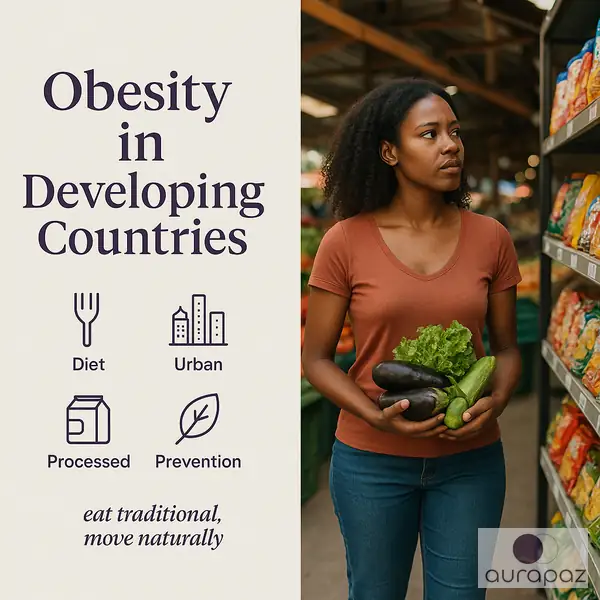
Obesity in Developing Countries: Causes and Prevention
A generation ago, obesity was considered a disease of the rich world. Today that assumption is broken. Over 70 percent of the world’s people living with obesity now live in low and middle income countries, according to the World Health Organization. India, Brazil, Mexico, South Africa, and Indonesia are all experiencing obesity rates climbing at speeds the wealthiest nations took decades to reach. What changed?
The causes are not about individual willpower or a sudden love of fast food. They are structural. They involve how cities grew, how global food corporations entered new markets, how economic growth changed working lives, and how governments failed to keep pace with a rapidly shifting food environment. Understanding these roots is the first step toward doing something about them.
This article examines why obesity is rising so rapidly in developing countries, what specific economic and environmental forces are driving it, and what evidence-based prevention strategies are actually working. Whether you are in Mumbai, Lagos, Mexico City, or a rural district of Bangladesh, this matters to you.
Table of Contents
The Nutrition Transition
Nutritional scientists use the term “nutrition transition” to describe what happens when a country’s food supply shifts from traditional whole foods to refined, calorie-dense, nutrient-poor products. It is the single most powerful driver of rising obesity in developing countries. In India, the traditional plate of dal, rice, sabzi, and curd is being rapidly replaced by instant noodles, packaged biscuits, fried snacks, and sugar-sweetened drinks. Industrial food systems targeting new markets are driving this shift.
Traditional diets in most low and middle income countries were naturally protective. They were high in fibre, diverse in plant foods, lower in refined carbohydrates, and almost entirely free of ultra-processed formulations. As a country’s income rises, food manufacturers move in, build distribution networks, and make convenience foods more accessible than whole foods. The calories go up. The nutrients go down. The body, built to regulate weight in environments with varied whole foods, begins to struggle.
Urbanisation and the Physical Activity Gap
When people move from rural to urban environments, they often leave behind the one thing that kept them lean without thinking about it: physical work built into daily life. A farmer in Bihar walks kilometres every day, carries weight, bends, plants, harvests. That same person’s child, working as a data entry clerk in Patna, sits for eight hours, commutes home by auto-rickshaw, and has no safe space to walk or exercise. This is not a character failure. It is a structural change in how life is organised.
Urban environments in most developing countries were not designed with movement in mind. Pavements are missing or dangerous. Parks are scarce. Heat and air pollution make outdoor activity uncomfortable or unhealthy for months at a time. Working hours are long, commutes are brutal, and by the time a person gets home there is genuinely no time or energy left for intentional exercise. Research consistently shows that physical inactivity in these settings is not primarily a motivational problem. It is an environmental one. When cities are not built for walking, people do not walk.

Processed Food Economics
Here is a reality that nutritionists and public health researchers have been documenting for two decades: in most low income markets, ultra-processed food is cheaper, more accessible, more shelf-stable, and more aggressively marketed than fresh whole food. A 100-gram pack of instant noodles in rural India costs less than a single fresh tomato in some regions. A 500ml cola bottle reaches remote villages through distribution networks that fruits and vegetables simply cannot match. When the choice is between a calorie-dense, affordable product that needs no refrigeration and a perishable vegetable that costs more, convenience wins every time.
Food corporations spend billions marketing to children in low and middle income countries specifically because brand loyalty formed early lasts a lifetime. Mexico, now one of the world’s highest obesity-rate countries, became a case study in how aggressive marketing of sugary drinks combined with cultural normalisation over two decades produced a public health emergency. The Mexican government’s sugar tax introduced in 2014 reduced sugary drink consumption measurably, especially among lower-income households, demonstrating that pricing policy can shift behaviour at scale.

Policy and Food Environments
The double burden of malnutrition is one of the most challenging public health phenomena of our era. It means that within a single country, region, or even household, you can find children stunted from undernutrition sitting alongside adults who are overweight. The same economic forces that drove caloric deficiency in previous generations have now pivoted to caloric excess through cheap, nutrient-stripped foods. Governments that spent decades focused exclusively on hunger did not build systems to handle obesity, and many are still catching up.
Effective policy interventions exist and the evidence is clear. Brazil’s national school feeding programme, which prioritises fresh local food, has shown measurable results in children’s diets. Chile’s graphic front-of-pack warning labels reduced purchases of high-sugar, high-sodium products significantly. India’s Eat Right India initiative and FSSAI labelling regulations are steps in the right direction, though enforcement remains uneven. Individual behaviour change advice alone has consistently failed as a public health strategy. Making whole food cheap, accessible, and normalised is what actually moves the needle.

Myths vs Facts About Obesity in Developing Countries
- ❌ Myth: Obesity only affects wealthy, high-income countries.
✅ Fact: Over 70% of the world’s people living with obesity now live in low and middle income countries. The burden has decisively shifted to the developing world. - ❌ Myth: People in developing countries just need more willpower around food.
✅ Fact: When cheap, ultra-processed food dominates the food environment and fresh produce is inaccessible, willpower is irrelevant. Obesity is a consequence of food environments, not personal character. - ❌ Myth: Traditional diets are being abandoned by choice.
✅ Fact: The shift away from traditional diets is driven by deliberate corporate strategies, subsidised commodity crops, and broken food supply chains, not by individuals spontaneously preferring processed food. - ❌ Myth: Obesity in developing countries is the same problem as in the West.
✅ Fact: In developing countries, obesity frequently coexists with micronutrient deficiency. Someone can be overweight and anaemic at the same time, requiring different interventions than those designed for high-income countries.
Prevention That Actually Works
The most powerful prevention strategy is also the simplest to describe and the hardest to implement: make whole, traditional foods as cheap, available, and culturally celebrated as processed food currently is. This means supporting local farmers, building cold chains for fresh produce, subsidising vegetables and pulses over refined grains, and investing in school meal programmes built around local whole food. Aggressive taxation of ultra-processed products and restriction of marketing to children are not radical ideas. They are what the evidence says works.
At an individual level, returning to traditional meal patterns is genuinely protective. In Indian households, this means dal-rice-sabzi-curd as a baseline, cooking from scratch, using spices like turmeric and cumin that carry metabolic benefits, and choosing fermented foods like idli, dosa, and curd that support gut health. Our guide to anti-inflammatory eating habits and restoring your gut microbiome both explore how these food choices support healthy weight and metabolism.
Conclusion
Obesity in developing countries is not an inevitable consequence of economic progress. It is the result of specific choices, corporate, governmental, and systemic, that have made unhealthy food cheap and movement unnecessary. Every society that has undergone rapid economic growth has faced a version of this challenge. The ones that navigate it best are those that protect and celebrate their traditional food cultures while building urban environments that make physical activity natural and normal, not optional and inconvenient.
The science is clear about what helps at the individual level: whole, mostly plant-based diets grounded in traditional food wisdom, limiting ultra-processed and sugar-sweetened products, consistent moderate movement, adequate sleep, and managing chronic stress, which drives cortisol-related weight gain regardless of diet quality. Traditional wellness systems from Ayurveda to traditional Chinese medicine have emphasised them for centuries, and modern epidemiology keeps confirming.
If you are reading this in India, Brazil, Nigeria, or any country navigating this transition, the most powerful act you can take for your health is to cook more, buy from local markets, eat the foods your grandparents recognised, and move in ways that feel natural rather than performative. Your body knows what to do when you give it the environment it evolved for. The challenge is building that environment, personally, communally, and through the policies we demand from our governments.
Useful Links
• Anti-Inflammatory Foods: The Complete Science-Backed Guide
• How to Heal Your Gut Naturally
• WHO: Obesity and Overweight Fact Sheet
• Harvard T.H. Chan: Obesity Prevention Source
DISCLAIMER
This content is for educational purposes only and does not constitute medical advice. Always consult a qualified healthcare provider regarding any medical concerns.
Contact Us
Ready to transform your health through personalised nutrition? Book a one-on-one consultation.
Book your consultation today
Website: www.aurapaz.com


Leave a Reply