“Anti-inflammatory” is printed on cereal boxes, turmeric latte mixes and supplement bottles now, usually beside a promise about joint pain, tiredness or glowing skin. The research underneath the label is real, but quieter than the marketing. Some ways of eating are linked with lower inflammation markers in the blood, and one of them cut major cardiovascular events in a large trial. No single food switches inflammation off, and no diet reverses a disease on its own.
Here is what those markers measure, which patterns have the best evidence, where turmeric and black pepper fit, and where the trend overreaches. As with food as medicine generally, food matters a great deal, but it works alongside medical care, not instead of it.
What “chronic inflammation” means, and how it is measured
Inflammation is your immune system’s response to injury or infection. A cut finger turns red, warm and swollen for a few days, then settles. Chronic low-grade inflammation is different: a slight, lasting rise in inflammatory signals throughout the body, with nothing you can see. In studies it travels alongside heart disease and type 2 diabetes.
You cannot feel it, so the online checklists that turn bloating, brain fog or tiredness into “signs of inflammation” are not diagnostic. Those symptoms have many causes.
CRP, the marker most studies use
C-reactive protein (CRP) is made by the liver and climbs when inflammation is active. A high-sensitivity CRP (hs-CRP) test picks up the small rises that matter for heart risk. A 2003 joint statement from the US Centers for Disease Control and Prevention and the American Heart Association grouped results like this:
- Below 1 mg/L: lower cardiovascular risk.
- 1 to 3 mg/L: average risk.
- Above 3 mg/L: higher risk.
- Above 10 mg/L: usually something acute, such as an infection or injury, to be looked into before retesting.
The statement advised averaging two tests about two weeks apart, because one reading can mislead. CRP also responds to far more than food. Body fat releases the inflammatory signal interleukin-6 (IL-6), and in a US survey of 16,616 adults, women with obesity had about six times the odds of a raised CRP compared with women of healthy weight. A cold, a tooth infection or an arthritis flare pushes it up too. One number is not a verdict on your diet.
When to see a doctor: joints that stay swollen, hot or stiff, a fever that keeps returning, unexplained weight loss, or tiredness that does not lift all need medical assessment. Rheumatoid arthritis, inflammatory bowel disease and psoriasis need proper treatment, and diet supports that care rather than replacing it.
Eating patterns, not superfoods: what the trials show
The strongest evidence is for whole ways of eating.
PREDIMED and the Mediterranean pattern
PREDIMED, run in Spain, enrolled 7,447 adults aged 55 to 80 at high cardiovascular risk. They were assigned to a Mediterranean diet with extra virgin olive oil, a Mediterranean diet with mixed nuts, or advice to cut down on fat. After a median of 4.8 years, heart attacks, strokes and cardiovascular deaths, taken together, were about 30 per cent lower in both Mediterranean groups. The original 2013 report was withdrawn and republished in 2018 after problems with how some participants were randomised; the reanalysis gave very similar results.
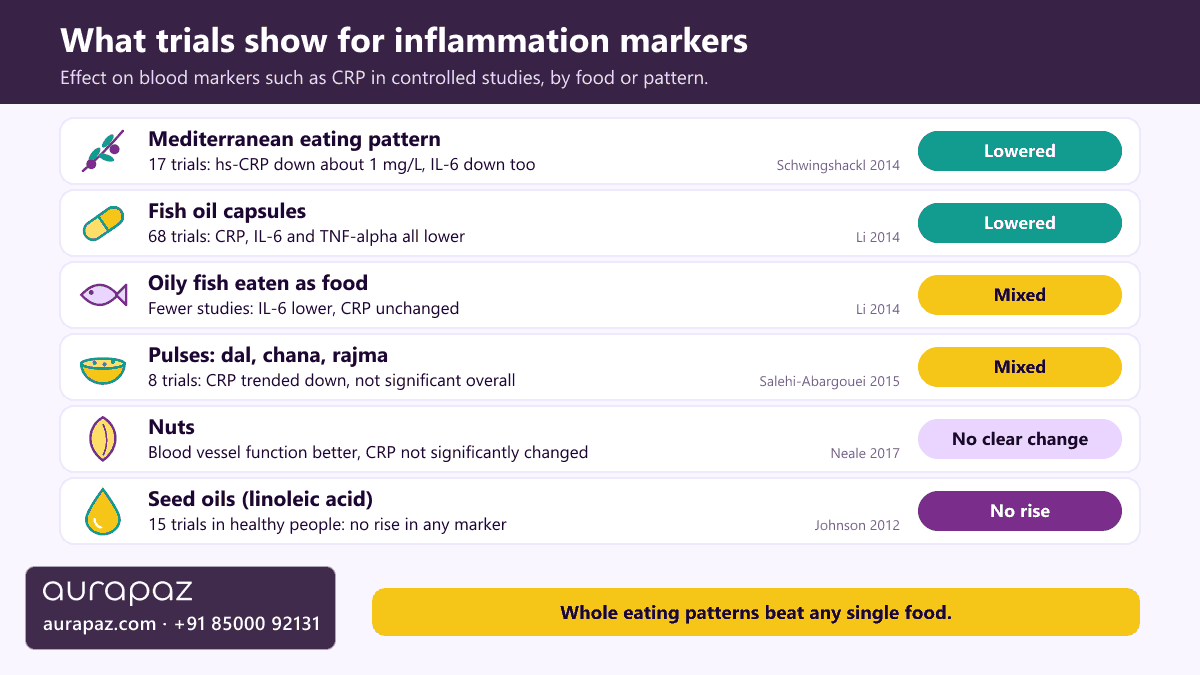
On the markers themselves, an early PREDIMED substudy of 772 people found that after three months, CRP in the olive oil group fell by 0.54 mg/L more than in the low-fat group. A pooled analysis of 17 trials with 2,300 people found the Mediterranean pattern lowered hs-CRP by about 1 mg/L and lowered IL-6. A 2022 review of 22 trials again found the clearest reductions with the Mediterranean diet, while DASH, vegetarian and vegan diets showed no substantial effect on these markers so far. That does not make them unhealthy; the marker evidence is simply thinner.
Where traditional Indian eating fits
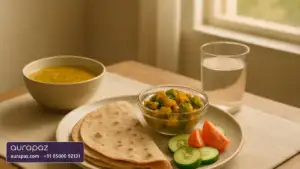
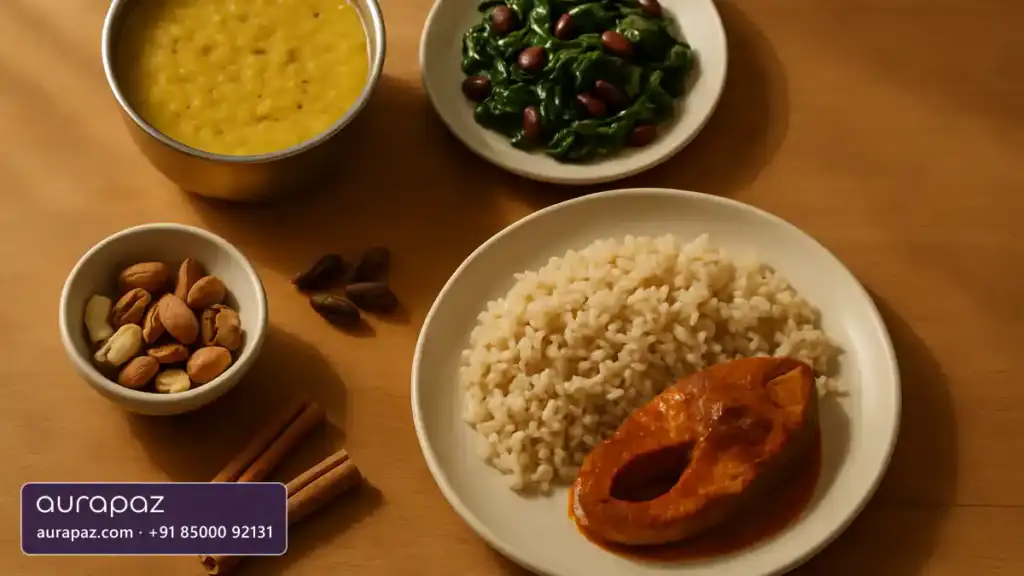
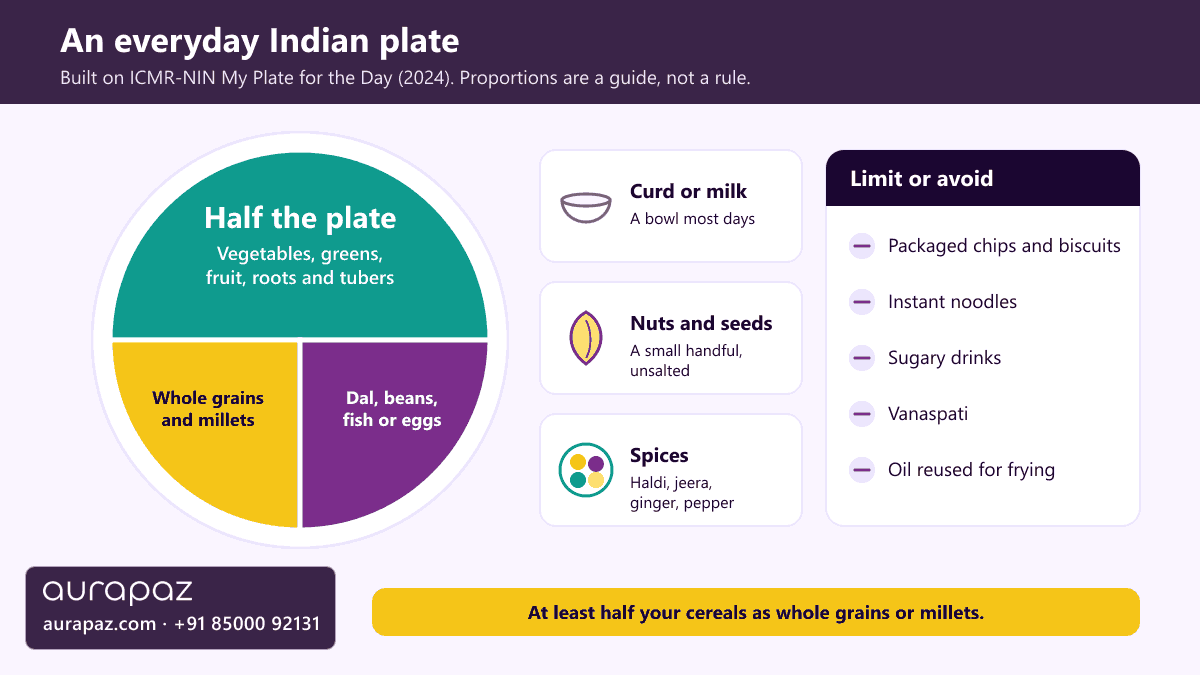
There is no PREDIMED-sized trial of an Indian diet, but the building blocks overlap: dals and beans, vegetables and greens, whole grains and millets, nuts, curd, spices and, in many coastal homes, fish. The ICMR National Institute of Nutrition’s Dietary Guidelines for Indians (2024) describe a “My Plate for the Day” in which vegetables, fruits, greens, roots and tubers make up essentially half the plate, with at least half of your cereals as whole grains such as millets. They also advise avoiding ultra-processed foods and those high in fat, sugar and salt. “Traditional” is not automatically protective, though: white rice, fried namkeen and sweet chai are traditional too.
The foods that keep turning up in the research
Fibre, whole grains and pulses
In a US survey of 3,920 adults, people in the highest fifth for fibre intake had 41 per cent lower odds of a CRP above 3 mg/L than those in the lowest fifth, after accounting for weight, smoking and activity. That is a link, not proof, but a 2019 Lancet review of 185 cohort studies and 58 trials found the greatest risk reductions, including for heart disease and type 2 diabetes, at 25 to 29 g of fibre a day.
Pulses are an easy fibre win. A meta-analysis of eight trials found only a trend towards lower CRP overall, so I would not sell dal as an anti-inflammatory food. I would sell it as cheap protein and fibre, which is reason enough. Add more gradually; my piece on the fibremaxxing trend explains why.
Oily fish and omega-3
A meta-analysis of 68 trials with 4,601 people found that fish oil supplements lowered CRP, IL-6 and tumour necrosis factor alpha. In the smaller set of studies where omega-3 came from eating fish, only IL-6 fell. The American Heart Association suggests one to two seafood meals a week for heart health. Mackerel (bangda or ayala) and sardines (mathi or chaala) are affordable choices in many Indian markets.
Vegetarians get a plant omega-3 from flaxseed, walnuts and chia, but the body converts only a small amount into the forms found in fish, as I explain in omega-3 for vegetarians. Before taking fish oil capsules, especially with blood-thinning medicine, check with your doctor.
Nuts and seeds
A review of 32 trials found that nuts improved how well blood vessels widen without significantly changing CRP or other inflammatory markers. Eat a small handful of unsalted peanuts, almonds or walnuts for your heart, and leave the “fights inflammation” claim on the packet.
Vegetables, fruit and the amla question
Half a plate of vegetables, greens and fruit is the common thread in every pattern above. Amla often arrives with a big claim: that one fruit holds the vitamin C of 20 oranges. India’s food composition tables list 252 mg of vitamin C per 100 g of amla against 42.7 mg in orange pulp, so amla has roughly six times as much, weight for weight. Impressive, but not twenty oranges, and vitamin C alone does not make a food “anti-inflammatory”. Enjoy amla as a fruit; murabba is mostly sugar syrup.
Oils, ghee and the omega-6 question
The most common online advice is to throw out sunflower and soybean oil because their omega-6 fat, linoleic acid, supposedly fuels inflammation. As I explain in the truth about seed oils, human trials do not bear that out. A systematic review of 15 randomised trials in healthy people found that adding linoleic acid did not raise CRP or any other inflammatory marker measured. The authors note most evidence links linoleic acid with lower heart disease risk.
The ICMR-NIN guidelines are practical. They advise limiting saturated fat such as butter and ghee, avoiding vanaspati because of its trans fat, using cooking oil, including high omega-6 oils, in moderation, and not reusing frying oil for frying again. In practice, measure your oil, rotate between a few you like such as groundnut, mustard, sesame or sunflower, keep ghee and coconut oil for flavour in small amounts, and eat more omega-3 foods rather than fearing omega-6.
The ultra-processed side
If one change is worth more than any superfood, it is eating fewer ultra-processed foods: packaged chips and biscuits, instant noodles, sugary drinks and processed meats. A 2024 BMJ umbrella review covering almost 9.9 million people found convincing evidence linking higher intake with cardiovascular death and type 2 diabetes. These studies show association rather than proof.
A tightly controlled US National Institutes of Health trial shows one route. Twenty adults lived in a clinical unit and ate an ultra-processed or an unprocessed diet for two weeks each, matched for calories, sugar, salt and fibre on offer. On the ultra-processed diet they ate about 508 calories more a day and gained weight, and extra body fat pushes CRP up. I cover the rest in what the ultra-processed food panic gets right. Roasted chana instead of chips is a good start.
Turmeric, black pepper and the spice box
The ICMR-NIN guidelines say spices such as turmeric, cumin, ginger, garlic, cinnamon, pepper and cloves are rich in antioxidants and could be part of a balanced diet. Evidence that spices in everyday amounts lower CRP on their own is limited.
Why black pepper gets paired with turmeric
Curcumin, the main active compound in turmeric, is poorly absorbed and quickly broken down in the gut wall and liver. In a 1998 study, 2 g of pure curcumin taken alone gave very low or undetectable blood levels. Adding 20 mg of piperine, the compound behind black pepper’s bite, raised the amount absorbed by about 2,000 per cent. That famous figure involved isolated extracts at doses far beyond a pot of dal, a small group of volunteers, and blood levels rather than any health outcome.
Cooking with turmeric and pepper
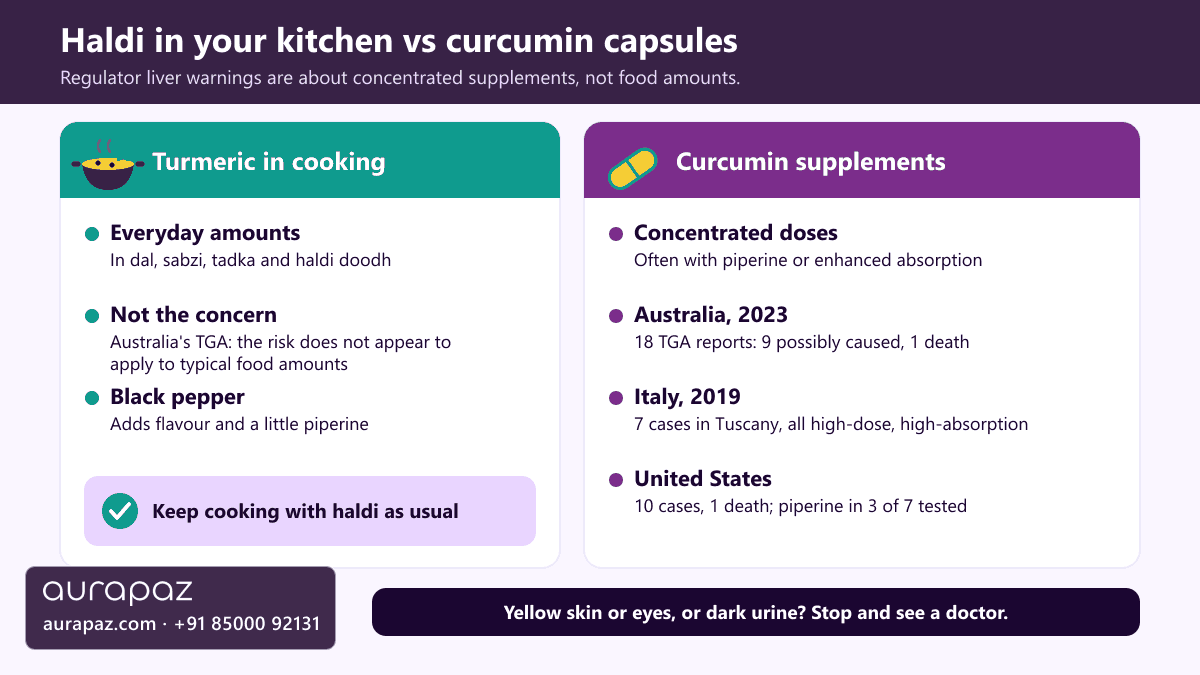
For everyday cooking, keep doing what many Indian kitchens already do. Curcumin dissolves in fat rather than water, so blooming turmeric in a little oil or ghee during the tadka makes chemical sense, though it has not been tested for health effects. A crack of black pepper in dal, sabzi, eggs or rasam adds flavour and some piperine. Turmeric milk is a comforting drink, not a medicine.
Curcumin supplements and liver injury
Supplements are a different story. They are concentrated, and many add piperine or use “enhanced absorption” formulas. A pooled analysis of six small trials found curcumin supplements lowered CRP, mainly with high-bioavailability products taken for four weeks or more. In a four-week trial of 367 people with knee osteoarthritis, a turmeric extract matched ibuprofen for pain and function, with fewer reports of stomach pain. Fewer is not zero, and it was one short trial. The US National Center for Complementary and Integrative Health says there is not enough evidence to definitively conclude that turmeric or curcumin helps any condition.
The liver signal is what worries me most:
- Italy, 2019: a cluster of acute cholestatic hepatitis followed turmeric supplement use. In seven Tuscan cases, every product was a high-dose, high-bioavailability formulation.
- Australia, 2023: the Therapeutic Goods Administration (TGA) issued a safety alert after 18 reports of liver problems, nine suggesting the product may have caused the injury, including one death. It said the risk may be higher with enhanced-absorption products and higher doses, and does not appear to apply to turmeric eaten in typical food amounts.
- United States: the US Drug-Induced Liver Injury Network described ten cases, one fatal. Three of the seven products tested also contained piperine.
Your liver does not need a supplement to do its job, a point I make in what actually supports your liver.
Please talk to your doctor before taking turmeric or curcumin supplements. Avoid them if you have, or have had, liver problems, and if you are pregnant. Check first if you take blood thinners or other regular medicines, because herbal products can interact with them. Stop and seek medical advice promptly if you notice yellowing of the skin or eyes, dark urine, nausea, vomiting, unusual tiredness, abdominal pain or loss of appetite. Turmeric in your cooking is not the concern here.
Myth vs Reality: anti-inflammatory eating
| What the trend says | What the science says |
|---|---|
| “Seed oils are inflammatory, so cook only in ghee or coconut oil.” | Trials found linoleic acid did not raise inflammatory markers. Ghee and coconut oil are high in saturated fat, which ICMR-NIN advises limiting. |
| “One amla has the vitamin C of 20 oranges.” | Indian food tables show about six times the vitamin C of orange pulp, weight for weight. |
| “Turmeric works like ibuprofen with zero side effects.” | One four-week trial of a concentrated extract found similar results with fewer stomach complaints, not none. Supplements are linked with rare liver injury. |
| “Black pepper boosts curcumin by 2,000 per cent, so stronger capsules are better.” | That figure came from 2 g of pure curcumin plus 20 mg of piperine. High-dose, enhanced-absorption products are the ones regulators flagged. |
| “The right diet will reverse arthritis or autoimmune disease.” | Good eating patterns modestly lower inflammation markers and, in PREDIMED, cardiovascular events. These conditions still need medical treatment. |
Key takeaways
- CRP is the main marker of chronic inflammation, and infection, injury and body fat all raise it.
- The Mediterranean pattern has the best evidence: lower hs-CRP across trials and about 30 per cent fewer cardiovascular events in PREDIMED.
- An Indian plate works on the same principles: half vegetables, greens and fruit, plus whole grains, dals, nuts, and fish if you eat it.
- Seed oils did not raise inflammatory markers in trials. Use oils in moderation and do not fry again in used oil.
- Eating less ultra-processed food matters more than adding any superfood.
- Turmeric and pepper in cooking are fine. Curcumin supplements have been linked with rare liver injury, so talk to your doctor first.
References & Further Reading
- Pearson TA, et al. Markers of inflammation and cardiovascular disease: application to clinical and public health practice. A statement for healthcare professionals from the Centers for Disease Control and Prevention and the American Heart Association. Circulation, 2003; 107(3): 499 to 511.
- Visser M, et al. Elevated C-reactive protein levels in overweight and obese adults. JAMA, 1999; 282(22): 2131 to 2135.
- Estruch R, et al. Primary prevention of cardiovascular disease with a Mediterranean diet supplemented with extra-virgin olive oil or nuts. New England Journal of Medicine, 2018; 378(25): e34.
- Estruch R, et al. Effects of a Mediterranean-style diet on cardiovascular risk factors: a randomized trial. Annals of Internal Medicine, 2006; 145(1): 1 to 11.
- Schwingshackl L, Hoffmann G. Mediterranean dietary pattern, inflammation and endothelial function: a systematic review and meta-analysis of intervention trials. Nutrition, Metabolism and Cardiovascular Diseases, 2014; 24(9): 929 to 939.
- Koelman L, et al. Effects of dietary patterns on biomarkers of inflammation and immune responses: a systematic review and meta-analysis of randomized controlled trials. Advances in Nutrition, 2022; 13(1): 101 to 115.
- Ajani UA, et al. Dietary fiber and C-reactive protein: findings from national health and nutrition examination survey data. Journal of Nutrition, 2004; 134(5): 1181 to 1185.
- Reynolds A, et al. Carbohydrate quality and human health: a series of systematic reviews and meta-analyses. The Lancet, 2019; 393(10170): 434 to 445.
- Salehi-Abargouei A, et al. Effects of non-soy legume consumption on C-reactive protein: a systematic review and meta-analysis. Nutrition, 2015; 31(5): 631 to 639.
- Li K, et al. Effect of marine-derived n-3 polyunsaturated fatty acids on C-reactive protein, interleukin 6 and tumor necrosis factor alpha: a meta-analysis. PLoS One, 2014; 9(2): e88103.
- Rimm EB, et al. Seafood long-chain n-3 polyunsaturated fatty acids and cardiovascular disease: a science advisory from the American Heart Association. Circulation, 2018; 138(1): e35 to e47.
- Neale EP, et al. The effect of nut consumption on markers of inflammation and endothelial function: a systematic review and meta-analysis of randomised controlled trials. BMJ Open, 2017; 7(11): e016863.
- Johnson GH, Fritsche K. Effect of dietary linoleic acid on markers of inflammation in healthy persons: a systematic review of randomized controlled trials. Journal of the Academy of Nutrition and Dietetics, 2012; 112(7): 1029 to 1041.
- Lane MM, et al. Ultra-processed food exposure and adverse health outcomes: umbrella review of epidemiological meta-analyses. BMJ, 2024; 384: e077310.
- Hall KD, et al. Ultra-processed diets cause excess calorie intake and weight gain: an inpatient randomized controlled trial of ad libitum food intake. Cell Metabolism, 2019; 30(1): 67 to 77.
- Shoba G, et al. Influence of piperine on the pharmacokinetics of curcumin in animals and human volunteers. Planta Medica, 1998; 64(4): 353 to 356.
- Sahebkar A. Are curcuminoids effective C-reactive protein-lowering agents in clinical practice? Evidence from a meta-analysis. Phytotherapy Research, 2014; 28(5): 633 to 642.
- Kuptniratsaikul V, et al. Efficacy and safety of Curcuma domestica extracts compared with ibuprofen in patients with knee osteoarthritis: a multicenter study. Clinical Interventions in Aging, 2014; 9: 451 to 458.
- Lombardi N, et al. Acute liver injury following turmeric use in Tuscany: an analysis of the Italian Phytovigilance database and systematic review of case reports. British Journal of Clinical Pharmacology, 2021; 87(3): 741 to 753.
- Halegoua-DeMarzio D, et al. Liver injury associated with turmeric: a growing problem. Ten cases from the Drug-Induced Liver Injury Network [DILIN]. American Journal of Medicine, 2023; 136(2): 200 to 206.
- Therapeutic Goods Administration (Australia). Medicines containing turmeric or curcumin: risk of liver injury. Safety alert, 2023.
- National Center for Complementary and Integrative Health. Turmeric. Updated April 2025.
- ICMR National Institute of Nutrition. Dietary Guidelines for Indians. 2024.
- Longvah T, et al. Indian Food Composition Tables 2017. ICMR National Institute of Nutrition, Hyderabad.