
“Why am I always tired?” is often asked with a small laugh, as if constant tiredness were a personal failing. It is not. Ongoing tiredness is one of the most common reasons adults see a family doctor, and there is often a reason for it that can be found and dealt with, though not always. Sometimes that reason shows up on an ordinary blood test.
The internet tends to skip that step and offer “adrenal fatigue” and herbal blends instead. This piece walks through the common, testable causes of tiredness in Indian women and families, what a doctor is likely to check, the warning signs that need prompt care, what ME/CFS really is, and what food and routine can sensibly do while you find out.
Tired, or something more?
Everyone has tired days. A bad night, a sick child or a wedding season will do it, and a few early nights usually fix it. Doctors use the word fatigue for something different: tiredness that does not lift with rest, drags on for weeks, or stops you doing what you normally do.
A 2023 review in American Family Physician puts fatigue among the top 10 reasons for a primary care visit, reported by 5 to 10 per cent of patients. The NHS suggests seeing a GP if you have felt tired for a few weeks without knowing why, if it is affecting your daily life, or if it comes with symptoms such as weight loss or mood changes. Its list of everyday drivers includes short sleep, stress, depression, a new baby and the hormonal shifts of pregnancy and menopause. None of these is “just in your head”.
The blood and hormone causes worth ruling out
Iron deficiency and anaemia
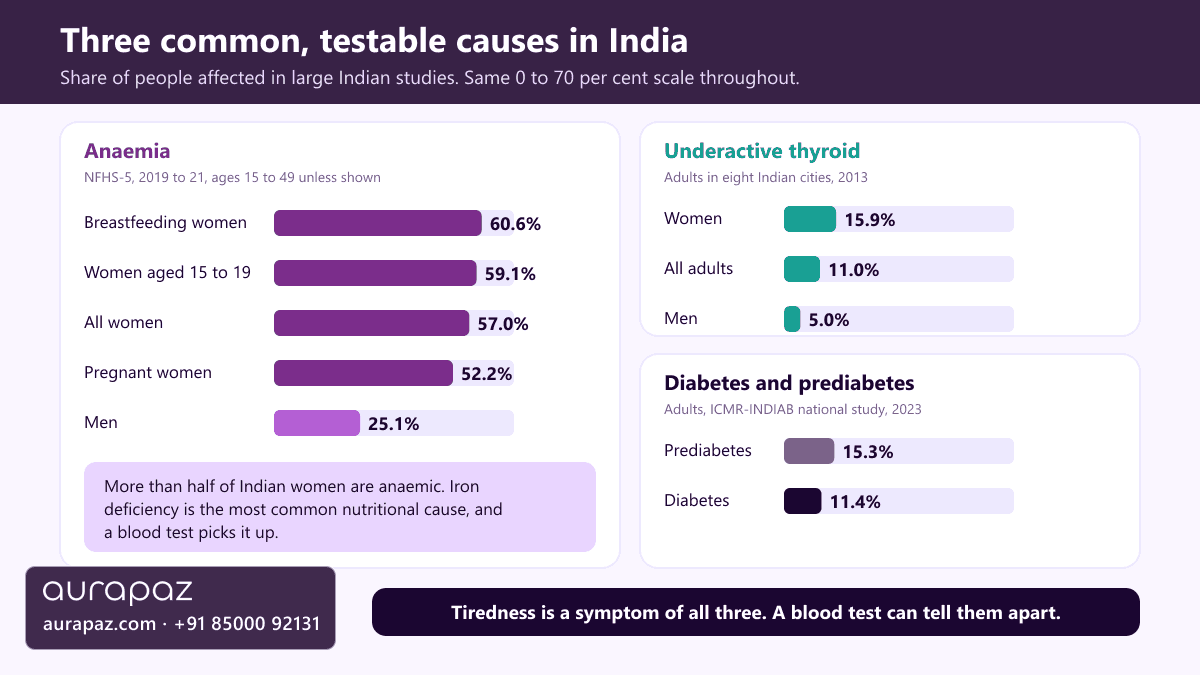
In India, this is where I would always start. In the fifth National Family Health Survey (NFHS-5, 2019 to 21), 57.0 per cent of women aged 15 to 49 were anaemic. The figure was 59.1 per cent among women aged 15 to 19, 52.2 per cent in pregnancy and 60.6 per cent among breastfeeding mothers. Men are not spared: 25.1 per cent of men aged 15 to 49 were anaemic.
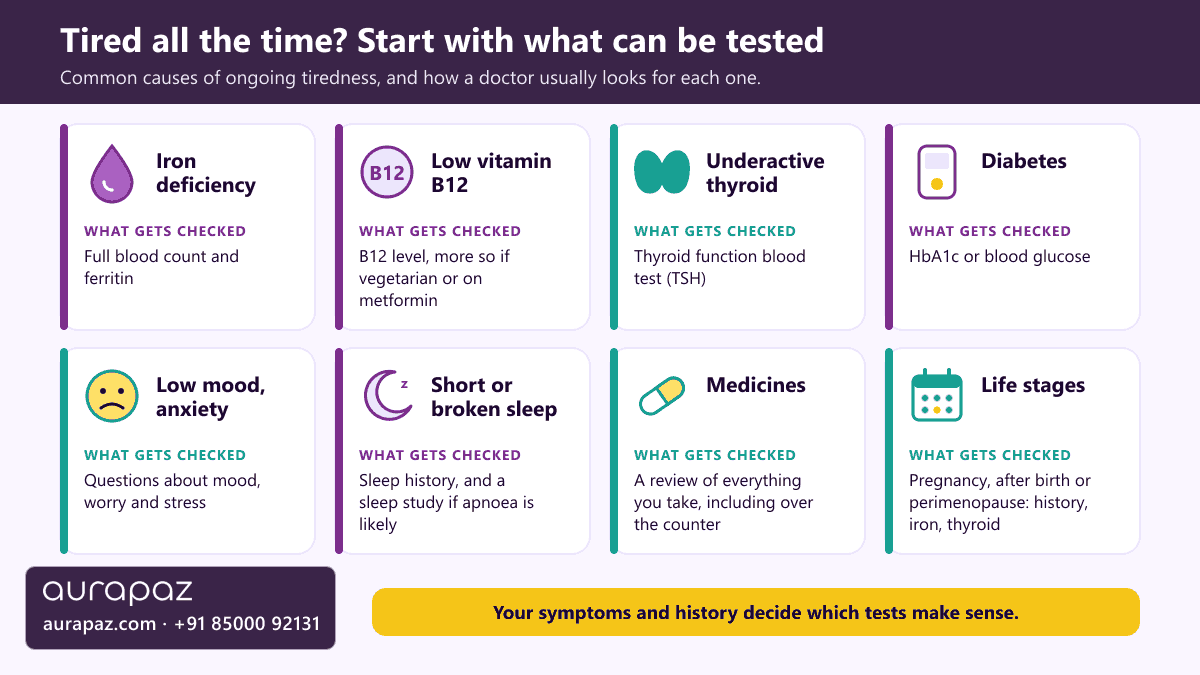
The WHO describes iron deficiency as the most common nutritional deficiency behind anaemia. The NHS lists tiredness, breathlessness, noticeable heartbeats, pale skin and headaches among its symptoms, and names heavy periods and pregnancy as very common causes. A full blood count shows anaemia; a ferritin test shows how much iron you have in storage.
Low iron can matter even before haemoglobin falls. In a 2012 trial in France, 198 menstruating women with unexplained fatigue, normal haemoglobin and ferritin below 50 micrograms per litre took iron or a placebo for 12 weeks. Fatigue scores fell by 47.7 per cent with iron and 28.8 per cent with the placebo. This is the kind of judgement your doctor makes with your results in front of them.
Vitamin B12 and vitamin D
Vitamin B12 comes mainly from animal foods, so vegetarian families can run low without knowing it. The NHS lists extreme tiredness, a sore and red tongue, mouth ulcers, pins and needles and memory problems among the symptoms, and names proton pump inhibitors (common acidity tablets) as medicines that can lower B12. The UK medicines regulator, the MHRA, advised in 2022 that metformin can lower B12 too, and that anyone taking it should seek medical advice for new or worsening extreme tiredness, a sore red tongue or pins and needles. There is more in my piece on vitamin B12 deficiency in Indian women.
Vitamin D is often low in India but frequently causes no symptoms, so it is a weak first suspect on its own. The NICE guideline on ME/CFS treats vitamin D, B12 and folate as tests to add by clinical judgement, not for everyone. My guide to vitamin D deficiency in India explains when testing is worth it.
An underactive thyroid
The NHS lists extreme tiredness, feeling cold, weight gain, constipation, low mood, dry skin and hair, and irregular or heavy periods as symptoms of an underactive thyroid. A study of 5,360 adults in eight Indian cities found hypothyroidism in 10.95 per cent, with women about three times as likely to be affected as men (15.86 against 5.02 per cent). About a third of cases had not been diagnosed before. A thyroid blood test, usually starting with TSH, answers the question.
Diabetes and high blood sugar
The ICMR-INDIAB study, which surveyed more than 1 lakh adults across India, estimated that 11.4 per cent have diabetes and 15.3 per cent prediabetes. The NHS links diabetes to feeling very tired along with strong thirst, peeing more often (especially at night) and weight loss. An HbA1c or fasting glucose test is cheap and widely available.
Sleep, mood, medicines and life stages
Short sleep and sleep apnoea
One popular claim says tiredness is “almost never the amount of sleep”. Sleep scientists disagree. The American Academy of Sleep Medicine and Sleep Research Society recommend that adults sleep 7 or more hours a night on a regular basis, and link regularly sleeping less with poorer performance and more errors. If the household starts at 5 am and the phone comes out at midnight, quantity is a perfectly good place to start. My piece on sleepmaxxing covers which sleep habits have evidence behind them.
Quality matters too. In obstructive sleep apnoea, breathing stops and starts during sleep, leaving people very tired in the day and waking with headaches. The NHS lists loud snoring and gasping, snorting or choking noises as signs. It is diagnosed with an overnight sleep study, often done at home, and is treatable, often with a CPAP machine.
Depression, anxiety and stress
The NHS lists lack of energy, disturbed sleep and appetite changes among the physical symptoms of depression. Many people mention tiredness to a doctor long before they mention their mood, so a good doctor will ask about both.
Medicines
Cleveland Clinic lists medicines that can cause fatigue, including sedatives and sleeping tablets, some anxiety medicines, antipsychotics, opioid painkillers, anti-seizure medicines, beta-blockers and over-the-counter antihistamines. Never stop a prescribed medicine on your own. Bring a list of everything you take, including supplements, and ask whether any of it could be playing a part.
Pregnancy, after birth and perimenopause
Tiredness is common in pregnancy, and so is anaemia. After birth, broken nights are only part of the story: six in ten breastfeeding mothers in NFHS-5 were anaemic, postnatal depression can bring difficulty sleeping even when there is time to rest, and the American Thyroid Association estimates that postpartum thyroiditis, a temporary thyroid inflammation, affects about 5 to 10 per cent of women in the United States. In perimenopause, the NHS describes sleep problems, night sweats, low mood and brain fog, and periods can become heavier, which drains iron.
What your doctor is likely to check
A good assessment starts with conversation: your sleep, periods, diet, mood, weight, medicines, recent infections and how the tiredness affects your day, followed by an examination. The American Family Physician review notes that testing without a specific reason may change treatment in only about 5 per cent of patients.
For a sense of the usual starting set, the NICE guideline on ME/CFS lists tests to rule out other conditions: a urine test, full blood count, kidney and liver function, thyroid function, inflammation markers, calcium and phosphate, HbA1c, ferritin, a coeliac screen and creatine kinase. Your doctor may not need all of these, and may add a pregnancy test.

Reference ranges describe where results fall in most healthy people. A result near the edge is worth talking through with your doctor rather than ignoring or self-treating. And if your tests are normal and you still feel unwell, go back. Normal results narrow the search; they do not mean your tiredness is imaginary.
Before your appointment, jot down: when the tiredness started, how many hours you actually sleep, whether anyone has heard you snore or gasp, how heavy your periods are, any weight change, your mood, and every medicine and supplement you take.
Red flags: when to get help quickly
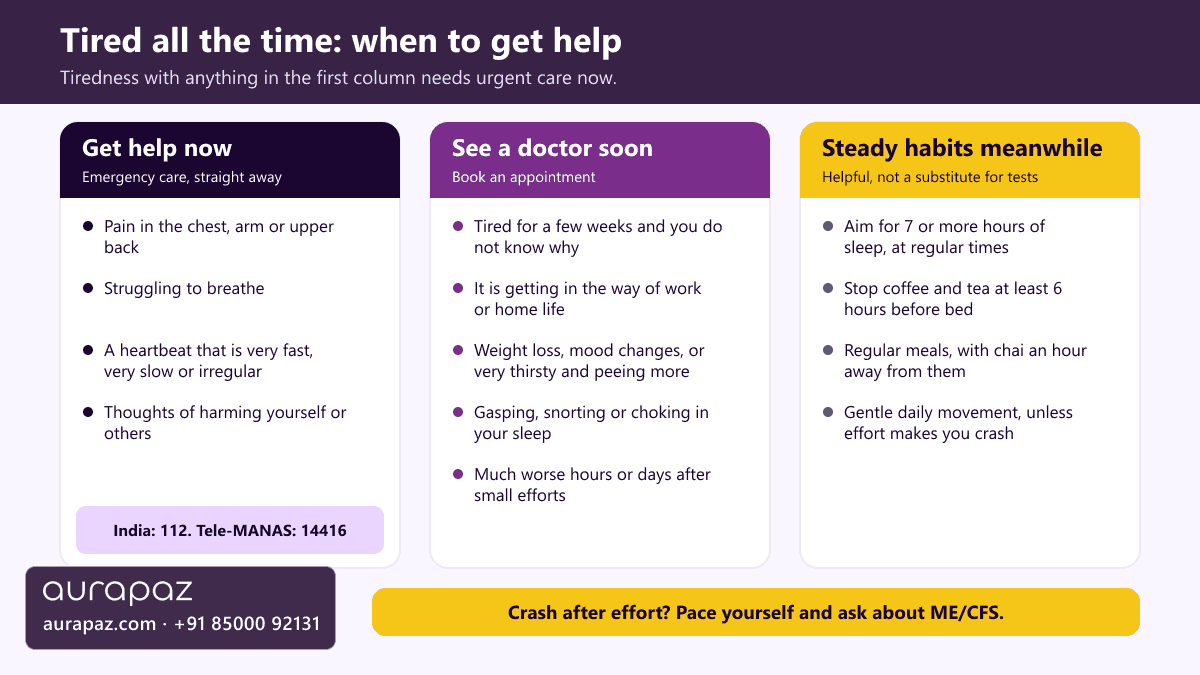
Most tiredness can wait for a routine appointment. Some cannot. Cleveland Clinic advises immediate medical attention if fatigue comes with breathlessness, pain in the chest, arm or upper back, a heartbeat that is unusually fast, slow or irregular, or thoughts of harming yourself or others. In India, call 112 in an emergency. Tele-MANAS, the free government mental health helpline, is on 14416 at any hour.
Book a sooner appointment if the tiredness came on suddenly, if you are losing weight without trying, if you are very thirsty and passing urine more often, or if someone has noticed you stop breathing in your sleep.
ME/CFS: when rest does not restore you
Myalgic encephalomyelitis or chronic fatigue syndrome (ME/CFS) is a recognised illness, not another word for being run down. The NICE guideline NG206 (2021) says there is no diagnostic test, so doctors recognise it from a pattern in which all four of these are present:
- Debilitating fatigue that is worsened by activity and not significantly relieved by rest.
- Post-exertional malaise: symptoms worsen after activity, often hours or days later, out of proportion to the effort, with a long recovery.
- Unrefreshing or disturbed sleep.
- Cognitive difficulties, often called brain fog.
NICE advises suspecting ME/CFS when these have lasted at least 6 weeks in adults and clearly limit daily life, and diagnosing it at 3 months if nothing else explains them. The American Family Physician review calls post-exertional malaise its most important feature, and says ME/CFS is not caused by deconditioning, laziness or a psychological disorder.
That changes the advice on exercise. NICE says people with ME/CFS should not be offered graded exercise therapy, meaning fixed, step-by-step increases in activity, or any exercise programme presented as a cure. It recommends energy management instead, often called pacing: learning your limits and staying within them. Cognitive behavioural therapy may be offered to help people live with the illness, not as a cure, and no medicine or supplement should be offered as one. If “pushing through” leaves you flattened for days, tell your doctor exactly that.
Myth vs Reality: adrenal fatigue, coffee and lab results
“Adrenal fatigue” is the idea that long-term stress wears out the adrenal glands. The Endocrine Society, a leading international society of hormone specialists, states that no scientific proof supports it as a true medical condition and that the tests sold for it are not backed by good studies. A 2016 systematic review of 58 studies agreed. The bigger worry is that the label delays finding the real cause, such as depression, sleep apnoea or genuine adrenal insufficiency. As I explained in my piece on the cortisol face trend, cortisol is an essential hormone with a healthy daily rhythm, not an enemy to suppress.
| What the trend says | What the science says |
|---|---|
| “Your exhaustion is adrenal fatigue or adrenal burnout.” | The Endocrine Society says there is no scientific proof that adrenal fatigue exists. Tiredness has real, testable causes worth finding. |
| “Coffee deepens adrenal dysregulation.” | There is no such condition to deepen. The real issue with caffeine is sleep: 400 mg taken 6 hours before bed still cut sleep by more than an hour in one study. |
| “If you wake up tired, it is never the amount of sleep.” | Adults need 7 or more hours a night on a regular basis. Short sleep is a common, fixable cause of tiredness. |
| “Lab ranges are not optimal, and doctors never flag low results.” | Doctors read results alongside symptoms. Borderline results are worth discussing, and lasting symptoms deserve a second look. |
| “Adaptogens will restore your energy.” | No supplement is proven to fix tiredness without a diagnosis. Ashwagandha has safety concerns and is not suitable for everyone. |
| “Push through it and you will toughen up.” | For most tiredness, gentle activity helps. In ME/CFS, overexertion can trigger a crash, and NICE advises energy management, often called pacing, instead. |
On coffee and chai, ICMR-NIN puts a 150 ml cup of brewed coffee at 80 to 120 mg of caffeine and tea at 30 to 65 mg, and treats 300 mg a day as the tolerable limit. For sleep, timing matters too, so let your last cup fall in the early afternoon.
What food and daily routine can sensibly do
Food will not fix an underactive thyroid or sleep apnoea, but it can stop nutritional gaps adding to the load. The NHS suggests regular meals and healthy snacks every 3 to 4 hours rather than one large meal.
- Build plates around iron. Dal, rajma, chana and green leafy vegetables, or meat, fish and eggs if you eat them, with a vitamin C food alongside: lemon, amla, guava or a coriander chutney.
- Move the chai. ICMR-NIN advises keeping tea and coffee at least one hour before and after meals because tannins interfere with iron absorption. My guide to chai and iron absorption shows how to keep your cup.
- Mind B12 on a vegetarian plate. Milk, curd and paneer provide some; vegans need fortified foods or a supplement.
- Protect sleep. Aim for 7 or more hours at regular times. The NHS advises no food or caffeine in the last couple of hours before bed, and no screens in the last hour.
- Move a little, often. The NHS notes that regular exercise usually leaves people less tired in the long run. The exception is ME/CFS, where activity should stay within your energy limits.
- Go easy on alcohol, which the NHS says means less deep sleep and a tired next day.
Supplements are best taken for a diagnosed reason, at a dose your doctor sets. Iron tablets can cause constipation and stomach upset, and the NHS warns that an iron overdose can be fatal for a young child, so store them out of reach. The same logic applies to magnesium supplements: filling a gap helps only if the gap is there.
About ashwagandha and “adrenal support” blends: ashwagandha has some research for stress, but none for adrenal fatigue. The US National Center for Complementary and Integrative Health notes rare cases of liver injury, advises avoiding it in pregnancy, while breastfeeding and with thyroid or autoimmune conditions, and warns of possible interactions with medicines for diabetes, blood pressure, thyroid and seizures, immunosuppressants and sedatives. The Endocrine Society warns that taking adrenal hormones you do not need can stop your own adrenal glands working. Please talk to your doctor before taking any of them.
Key takeaways
- Ongoing tiredness often has a findable cause: anaemia, low B12, thyroid problems, diabetes, short or broken sleep, low mood, medicines and life stages top the list.
- 57.0 per cent of Indian women aged 15 to 49 were anaemic in NFHS-5, so a full blood count and ferritin are a sensible start.
- Tiredness with chest pain, breathlessness, an irregular heartbeat or thoughts of self-harm needs urgent help straight away: call 112 (Tele-MANAS, 14416, for thoughts of self-harm).
- ME/CFS is defined by post-exertional malaise. NICE advises energy management, not graded exercise therapy.
- “Adrenal fatigue” is not a recognised diagnosis. Enough sleep, earlier caffeine and iron-aware meals are sensible while you get checked.
References & Further Reading
- Latimer KM, Gunther A, Kopec M. Fatigue in adults: evaluation and management. American Family Physician, 2023; 108(1): 58 to 69.
- National Institute for Health and Care Excellence. Myalgic encephalomyelitis (or encephalopathy)/chronic fatigue syndrome: diagnosis and management (NG206). 2021.
- NHS. Tiredness and fatigue.
- NHS. Self-help tips to fight tiredness.
- International Institute for Population Sciences and ICF. National Family Health Survey (NFHS-5), 2019 to 21: India. 2021.
- World Health Organization. Anaemia: fact sheet.
- NHS. Iron deficiency anaemia.
- Vaucher P, et al. Effect of iron supplementation on fatigue in nonanemic menstruating women with low ferritin: a randomized controlled trial. CMAJ, 2012; 184(11): 1247 to 1254.
- NHS. Vitamin B12 or folate deficiency anaemia.
- Medicines and Healthcare products Regulatory Agency. Metformin and reduced vitamin B12 levels: new advice for monitoring patients at risk. Drug Safety Update, June 2022.
- Unnikrishnan AG, et al. Prevalence of hypothyroidism in adults: an epidemiological study in eight cities of India. Indian Journal of Endocrinology and Metabolism, 2013; 17(4): 647 to 652.
- NHS. Underactive thyroid (hypothyroidism).
- Anjana RM, et al. Metabolic non-communicable disease health report of India: the ICMR-INDIAB national cross-sectional study (ICMR-INDIAB-17). Lancet Diabetes and Endocrinology, 2023; 11(7): 474 to 489.
- Watson NF, et al. Recommended amount of sleep for a healthy adult: a joint consensus statement of the American Academy of Sleep Medicine and Sleep Research Society. Journal of Clinical Sleep Medicine, 2015; 11(6): 591 to 592.
- NHS. Sleep apnoea.
- NHS. Symptoms of depression in adults.
- NHS. Postnatal depression.
- Cleveland Clinic. Fatigue.
- American Thyroid Association. Postpartum thyroiditis.
- NHS. Symptoms of menopause and perimenopause.
- Endocrine Society. Adrenal fatigue. Endocrine Library, 2022.
- Cadegiani FA, Kater CE. Adrenal fatigue does not exist: a systematic review. BMC Endocrine Disorders, 2016; 16(1): 48.
- Drake C, et al. Caffeine effects on sleep taken 0, 3, or 6 hours before going to bed. Journal of Clinical Sleep Medicine, 2013; 9(11): 1195 to 1200.
- ICMR National Institute of Nutrition. Dietary Guidelines for Indians. 2024.
- National Center for Complementary and Integrative Health. Ashwagandha.
- Ministry of Health and Family Welfare, Government of India. Tele-MANAS: national tele mental health programme.