
Talk about perimenopause usually turns to hot flushes, broken sleep and irregular periods. The heart rarely comes up, even though cardiovascular disease, which includes heart attacks and strokes, is the leading cause of death in women. In the years around your final period several heart risk factors shift at once, mostly without a single symptom, which makes this decade one of the most useful times to look at your numbers and your habits.
Here I cover what large studies have measured in women going through the transition, why South Asian women have extra reason to pay attention, which tests to ask for, what everyday changes help, and where hormone replacement therapy (HRT) honestly fits.
When perimenopause starts, and why the heart is part of the story
Perimenopause, also called the menopausal transition, is the stretch of years before your final menstrual period when cycles become irregular and hormone levels swing. Menopause is confirmed once you have gone 12 months without a period. The US National Institute on Aging says most women begin the transition between 45 and 55. In the Massachusetts Women’s Health Study, perimenopause began at a median age of 47.5 and lasted nearly four years.
Indian women tend to reach menopause earlier. A pan-India survey by the Indian Menopause Society put the average age at 46.2 years, against about 51 in Western populations. So for many Indian women the transition begins in the forties. Period changes in your thirties are earlier than usual and worth checking with your doctor rather than putting down to perimenopause.
Women typically develop coronary heart disease several years later than men, with a notable rise in risk after menopause. In 2020 the American Heart Association (AHA) pulled together twenty years of studies that followed women through midlife. Its scientific statement concluded that the menopause transition is a time of accelerating cardiovascular risk, with adverse changes in body composition, cholesterol and blood vessel health, and that midlife is a critical window for prevention.
What actually changes in your body
Much of the evidence comes from SWAN, the Study of Women’s Health Across the Nation, which has followed 3,302 American women of several ethnic backgrounds with regular check-ups.
Cholesterol jumps around the final period
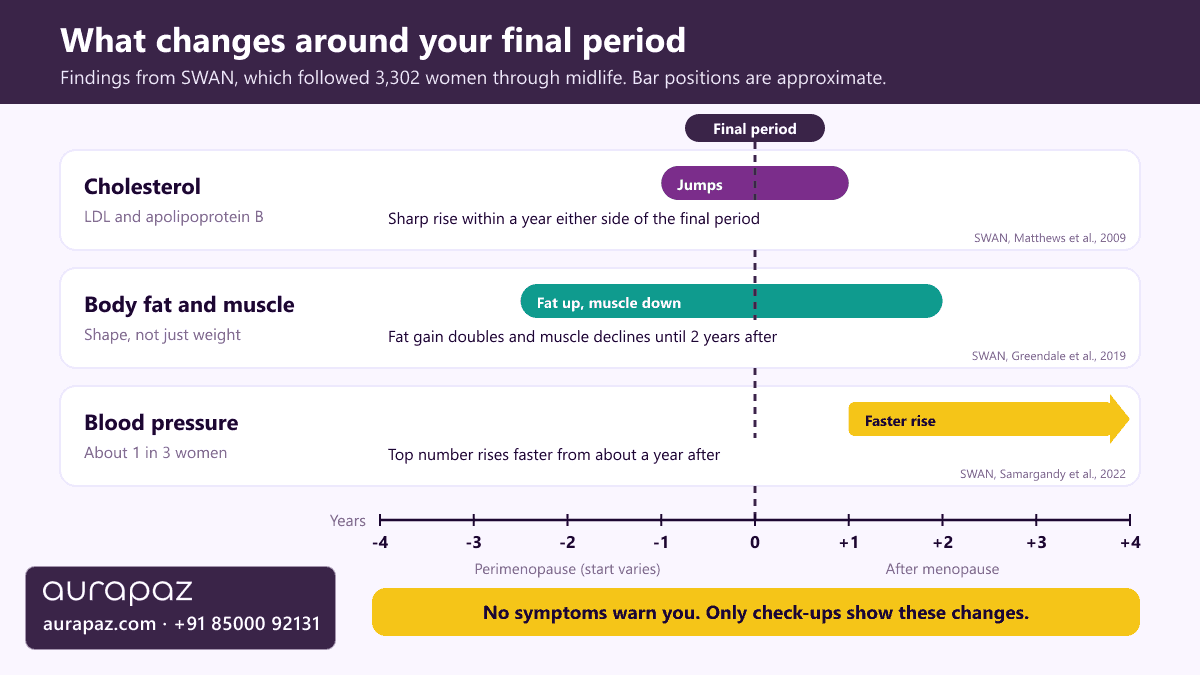
In a 2009 SWAN analysis of 1,054 women, most risk factors, including blood sugar and blood pressure, rose steadily in line with ageing. Three did not. Total cholesterol, LDL cholesterol (the kind that builds up in artery walls) and apolipoprotein B (a count of those harmful particles) rose sharply within the year before and the year after the final period, across ethnic groups. The authors recommended monitoring lipids in perimenopausal women.
Blood pressure can climb faster after menopause
A 2022 SWAN study followed blood pressure over 17 visits. In about a third of women, systolic pressure (the top number) rose slowly, then faster from about a year after menopause. In the rest it was already climbing before menopause, then held its pace or eased off. Women with hot flushes and night sweats tended to have higher readings. The authors advised frequent blood pressure checks through the transition.
Fat moves to the middle, muscle slips away
Many women notice their shape changing more than their weight, and the research agrees. In SWAN body scans, the rate of fat gain doubled at the start of the transition while lean mass, mostly muscle, began to fall, until about two years after the final period. Weight kept rising at the same steady pace, so the scales hide this. A separate four-year study using CT scans found that only women who became postmenopausal gained significant visceral fat, the deep fat around the organs that is closely linked with heart and metabolic disease.
Why South Asian women need to pay closer attention
These changes land on top of whatever risk you already carry, and for South Asians that starting point is often higher.
In the INTERHEART study, the average age at a first heart attack was 53 in five South Asian countries, against nearly 59 elsewhere, largely because known risk factors such as diabetes, unhealthy blood fats and little exercise were more common at younger ages. A 2018 AHA statement on South Asians agreed: no mysterious extra factor, but more insulin resistance and its related problems.
The ICMR-INDIAB study, which tested more than 100,000 Indian adults aged 20 and over, found that 35.5 per cent had high blood pressure, 11.4 per cent had diabetes, another 15.3 per cent had prediabetes and 39.5 per cent had abdominal obesity.
American prevention guidelines list South Asian ancestry as a “risk-enhancing factor”, alongside menopause before 40 and pregnancy conditions such as pre-eclampsia. A pooled analysis of more than 300,000 women found that, compared with menopause at 50 or 51, menopause between 40 and 44 carried about 30 per cent higher risk of a first non-fatal heart attack, angina or stroke, and menopause before 40 about 55 per cent higher.
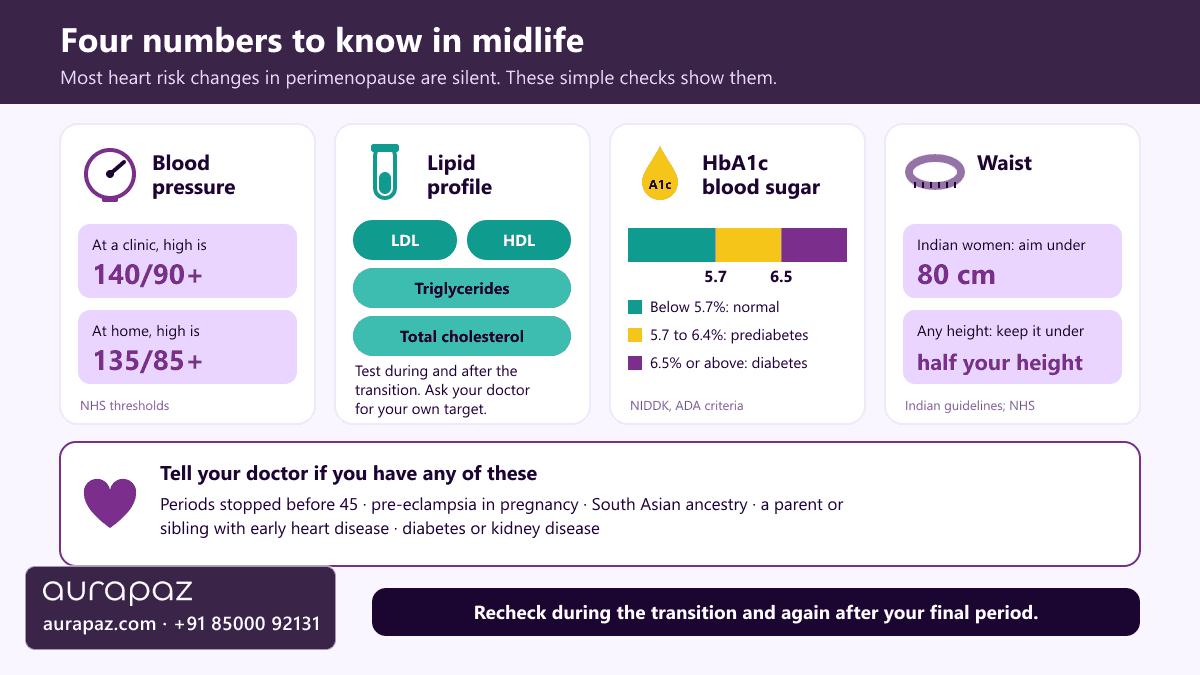
Tell your doctor if any of these apply to you: periods that stopped before 45, pre-eclampsia, a parent or sibling with early heart disease, diabetes, kidney disease, or lupus or rheumatoid arthritis. These change how your results are read.
The numbers to know and get checked
Because these changes are silent, the only way to see them is to measure. Four checks are simple and widely available.
Blood pressure
The NHS considers blood pressure high at 140/90 or above when measured in a clinic, or 135/85 or above at home, so the home threshold is slightly lower. If you are near those lines, a week of home readings tells your doctor more than one rushed clinic reading.
Cholesterol (lipid profile)
A lipid profile shows total cholesterol, LDL, HDL and triglycerides. Given the SWAN findings, testing during perimenopause and again after your final period makes sense. Targets depend on your overall risk, so ask your doctor what yours should be.
HbA1c
HbA1c reflects your average blood sugar over the past two to three months. Using American Diabetes Association cut-offs, below 5.7 per cent is normal, 5.7 to 6.4 per cent is prediabetes and 6.5 per cent or above is in the diabetes range. My piece on blood sugar spikes explains what everyday glucose readings do and do not mean.
Waist
Measure around your middle, just above the hip bones, after breathing out. Indian expert guidelines on obesity count a waist of 80 cm or more in women as abdominal obesity. The NHS rule suits any height: keep your waist to less than half your height.
What actually helps: food, movement, sleep and the rest
The habits that protect the heart at 30 still work at 45 and 55. There is no special perimenopause diet; the stakes are simply higher.
An eating pattern, not a superfood
The AHA’s 2021 dietary guidance focuses on overall patterns, not single foods. On an Indian plate:
- Plenty of vegetables and fruit, in variety.
- Whole grains such as whole wheat, millets, hand-pounded rice and oats, in place of maida.
- Mostly plant protein: dal, chana, rajma, nuts and seeds, regular fish if you eat it, low-fat dairy, and lean unprocessed meat if you want meat. Protein also helps you keep muscle; my guide to how much protein you need covers the vegetarian options.
- Liquid plant oils rather than vanaspati, coconut or palm oil, with ghee and butter used sparingly. I unpack the cooking oil debate in the truth about seed oils.
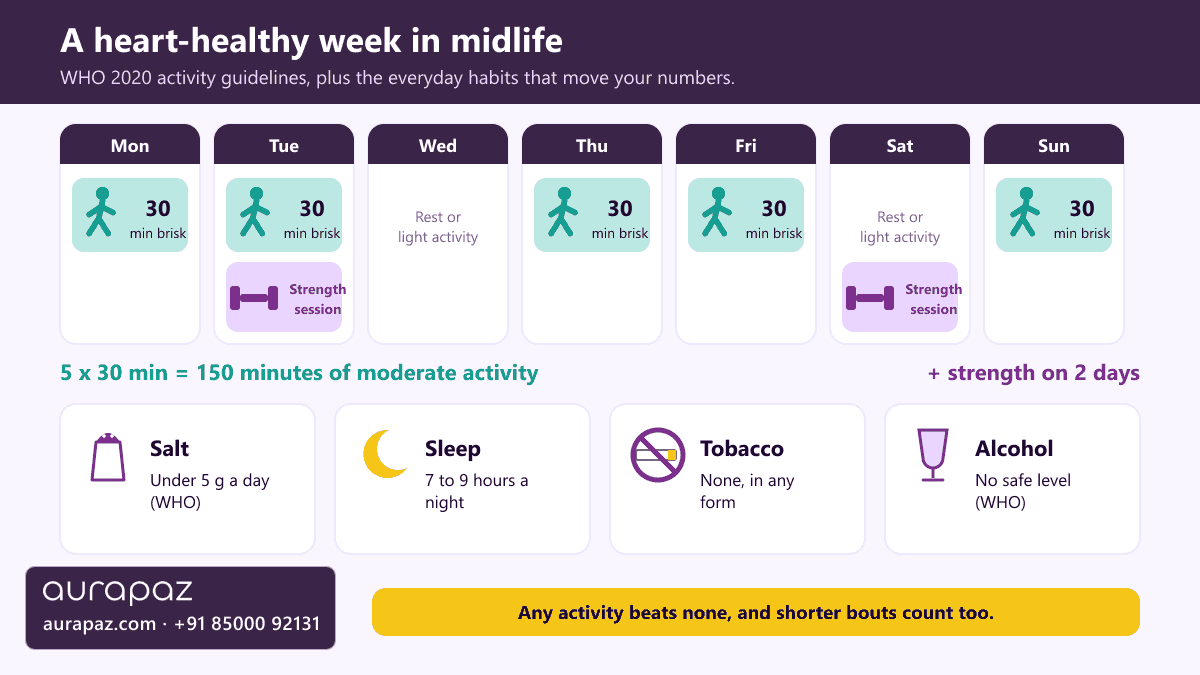
- Less salt. The WHO advises under 5 g a day, just under a teaspoon, including what hides in pickles, papad and namkeen.
- Fewer added sugars and ultra-processed snacks, such as sweetened drinks and biscuits.
Movement: 150 minutes plus two strength sessions
The WHO’s 2020 physical activity guidelines advise adults to do at least 150 to 300 minutes of moderate activity a week, or 75 to 150 minutes of vigorous activity, plus muscle-strengthening work on two or more days. Moderate means you can talk but not sing, as on a brisk walk. Thirty minutes on five days covers it, and shorter bouts count.
Strength work matters more now, because the transition speeds up muscle loss. Squats, wall push-ups, resistance bands and weights all qualify. In the CT-scan study above, activity fell about two years before menopause and stayed low, so protect your routine deliberately.

Sleep
Sleep is one of the AHA’s eight measures of heart health, and the US National Heart, Lung, and Blood Institute says adults need 7 to 9 hours. If night sweats are wrecking your sleep, raise it with your doctor. My piece on which viral sleep hacks work sorts the useful from the gimmicks.
Smoking, tobacco and alcohol
Smoking is a major cause of heart attacks, and in the Massachusetts study smokers reached menopause almost two years earlier. If you use tobacco in any form, including beedis, stopping is the most powerful change here, and your doctor can help.
WHO Europe says no amount of alcohol is safe for health. The AHA puts it practically: if you do not drink, do not start.
A note on herbal heart products. Arjuna, ashwagandha and similar products are widely sold for the heart and “hormone balance”, but the human evidence is thin: a 2014 review from PGIMER Chandigarh found arjuna trials in angina were of poor quality and showed no clear benefit over standard care. The US National Center for Complementary and Integrative Health notes ashwagandha may interact with diabetes, blood pressure and thyroid medicines, has been linked to rare liver injury, and should be avoided in pregnancy, breastfeeding, and autoimmune or thyroid conditions. If you take any prescribed medicine, especially blood thinners, talk to your doctor before adding a herb, and never use one in place of your medicine.
Where HRT fits
HRT is the most effective option for hot flushes and night sweats, and it prevents bone loss. Whether it protects the heart is a separate question.
What the Women’s Health Initiative found
The Women’s Health Initiative (WHI) was a large American trial that randomly gave women aged 50 to 79 hormones or a dummy pill, largely to test whether HRT prevented heart disease. In 2002 the oestrogen plus progestin arm was stopped early: over about five years, women on hormones had more heart attacks, strokes, lung clots and breast cancers, and fewer hip fractures and bowel cancers. The authors concluded this regimen should not be used to prevent heart disease.
A later WHI analysis looked at timing. Women who started within ten years of menopause showed no increase in coronary heart disease, while those 20 or more years past menopause had higher risk. The trend missed the study’s significance threshold, and stroke risk was raised regardless of timing. So timing may matter, but this is not proof that HRT protects the heart.
What guidelines say now
The North American Menopause Society’s 2022 position statement says that for women under 60 or within 10 years of menopause, without contraindications, benefits outweigh risks for bothersome hot flushes and preventing bone loss. Beyond that, the balance is less favourable because absolute risks of heart disease, stroke, clots and dementia are higher.
The UK’s NICE menopause guideline, NG23 (heart recommendations updated in 2024), says coronary heart disease risk does not increase with HRT in women without heart disease. Stroke risk rises with oestrogen tablets but is unlikely to rise with oestrogen patches or gel. And it states plainly: do not offer HRT to prevent cardiovascular disease. The US Preventive Services Task Force reached the same conclusion in 2022.
So HRT is a decision about symptoms and bone health, made with a doctor who knows your history. It is not a heart medicine, and whether you take it or not, everything in the section above still applies.
Myth vs Reality: your heart in midlife
| What the trend says | What the science says |
|---|---|
| “Heart disease is a men’s problem.” | Cardiovascular disease is the leading cause of death in women, and risk accelerates across the transition. |
| “Perimenopause starts in your mid-thirties.” | For most women the transition begins in the forties. Indian women reach menopause at about 46 on average. |
| “If I feel fine, my heart is fine.” | The cholesterol, blood pressure and fat changes cause no symptoms. Only tests show them. |
| “My weight is the same, so nothing has changed.” | Fat gain doubles and muscle declines while weight rises at the same pace. Your waist tells you more. |
| “HRT will protect my heart.” | NICE and the US Preventive Services Task Force advise against HRT to prevent heart disease. |
| “Arjuna tea is a safe way to look after your heart.” | Human evidence is weak, and herbal products can interact with prescribed medicines. Discuss any herb with your doctor first. |
Key takeaways
- Perimenopause usually starts in the forties; Indian women reach menopause at about 46 on average.
- Around the final period LDL cholesterol jumps, fat shifts to the middle and muscle declines.
- South Asian ancestry, early menopause and pre-eclampsia all raise risk.
- Check blood pressure, lipids, HbA1c and waist during and after the transition.
- Aim for 150 minutes of activity plus two strength sessions a week, under 5 g of salt a day, 7 to 9 hours of sleep and no tobacco.
- HRT is for symptoms and bone health, not heart protection. Decide with your doctor.
Know the warning signs. Tight or squeezing chest pain that does not go away, pain spreading to the arms, neck, jaw or back, or chest pain with sweating, sickness or breathlessness can signal a heart attack. In women, breathlessness, sickness, or back or jaw pain can be the main signs, with little or no chest pain. Call 112 straight away.
References & Further Reading
- El Khoudary SR, et al. Menopause transition and cardiovascular disease risk: implications for timing of early prevention. A scientific statement from the American Heart Association. Circulation, 2020; 142(25): e506 to e532.
- Matthews KA, et al. Are changes in cardiovascular disease risk factors in midlife women due to chronological aging or to the menopausal transition? Journal of the American College of Cardiology, 2009; 54(25): 2366 to 2373.
- Samargandy S, et al. Trajectories of blood pressure in midlife women: does menopause matter? Circulation Research, 2022; 130(3): 312 to 322.
- Greendale GA, et al. Changes in body composition and weight during the menopause transition. JCI Insight, 2019; 4(5): e124865.
- Lovejoy JC, et al. Increased visceral fat and decreased energy expenditure during the menopausal transition. International Journal of Obesity, 2008; 32(6): 949 to 958.
- McKinlay SM, Brambilla DJ, Posner JG. The normal menopause transition. Maturitas, 1992; 14(2): 103 to 115.
- Ahuja M. Age of menopause and determinants of menopause age: a PAN India survey by IMS. Journal of Mid-life Health, 2016; 7(3): 126 to 131.
- Joshi P, et al. Risk factors for early myocardial infarction in South Asians compared with individuals in other countries. JAMA, 2007; 297(3): 286 to 294.
- Volgman AS, et al. Atherosclerotic cardiovascular disease in South Asians in the United States: epidemiology, risk factors, and treatments. A scientific statement from the American Heart Association. Circulation, 2018; 138(1): e1 to e34.
- Anjana RM, et al. Metabolic non-communicable disease health report of India: the ICMR-INDIAB national cross-sectional study (ICMR-INDIAB-17). Lancet Diabetes and Endocrinology, 2023; 11(7): 474 to 489.
- Arnett DK, et al. 2019 ACC/AHA guideline on the primary prevention of cardiovascular disease. Circulation, 2019; 140(11): e596 to e646.
- Zhu D, et al. Age at natural menopause and risk of incident cardiovascular disease: a pooled analysis of individual patient data. Lancet Public Health, 2019; 4(11): e553 to e564.
- Misra A, et al. Revised definition of obesity in Asian Indians living in India. Diabetes and Metabolic Syndrome: Clinical Research and Reviews, 2025; 19(1): 102989.
- Lichtenstein AH, et al. 2021 dietary guidance to improve cardiovascular health: a scientific statement from the American Heart Association. Circulation, 2021; 144(23): e472 to e487.
- Bull FC, et al. World Health Organization 2020 guidelines on physical activity and sedentary behaviour. British Journal of Sports Medicine, 2020; 54(24): 1451 to 1462.
- Lloyd-Jones DM, et al. Life’s Essential 8: updating and enhancing the American Heart Association’s construct of cardiovascular health. Circulation, 2022; 146(5): e18 to e43.
- Rossouw JE, et al. Risks and benefits of estrogen plus progestin in healthy postmenopausal women: principal results from the Women’s Health Initiative randomized controlled trial. JAMA, 2002; 288(3): 321 to 333.
- Rossouw JE, et al. Postmenopausal hormone therapy and risk of cardiovascular disease by age and years since menopause. JAMA, 2007; 297(13): 1465 to 1477.
- The North American Menopause Society. The 2022 hormone therapy position statement of The North American Menopause Society. Menopause, 2022; 29(7): 767 to 794.
- US Preventive Services Task Force. Hormone therapy for the primary prevention of chronic conditions in postmenopausal persons. JAMA, 2022; 328(17): 1740 to 1746.
- NICE. Menopause: identification and management (NG23). National Institute for Health and Care Excellence.
- Kaur N, et al. Terminalia arjuna in chronic stable angina: systematic review and meta-analysis. Cardiology Research and Practice, 2014; 2014: 281483.
- Mehta LS, et al. Acute myocardial infarction in women: a scientific statement from the American Heart Association. Circulation, 2016; 133(9): 916 to 947.
- National Center for Complementary and Integrative Health. Ashwagandha.
- National Institute on Aging. What is menopause?
- NHS. High blood pressure.
- NHS. Overweight and obesity (waist to height ratio).
- National Institute of Diabetes and Digestive and Kidney Diseases. Diabetes tests and diagnosis.
- World Health Organization. Sodium reduction fact sheet.
- World Health Organization Europe. No level of alcohol consumption is safe for our health. 4 January 2023.
- National Heart, Lung, and Blood Institute. How much sleep is enough?