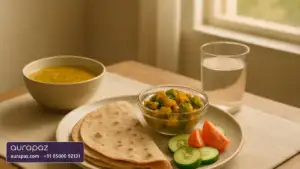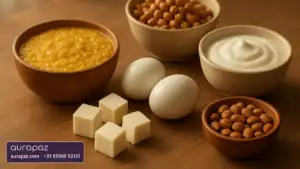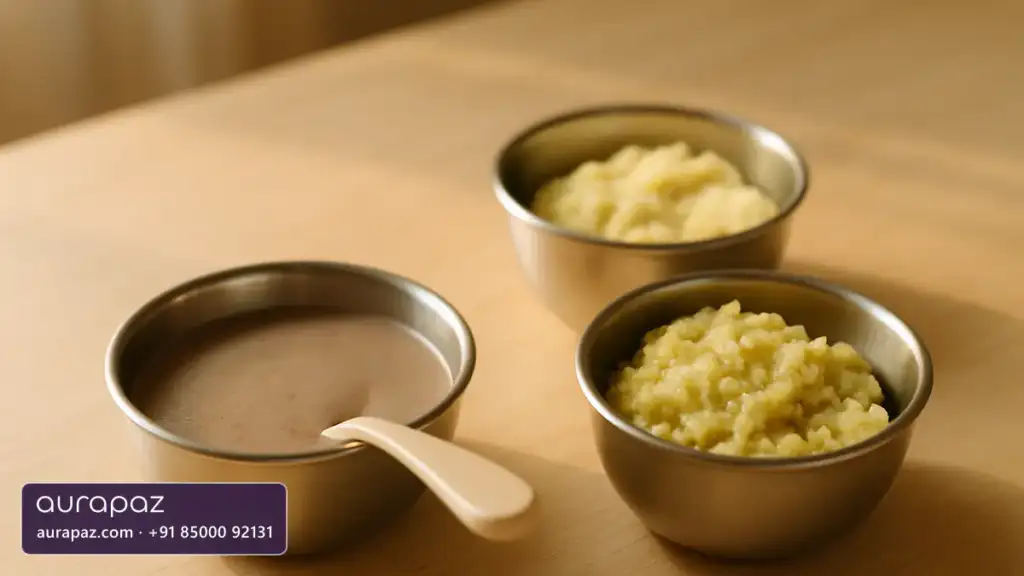
Few milestones bring out as much family advice as a baby’s first meal. One relative wants to start dal ka pani at four months, another insists on a drop of honey for luck, and someone’s baby apparently ate khichdi before she could sit. The evidence is calmer and more consistent than the chatter: around six months, at your baby’s pace, with breastfeeding carrying on alongside.
Why “around six months” is the advice
The World Health Organization’s 2023 guideline on complementary feeding recommends introducing foods at six months (180 days) while breastfeeding continues. The Indian Academy of Pediatrics (IAP), the Government of India’s national feeding guidelines and the ICMR National Institute of Nutrition’s Dietary Guidelines for Indians (2024) all agree, and all add that breastfeeding should continue to two years and beyond.
Why not four months? The WHO review found harms linked to starting foods before four months, and generally none from starting around six. It also notes that a baby’s ability to sit without support tends to go hand in hand with maturing of the gut, kidneys and immune system. Why not later? Because milk alone stops covering a growing baby’s needs. ICMR-NIN puts energy needs from 6 to 12 months at 650 to 720 kcal a day, while breast milk after six months provides about 500 kcal and 5 g of protein. Iron is a particular gap.
What breast milk antibodies actually do
You may have read that a young baby’s “leaky” gut lets antibodies from breast milk pass into the blood. That is not how it works. The antibodies circulating in a newborn’s blood are mostly IgG, which crossed the placenta during pregnancy. The main antibody in breast milk is secretory IgA, and its job is local: it works on the lining of the baby’s gut, helping to keep germs out. It is tuned to germs in the mother’s own surroundings, the ones her baby is most likely to meet. That protection does not stop at six months, one reason the guidelines want breastfeeding to continue long after solids begin.
What about sleep?
Early solids are often suggested for night waking, and the evidence is not a flat “no link”. In the EAT trial in England and Wales, 1,303 breastfed babies were randomly assigned to start foods from three months or wait until around six. A 2018 analysis found the early group slept about 17 minutes longer a night at six months and woke slightly less, 1.74 times a night against 2.01. Sleep was reported by parents, who could not be blinded to whether their baby was eating solids. A modest difference is not a reason to rush, and WHO, IAP and ICMR-NIN all still advise around six months.
Signs your baby is ready to start solids
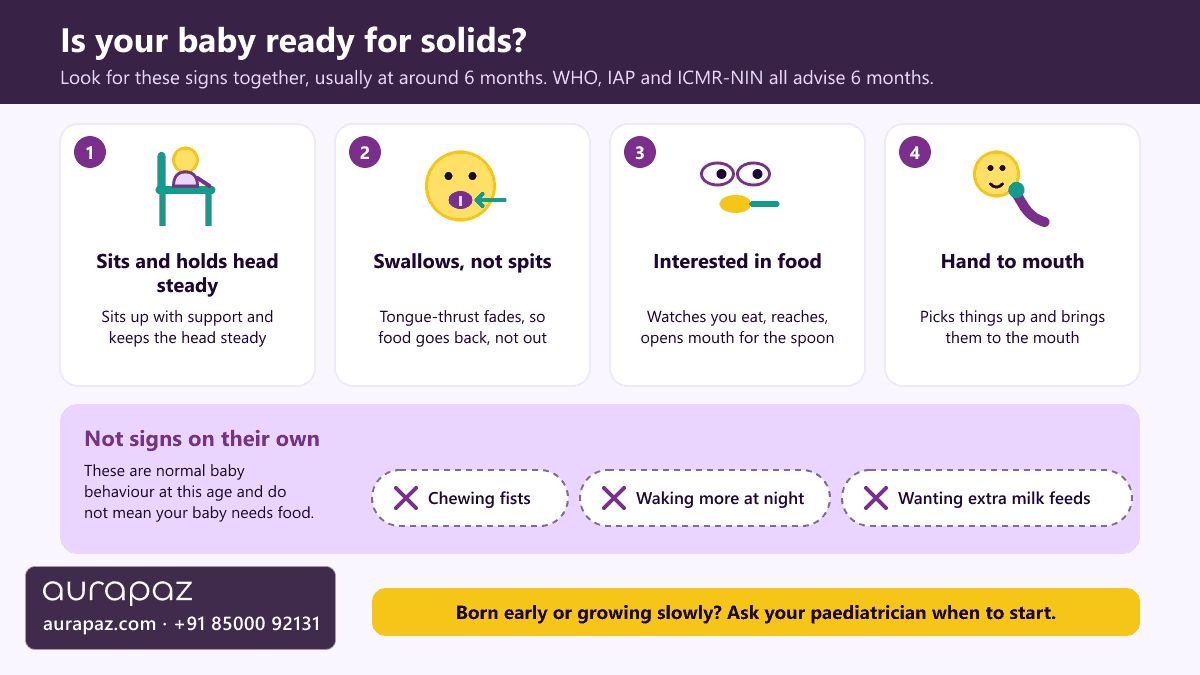
The NHS lists signs that usually show up together around six months, and the US CDC adds a few. Look for a baby who can:
- Sit up with support and hold the head steady, so they can swallow safely and turn away when full.
- Swallow food instead of pushing it back out. Young babies have a tongue-thrust reflex that pushes anything solid forward. When it fades and your baby can move food from the front of the tongue to the back, that is a genuine readiness sign, and the CDC lists it.
- Show real interest: watching you eat, reaching for your plate, opening the mouth for the spoon.
- Co-ordinate eyes, hands and mouth, picking things up and bringing them to the mouth.
The NHS is equally clear on what does not count: chewing fists, waking more at night and wanting extra milk feeds are normal baby behaviour, not signs on their own. If your baby was born early, has a medical condition or is not growing as expected, ask your paediatrician when to begin.
First foods in an Indian kitchen
There is no required order of first foods and no need for a packaged rice cereal. ICMR-NIN recommends homemade foods, starting with two or three teaspoons of a thin but not watery dal gruel for a few days, then thickening it to well-mashed, semi-solid food. Its sample menus for 6 to 8 months read like an ordinary Indian week: dal-rice with spinach, rajma khichdi with amaranth, ragi with cowpea or egg, and mashed papaya, banana or chikoo.
Put iron on the plate early
WHO recommends meat, fish or eggs daily, fruit and vegetables every day, and pulses, nuts and seeds often, especially where animal foods are limited. Plain cereal should not crowd out the rest, because it is a poor source of iron, zinc and vitamin B12.
- Vegetarian families: dal, chana and rajma mashed into rice, greens such as palak, methi and amaranth, ragi and other millets, and curd. Plant iron is absorbed less well, so add a vitamin C source such as mashed orange, papaya or guava.
- Families who eat eggs, fish or meat: hard-boiled egg, flaked fish with every bone removed, or finely shredded chicken stirred into khichdi. ICMR-NIN’s text suggests these from about eight months, though its own 6 to 8 month menus include egg, and WHO and allergy experts support them from around six. The NHS advises that eggs without the British Lion safety mark, such as eggs bought in India, be cooked until the white and yolk are solid.
- A little fat: ICMR-NIN’s menus add about a teaspoon of ghee or oil per meal to make small portions more energy dense.
One habit to drop is offering sips of tea. ICMR-NIN notes that tea binds dietary iron, and the NHS says tea and coffee are not suitable for babies or young children. My piece on chai and iron absorption explains why.
If your baby was born preterm or small, food alone may not be enough. WHO notes that early solids, even iron-fortified ones, do not reliably prevent anaemia in high-risk babies, and targeted iron supplements work better. Ask your paediatrician; please do not start an iron syrup on your own.
Textures, amounts and how often
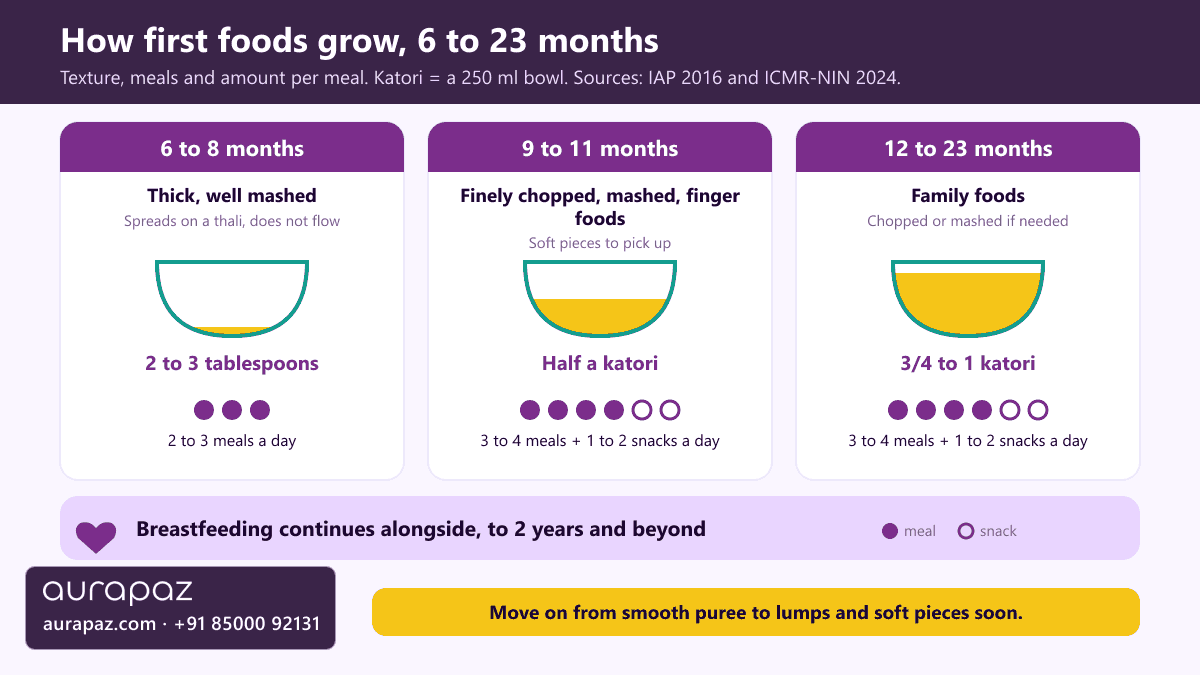
Food should stay on a tilted spoon (IAP) and spread on a thali rather than flow (ICMR-NIN). Watery dal ka pani fills a small stomach with little nourishment.
- 6 to 8 months: thick, well-mashed food, 2 to 3 meals a day starting at 2 to 3 tablespoons, plus frequent breastfeeds.
- 9 to 11 months: finely chopped or mashed food and soft pieces to pick up, 3 to 4 meals plus 1 or 2 snacks, about half a 250 ml katori each time.
- 12 to 23 months: family foods, chopped or mashed if needed, 3 to 4 meals plus 1 or 2 snacks, three quarters to one katori.
Do not stay on smooth purée too long. The NHS suggests moving to mashed, lumpy and finger foods as soon as your baby can manage, because some babies need practice to accept lumps. Wash hands, utensils and vegetables well, since diarrhoea from unsafe food is a real risk at this age; my guide to food safety at home covers the habits that matter.
Peanut, egg and other allergens: earlier, not later
Parents were once told to hold back peanut and egg. That advice has been reversed. In the LEAP trial, published in 2015, 640 high-risk babies with severe eczema, egg allergy or both were randomly assigned to eat peanut regularly or avoid it. Among those who did not already react on a skin test, 13.7 per cent of the avoidance group had peanut allergy by age five, against 1.9 per cent of those who ate it.
The EAT trial tested six allergenic foods in ordinary breastfed babies. Its main result was not statistically significant, and many families found it hard to give all six foods so early, but among babies who managed the plan, peanut and egg allergy were less common. Joint 2021 guidance from the North American allergy societies now advises introducing both peanut and egg around six months, not before four, without routine testing first. WHO also notes that delaying peanut may promote allergy rather than prevent it.
Doing it safely at home
- Never whole or chopped peanuts. The NHS says nuts should be crushed or ground and added to food. Stir finely ground peanut or a little smooth peanut butter into ragi porridge or khichdi, never a lump of nut butter on its own.
- One new allergen at a time, in a small amount, on a day you can watch your baby afterwards. Reactions usually happen within minutes.
- Keep it going. Once a food is tolerated, the NHS advises keeping it in the usual diet.
Talk to your paediatrician first if your baby has eczema, a diagnosed food allergy, or a strong family history of allergy, eczema, asthma or hay fever. Watch for swollen lips or face, a red itchy rash or watery eyes after a new food. Breathing difficulty or a swollen tongue or throat is an emergency: get urgent medical help.
Spoon-feeding, baby-led weaning, or both?
Baby-led weaning skips the spoon: babies feed themselves soft finger foods from the start. The best evidence comes from the BLISS trial in Dunedin, New Zealand, where 206 families were randomly assigned to usual care or a baby-led approach with guidance on avoiding choking hazards.
The choking results, published in Pediatrics in 2016, showed no difference: about 35 per cent of babies choked at least once between six and eight months, whichever way they were fed. More worrying, over half of families offered a choking-risk food at seven months, and almost all by twelve. A 2017 follow-up found no difference in weight, though BLISS parents reported less fussiness at a year.
For most Indian families the practical answer is a mix: mashed dal-rice on a spoon, plus a strip of well-cooked carrot, a soft idli or a piece of ripe banana to hold. The safety rules matter more than the method.
Gagging is noisy, choking is quiet
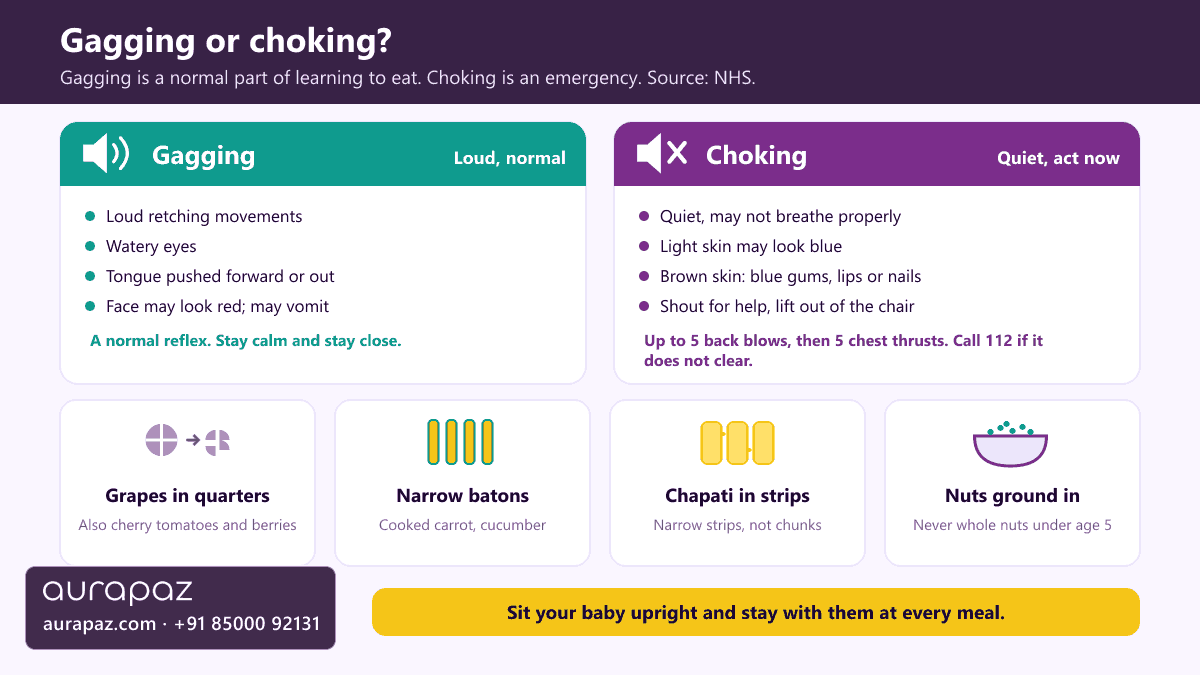
Gagging is a normal reflex while a baby learns to manage food. The NHS describes it as loud: watery eyes, the tongue pushed forward, retching, sometimes vomiting, and a face that may look red. Choking is quiet. Light skin may turn blue; on brown or black skin, look for a blue tinge on the gums, inside the lips or on the fingernails. If your baby is choking and cannot breathe properly, shout for help, lift them out of the high chair and give up to five sharp back blows between the shoulder blades, supporting the chest and chin. If that fails, give up to five chest thrusts (two fingers, middle of the chest, below the nipple line), call 112 and repeat both until help arrives. Even if it clears, get your baby checked.
Always sit your baby upright and stay with them while they eat. The NHS advises cutting grapes, cherry tomatoes and berries into quarters, vegetables into narrow batons and chapati into thin strips. Whole nuts are unsafe for children under five.
What to keep off the menu in the first year
- Honey, even the traditional first lick for a newborn, until after the first birthday. The NHS explains that honey can carry bacteria that grow in a baby’s gut and cause infant botulism, a rare but serious illness. ICMR-NIN also advises against honey, glucose or water at any time in the first six months.
- Added salt and sugar. Salt is hard on young kidneys, so set aside your baby’s portion before seasoning. ICMR-NIN advises no added sugar at all under two, and WHO says foods high in sugar, salt and trans fats, biscuits and packaged snacks included, should not be given.
- Cow’s milk as the main drink before 12 months, says the NHS, though it can go into cooking from around six months. Breast milk stays the main milk; if your baby is not breastfed, ask your paediatrician which milk to use.
- Tea and coffee, for the iron reasons above.
- Fruit juice and sweetened drinks. The NHS says babies under 12 months do not need juice, and WHO advises limiting it. Offer mashed fruit, and sips of water from an open cup.
Responsive feeding: let your baby lead
WHO recommends responsive feeding: watching your baby’s signals and letting them eat at their own pace. ICMR-NIN describes hunger cues such as sucking on the fist, drooling and looking at food, and fullness cues such as turning away or getting distracted. It asks families not to feed while the baby watches television or a phone, and never to force-feed.
ICMR-NIN points out that a baby pushing food out is often still learning to swallow, not rejecting the taste, and suggests offering it again a few days later. Calm, repeated exposure is what wins acceptance, the same principle as in my guide to feeding fussy eaters. Eat together, and stop when your baby shows you they are done.
Solids complement breastfeeding rather than replace it. By the toddler years, the building blocks in protein for children take over: dal, curd, paneer, eggs and the rest of the family plate.
Myth vs Reality: first foods
| What the trend says | What the science says |
|---|---|
| “Start solids at four months and your baby will sleep through the night.” | In the EAT trial, early solids added about 17 minutes of sleep a night at six months. A modest effect; WHO, IAP and ICMR-NIN still advise around six months. |
| “Rice cereal has to be the first food.” | There is no required order. ICMR-NIN suggests homemade dal-rice, khichdi, ragi, vegetables and fruit, and WHO favours iron-rich foods over plain cereal. |
| “Keep peanut and egg away until age one to avoid allergies.” | In LEAP, peanut allergy at five was 13.7 per cent with avoidance and 1.9 per cent with early eating. Allergy societies now advise peanut and egg around six months. |
| “Baby-led weaning makes babies choke.” | BLISS found no difference in choking when parents had safety guidance. About 35 per cent of babies in both groups choked at least once, so safe shapes matter for everyone. |
| “Once solids start, breastfeeding can stop.” | WHO, IAP and India’s national guidelines recommend breastfeeding to two years and beyond alongside food. |
Key takeaways
- Start foods at around six months and keep breastfeeding to two years and beyond.
- Readiness: sitting with support, a steady head, swallowing instead of pushing food out, and interest in food.
- Begin with thick, homemade, iron-rich foods: dal-rice, khichdi, ragi, greens, and well-cooked egg, fish or chicken if you eat them.
- Introduce ground peanut and cooked egg around six months, one at a time, after checking with your paediatrician if your baby has eczema or a known allergy.
- Gagging is loud and normal; choking is quiet. Keep your baby upright and stay with them.
- No honey before one, no added salt or sugar, no tea or juice, and no cow’s milk as the main drink before 12 months.
When to see your paediatrician: if your baby was born early or small, is not gaining weight, still cannot manage mashed food after a few weeks of trying, gags or vomits at most meals, or reacts to a new food.
References & Further Reading
- World Health Organization. WHO guideline for complementary feeding of infants and young children 6 to 23 months of age. Geneva: WHO, 2023.
- Tiwari S, et al. Infant and Young Child Feeding Guidelines, 2016. IYCF Chapter of the Indian Academy of Pediatrics. Indian Pediatrics, 2016; 53(8): 703 to 713.
- Ministry of Women and Child Development (Food and Nutrition Board), Government of India. National Guidelines on Infant and Young Child Feeding. Second edition, 2006.
- ICMR National Institute of Nutrition. Dietary Guidelines for Indians (Guidelines 3 and 4). 2024.
- Palmeira P, et al. IgG placental transfer in healthy and pathological pregnancies. Clinical and Developmental Immunology, 2012; 2012: 985646.
- Brandtzaeg P. The mucosal immune system and its integration with the mammary glands. Journal of Pediatrics, 2010; 156(2 Suppl): S8 to S15.
- Perkin MR, et al. Association of early introduction of solids with infant sleep: a secondary analysis of a randomized clinical trial. JAMA Pediatrics, 2018; 172(8): e180739.
- Du Toit G, et al. Randomized trial of peanut consumption in infants at risk for peanut allergy. New England Journal of Medicine, 2015; 372(9): 803 to 813.
- Perkin MR, et al. Randomized trial of introduction of allergenic foods in breast-fed infants. New England Journal of Medicine, 2016; 374(18): 1733 to 1743.
- Fleischer DM, et al. A consensus approach to the primary prevention of food allergy through nutrition: guidance from the AAAAI, ACAAI and CSACI. Journal of Allergy and Clinical Immunology: In Practice, 2021; 9(1): 22 to 43.
- Togias A, et al. Addendum guidelines for the prevention of peanut allergy in the United States. Journal of Allergy and Clinical Immunology, 2017; 139(1): 29 to 44.
- Fangupo LJ, et al. A baby-led approach to eating solids and risk of choking. Pediatrics, 2016; 138(4): e20160772.
- Taylor RW, et al. Effect of a baby-led approach to complementary feeding on infant growth and overweight: a randomized clinical trial. JAMA Pediatrics, 2017; 171(9): 838 to 846.
- NHS. Your baby’s first solid foods.
- NHS. Foods to avoid giving babies and young children.
- NHS. Food allergies in babies and young children.
- NHS. Drinks and cups for babies and young children.
- NHS Best Start in Life. Choking and gagging on food.
- NHS Best Start in Life. Preparing food safely.
- Centers for Disease Control and Prevention. When, what, and how to introduce solid foods.