
A client came to me last month with a photograph of a jawline she wanted. It was her own face, run through a filter. She had already booked a consultation for fillers, and what she wanted from me was permission. What she got instead was a question she had not been asked anywhere in three months of research: if you do not like the result, what exactly happens next?
That question is the whole subject of this article. Not whether cosmetic procedures work, because many of them do. Not whether they are vain, because that framing helps nobody. The useful axis is reversibility, and it is the one thing nobody selling you a procedure puts on the price list.
The only question worth asking first
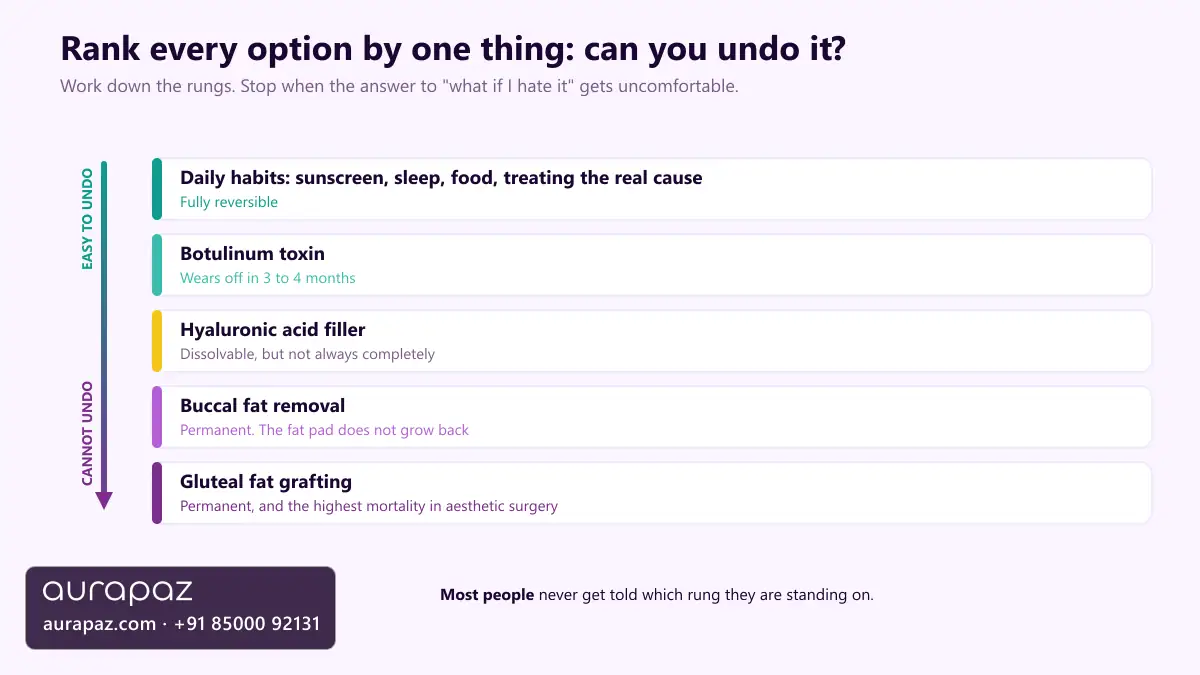
Aesthetic medicine is sold as a menu of results: sharper jaw, fuller lips, hollower cheeks. It is far more useful to think of it as a ladder of commitment. At one end sit the things you can stop doing tomorrow with no trace. At the other sit procedures that remove tissue which does not grow back, and a small number that carry a genuine risk of death.
It is worth naming what my client had done, because it is now extremely common. She had brought in an edited version of her own face. Filters do not just smooth skin, they restructure bone: they narrow jaws, lift brows, shrink noses. When that image becomes the target, the request that comes out of it is usually for a structural change, which lives at the permanent end of the ladder, in service of a face that no procedure can actually produce.
Most people booking their first appointment have no idea which rung they are standing on. That is not their fault. The marketing deliberately flattens the difference, so that a permanent operation and a moisturiser get described in the same cheerful language about “enhancing your natural features”.
Myth versus reality: natural and surgical beauty
| What the trend says | What the science says |
|---|---|
| Surgery is the risky one. Injectables are basically lunchtime treatments. | Injectables carry the risk of blindness. A 2024 review documented 511 published cases of vision loss after filler, 365 of them in under five years. Of the 318 cases that reported a visual outcome, 68.2 per cent recovered no vision at all. |
| Fillers are fine because they just dissolve. | Hyaluronic acid filler can be dissolved with hyaluronidase, which is a real advantage. But dissolving is itself a procedure, it is not always complete, and migration and nodules are well documented. |
| Buccal fat removal is a minor tweak. | It is permanent, and the evidence is thin. Two systematic reviews published since 2025 put the complication rate at 4.2 per cent and 25 per cent, the latter with a confidence interval from 4 to 46 per cent, and long term follow up is too short in the published studies to judge. |
| Fat transfer is safer because it uses your own fat. | Gluteal fat grafting carries the highest mortality of any aesthetic surgical procedure. The mechanism is fat entering the bloodstream and lodging in the lungs. |
| If a clinic owns the machine, someone there is qualified to use it. | In February 2026 the Tamil Nadu Medical Council had to clarify that only registered medical practitioners may perform aesthetic procedures on skin and hair, including lasers and hair transplants. |
| The natural route is just something wellness brands say. | In a randomised trial, adults using sunscreen daily showed no detectable increase in skin ageing over four and a half years. |

The reversibility ladder
Here is how I actually talk this through with clients. Work down the rungs, and stop as soon as the answer to “what if I hate it” becomes uncomfortable.
Fully reversible: the things you do daily
Sunscreen, sleep, what you eat, treating the acne or the anaemia that is actually driving your complaint. Stop any of it and you are back where you started, no worse. This rung is unglamorous and it is where the largest share of visible difference is available to most people, which is an annoying thing to be told and still true.
Temporary: botulinum toxin
It wears off, typically within three to four months. That is the honest appeal of it: a bad result is a problem measured in months rather than decades, and a heavy brow or a lopsided smile will resolve on its own. It is not risk free, and repeated use over many years is not the same as doing nothing. But on the axis that matters here, it sits high up the ladder, and that genuinely counts in its favour compared with anything that removes tissue.
Mostly reversible: hyaluronic acid filler
Genuinely dissolvable, which sets it apart from almost everything below it. But “mostly” is doing real work in that phrase. Filler can migrate away from where it was placed, it can form nodules, and dissolving means another injection appointment and another practitioner decision. Permanent and semi permanent fillers, which are still sold, do not have this escape route at all.
Effectively permanent: buccal fat removal
The buccal fat pad does not regenerate. There is no dissolving appointment. Correction means adding filler or fat back, which is a different procedure achieving an approximation, not a reversal.
The rung with a body count: gluteal fat grafting
The task force report that changed practice in this field surveyed plastic surgeons worldwide. From 692 responding surgeons reporting 198,857 cases, there were 32 deaths from pulmonary fat emboli and 103 non fatal ones. Three per cent of the surgeons who replied had lost a patient.
Turning that into a risk figure is genuinely difficult, and the task force was careful to say none of its estimates should be treated as the real rate. Its three methods produced one death in 6,214 cases, one in 3,448, and one in 2,351, and the authors judged the true figure likely worse than one in 4,000. For scale, the procedure that previously held the record for aesthetic surgical mortality was abdominoplasty, at one in 13,147.
The task force’s own recommendations were specific: avoid injecting fat into the deep muscle, use a cannula of at least 4 mm, and do not angle it downwards. I am quoting surgeons there rather than offering surgical advice. The consumer version is simpler: if a practitioner cannot tell you which plane they inject into and why, you are in the wrong room.
What the filler data actually shows
I want to be careful here, because this is where articles like this one usually turn into scare content. Filler blindness is rare. It is also not hypothetical, and the trend line is the part worth your attention.
A 2024 review in the Aesthetic Surgery Journal gathered every published case it could find. Across more than a century it counted 511. Of those, 365 appeared in the four and a half years between September 2018 and March 2023. Some of that is better reporting. Most of it is simply that far more people are having filler.
The outcomes are the sobering part. Of the 318 cases that reported what happened to the patient’s sight, complete recovery occurred in 6.0 per cent. Partial improvement in 25.8 per cent. No recovery at all in 68.2 per cent.
Initial visual acuity determined 90.3 per cent of the variation in final vision. Which means the outcome is mostly decided in the first minutes, before anyone has driven anywhere.
Risk is not spread evenly across the face. The nose accounted for 40.6 per cent of recent cases, the forehead 27.7 per cent, and the glabella between the brows 19.0 per cent. Glabellar injections carried about five and a half times the odds of an accompanying stroke compared with injections in the nose. Material matters too: hyaluronic acid caused 79.6 per cent of recent cases, but recovered better, while injected body fat carried roughly seven times the odds of a stroke and did considerably worse.
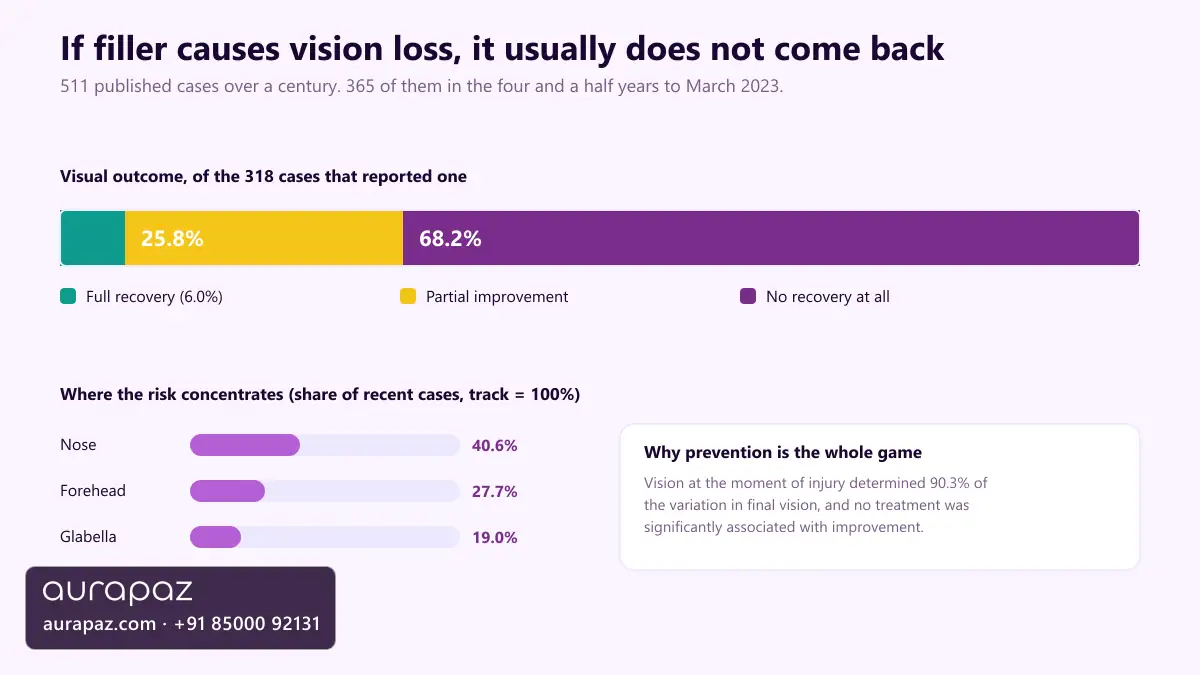
And here is the finding that should change how you choose a practitioner. In this review, no treatment was significantly associated with visual improvement once the blockage had happened. Not hyaluronidase, not anything else reported. That inverts the usual reassurance. The value of a well trained injector is not that they can rescue your sight afterwards, because the evidence says nobody reliably can. It is that they know the anatomy, the danger zones and the injection technique well enough not to cause it. Prevention is the whole game.
If you develop sudden vision changes, severe or disproportionate pain, or skin that turns white, mottled or dusky during or after a filler injection, treat it as an emergency. Get to an ophthalmologist or a hospital immediately rather than waiting to see whether it settles.
The buccal fat problem is what nobody has measured
This is the procedure I get asked about most, and it is the one where I part company with most of what is circulating online.
Two systematic reviews have appeared since 2025, and their complication estimates sit a long way apart. A 2025 meta-analysis pooled 12 studies and 308 patients, found that 81 of them had some complication, and put the overall prevalence at 25 per cent, though with a confidence interval running from 4 to 46 per cent, which is another way of saying nobody really knows. Almost all of it was short lived: of the complications recorded, swelling made up 38 per cent, jaw stiffness 30 per cent and pain 19 per cent, with facial nerve paralysis under 1 per cent. Its authors concluded the procedure should be recommended with caution, citing a lack of predictability. A 2026 review searching the literature to December 2025 pooled ten studies and 1,123 patients, and reached 39 complications across 921 procedures, or 4.2 per cent, describing satisfaction as high.
The 2026 review is explicit about the thing that actually matters here: long term outcomes were poorly assessed, because follow up in the published studies is too short. Only one study it found reported the outcome everybody argues about online, a gaunt appearance, and that was in 1.6 per cent of cases. The earlier 2021 review said much the same about the literature available to it.
So where does that leave the viral claim that a large share of patients regret it by year three and that it will hollow out your face by 45? I went looking for the source. It is not in the peer reviewed literature. It traces back to clinic blogs.
Read that carefully, because it cuts both ways. Nobody can tell you this procedure ruins faces in midlife. Nobody can honestly tell you it is fine at 30 years either, because the follow up does not exist. For something reversible, unmeasured long term effects would be a footnote. For something permanent, the absence of long term data is the finding.
In India, ask who is holding the needle
This is the part that worries me more than any individual procedure, and it barely features in the beauty conversation.
In February 2026 the Tamil Nadu Medical Council issued a clarification: only registered medical practitioners, holding recognised medical qualifications and valid registration with the state medical council, may perform aesthetic and cosmetology procedures involving skin and hair. That explicitly includes hair transplantation and laser based treatments. The Indian Association of Dermatologists, Venereologists and Leprologists and the Association of Plastic Surgeons of India have since pressed for the same rules nationwide. Be clear that this is a live dispute rather than settled national law: it turns on which qualifications count, and it has not been resolved.
The reason a council had to say something so obvious is that the gap had grown wide enough to be dangerous. As the IADVL president put it, aesthetic procedures need training beyond an MBBS: a dermatology qualification means three further years of postgraduate residency at an accredited institution. The plastic surgeons’ association was blunter still, noting that hair transplant and facial aesthetic surgery sit outside the scope of dental qualification, legally and scientifically.
Four questions are worth asking out loud, before any money changes hands:
- What is your qualification, and what is your medical council registration number? Then check that number on your state council register yourself, rather than taking a framed certificate on the wall as evidence.
- Who handles a complication, and where? For filler specifically, ask whether hyaluronidase is in the building right now, not orderable.
- What exactly are you injecting or removing, and is it reversible? If the answer is vague about the product name, stop.
- What does the correction look like if I dislike this? Compare the answer against the ladder above.
A qualified professional will not be offended by any of that. Owning a machine is not a licence to use it on your face, and a low quote is often the sound of an unqualified operator competing on price.

What actually works without a needle
I am not against procedures, and I do not think ageing is a moral test you pass by refusing help. But if you have not yet exhausted the reversible rung, you are paying permanent prices for problems that had cheaper answers.
The strongest single piece of evidence in this whole article is not about a procedure at all. In a randomised trial of 903 adults, the group told to apply broad spectrum sunscreen daily showed no detectable increase in skin ageing over four and a half years, and about 24 per cent less ageing than the group using it at their discretion. No injectable has an equivalent result on that timescale.
Alongside it, the boring list holds up better than it has any right to. Sleep, because skin repair is not negotiable and no serum substitutes for it. Enough protein, since skin and hair are built from it and Indian diets often run short. Not smoking. Managing the blood sugar swings that drive glycation. None of it photographs well as a before and after, and all of it compounds.
After that, most of what people book procedures for turns out to be something else wearing a cosmetic mask:
- Persistent dullness and shadowing is often iron or B12, not a hollow that needs filling. Our piece on B12 deficiency in Indian women covers who is at risk.
- Under eye darkness has several distinct causes, and the treatment that works depends entirely on which one you have. We went through them in dark circles under the eyes.
- Breakouts on a monthly cycle are hormonal and respond to different things than a facial. See why your skin breaks out before your period.
- Overall skin quality tracks glycation and gut health more than most people expect. Both how sugar affects your skin and how to heal your gut naturally are relevant here.
And if after all that you still want a procedure, that is a legitimate choice. Make it from the top of the ladder rather than the bottom, from a practitioner whose registration you have actually verified, and with a clear answer to the question my client had never been asked. The same scepticism is worth applying to anything sold as a shortcut, which is why we took apart the colostrum supplement boom as well.
Key takeaways
- Sort every option by reversibility, not by how dramatic it sounds. Daily habits, then botulinum toxin, then hyaluronic acid filler, then permanent tissue removal, then fat grafting.
- Injectables are not the safe end of the scale. A 2024 review found 511 published cases of vision loss after filler, and of the 318 with a reported outcome, 68.2 per cent recovered no vision. No treatment was significantly associated with improvement.
- The nose, forehead and glabella carry the most filler risk, and injected body fat carried around seven times the odds of stroke compared with hyaluronic acid.
- Gluteal fat grafting has the highest mortality of any aesthetic surgery. The task force that reshaped the field estimated somewhere between one death in 6,214 cases and one in 2,351, and thought the truth was likely worse than one in 4,000.
- For buccal fat removal, recent reviews put the complication rate anywhere from 4.2 to 25 per cent, and long term follow up is too short to judge the outcome people actually worry about. That uncertainty matters far more because it cannot be undone.
- Who may legally perform aesthetic skin and hair procedures in India is actively contested. Tamil Nadu’s medical council restricted it to registered medical practitioners in February 2026, dermatologists and plastic surgeons want that nationwide, and the position is not yet settled. Ask for a registration number and check it yourself.
- Daily sunscreen prevented detectable skin ageing over four and a half years in a randomised trial, which is a better documented result than any injectable can claim.
References & Further Reading
- Doyon VC, Liu C, Fitzgerald R, Humphrey S, Jones D, Carruthers JDA, Beleznay K. “Update on Blindness From Filler: Review of Prognostic Factors, Management Approaches, and a Century of Published Cases.” Aesthetic Surgery Journal, 2024;44(10):1091-1104. PMID 38630871.
- Mofid MM, Teitelbaum S, Suissa D, et al. “Report on Mortality from Gluteal Fat Grafting: Recommendations from the ASERF Task Force.” Aesthetic Surgery Journal, 2017;37(7):796-806. PMID 28369293.
- Pazmiño P, Garcia O. “Brazilian Butt Lift-Associated Mortality: The South Florida Experience.” Aesthetic Surgery Journal, 2023. PMID 35959568.
- Traboulsi-Garet B, Camps-Font O, Traboulsi-Garet M, Gay-Escoda C. “Buccal fat pad excision for cheek refinement: A systematic review.” Med Oral Patol Oral Cir Bucal, 2021. PMID 34023838.
- Albuquerque MC, Arruda KAR, Xavier Junior GF, et al. “Prevalence of complications of buccal fat removal: A systematic review and meta-analysis.” Journal of Cranio-Maxillofacial Surgery, 2025;53(4):363-369. PMID 39809616.
- Shapiro J, Zgardau A, Pundkay G, et al. “Aesthetic Outcomes, Complications, and Reported Long-Term Effects of Buccal Fat Pad Reduction: A Systematic Review.” Facial Plastic Surgery, 2026 (online ahead of print). PMID 42235535.
- Hughes MCB, Williams GM, Baker P, Green AC. “Sunscreen and prevention of skin aging: a randomized trial.” Annals of Internal Medicine, 2013;158(11):781-790. PMID 23732711.
- Medical Dialogues. “Doctors flag unqualified practice, misleading ads, demand stricter regulations for hair transplant, aesthetic procedures.” March 2026, reporting the February 2026 Tamil Nadu Medical Council clarification. medicaldialogues.in.