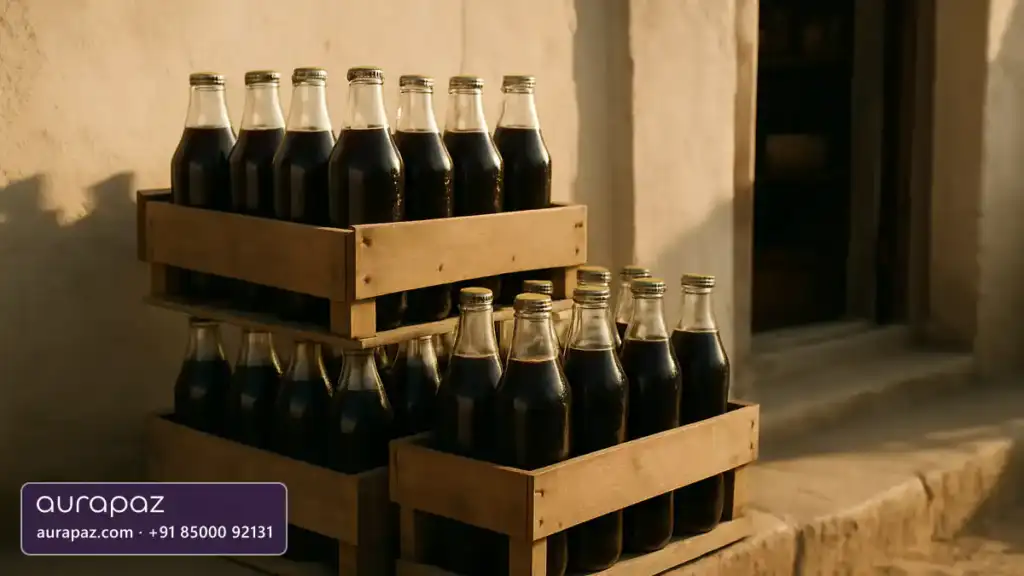
In the highlands of Chiapas, Mexico’s poorest state, people drink an average of 821 litres of soft drink per person per year. That is about 2.2 litres a day, every day, from infants to the elderly. The American average is around 98 litres. In some highland communities Coca-Cola has replaced the traditional corn and sugarcane liquor as the offering placed before the gods in healing ceremonies, and it is often drunk in place of water, because roughly 56 per cent of the state has no reliable access to a safe supply.
That is not a story about Mexican culture. It is a story about what happens when one product is cheaper, safer and more available than water, and it is the closest thing the world has to a controlled experiment in what a food environment can do to a population. Mexico then spent twelve years trying to undo it. The results are not what either side of the argument claims, and they matter for anyone reading this in the United States, because the same fight was fought here and quietly lost.
The town that drank more Coke than water
The 821 litre figure comes from researchers at the Chiapas and Southern Border Multidisciplinary Research Centre, published in 2019. San Cristóbal de las Casas sits at the centre of it, and so does a Coca-Cola FEMSA bottling plant on the edge of town that holds government concessions to extract up to 481,982 cubic metres of water a year, about 1.32 million litres a day.
The consequences arrived as you would expect. Diabetes mortality in Chiapas rose by roughly 30 per cent between 2013 and 2016. Researchers working in the highlands describe soft drinks and beer as the substances substituting for water in a population with a chronic water shortage, and treat that substitution as a direct driver of type 2 diabetes and obesity. If you want the physiology of what sustained liquid sugar does to a body, I set it out in this piece on sugar.
Notice what is doing the work here. Nobody in Chiapas chose a beverage over a vegetable. They chose a bottle that was reliably available over a tap that was not. That is a distribution story, and distribution is the part of nutrition nobody puts on a food label.
How a country gets there
There is one biographical detail that explains the politics better than any analysis. Vicente Fox began his career as a route supervisor for Coca-Cola. He became chief executive of Coca-Cola in Mexico between 1975 and 1979, grew the company’s sales in the country by about 50 per cent, went on to run its Latin American operations, and in 2000 was elected President of Mexico.
I am not suggesting anything improper. He left the company two decades before taking office. The point is narrower and more useful: the person who built the distribution network later ran the state that would have had to regulate it. When people say the food industry is close to government, this is what that looks like in practice, and it is a matter of public record rather than speculation.

Then Mexico decided to act
What followed is the most serious sustained attempt by any large country to tax and label its way out of a sugar problem.
2014: the tax
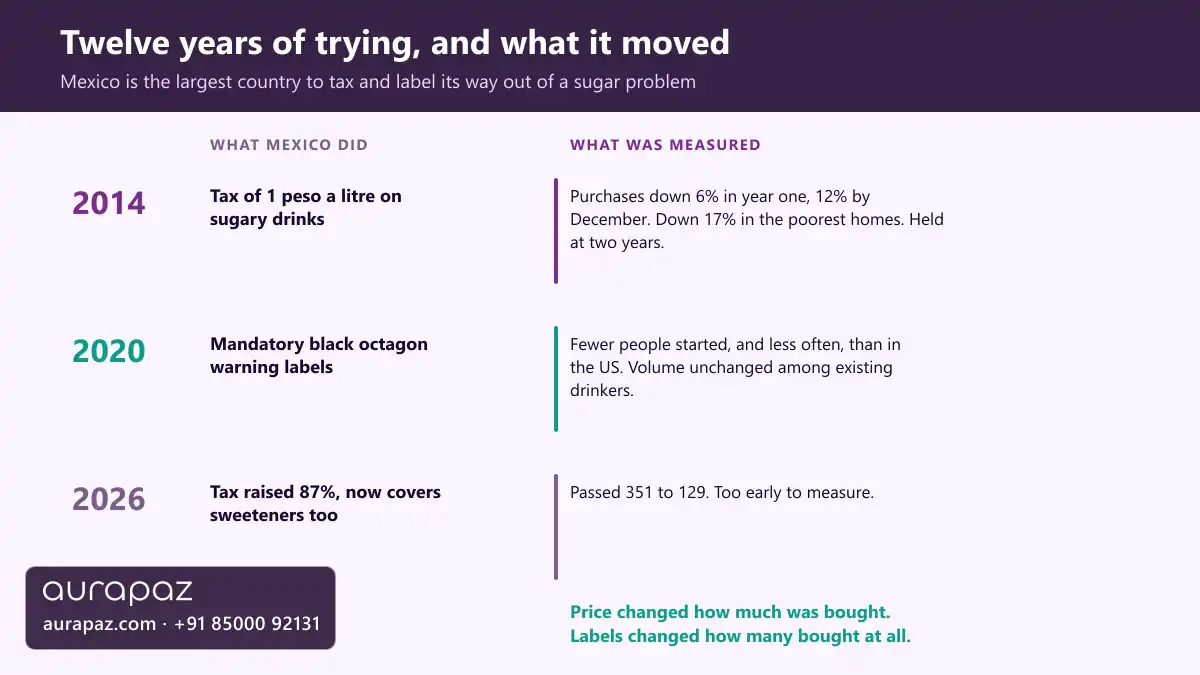
Mexico introduced an excise duty of one peso per litre on sugar-sweetened drinks. Purchases of taxed drinks fell about 6 per cent across the first year, reaching a 12 per cent drop by December. Purchases of untaxed drinks rose about 4 per cent. The effect was strongest where the health burden was heaviest: households in the lowest socioeconomic group cut their purchases by about 9 per cent on average and 17 per cent by the end of the year. Follow-up work found the response was still there two years on, rather than fading once the novelty passed.
2020: the black octagons
In October 2020 Mexico made front-of-package warning labels mandatory: blunt black octagons declaring an excess of calories, added sugars, saturated fat, trans fat or sodium. No traffic lights, no percentages, no interpretation required.
2026: the tax nearly doubles
On 1 January 2026 the duty rose from 1.64 pesos per litre to 3.08, an increase of about 87 per cent. The Chamber of Deputies passed it by 351 votes to 129. It now also covers artificially sweetened drinks, at a lower rate of 1.5 pesos per litre agreed after negotiation with the industry, Coca-Cola included. The government expects roughly 41 billion pesos in extra revenue, and President Sheinbaum framed it plainly as a response to the country’s obesity and diabetes crisis. Coca-Cola FEMSA raised its Mexican prices in response.
What the labels actually did
Here is the part almost nobody reports, and it was published in June 2026 in the CDC’s own journal.
Researchers from Mexico’s National Institute of Public Health, the University of South Carolina, Waterloo, Laval and North Carolina compared sugar-sweetened beverage intake in Mexico and the United States across six annual surveys from 2018 to 2023, covering 24,574 Mexican and 25,019 American adults. They compared the two countries before and after Mexico’s labels came in.
The findings, stated honestly:
- Soda drinking increased in both countries. In the United States the odds of drinking any sugar-sweetened beverage rose 26 per cent and the frequency rose 16 per cent.
- Mexico rose too, but by less. Up 11 per cent for any consumption, and the difference between the two countries favoured Mexico for both whether people drank soda and how often.
- Among people who already drank it, nothing changed. Volume, calories and added sugars from soft drinks did not differ between the two countries.
- One group did shift. Mexican women reduced their volume relative to American women by about 304 millilitres a week.
A warning label reaches the person who has not decided yet. It does not reach the person who already drinks two litres a day. Those are different interventions, and only one of them has been tried at scale.
That is a real effect and a modest one, and the contrast with the tax results is the lesson. The tax moved purchases, most of all in the poorest households, because it changed the price at the moment of purchase. The label changed how many people picked up a bottle at all, and did nothing to the habit of those who already had one.
Meanwhile in America
The United States ran the same experiment on a smaller scale, and got a similar answer. Philadelphia’s tax cut the volume of taxed drinks sold by roughly half compared with Baltimore, and the drop held at two years. Across Boulder, Philadelphia, Oakland, Seattle and San Francisco, purchases fell steadily rather than briefly. Berkeley research published in 2024 found something subtler: a 28 per cent decline in how socially acceptable people believed drinking sugary drinks to be. Sales of untaxed drinks, water and milk among them, rose.
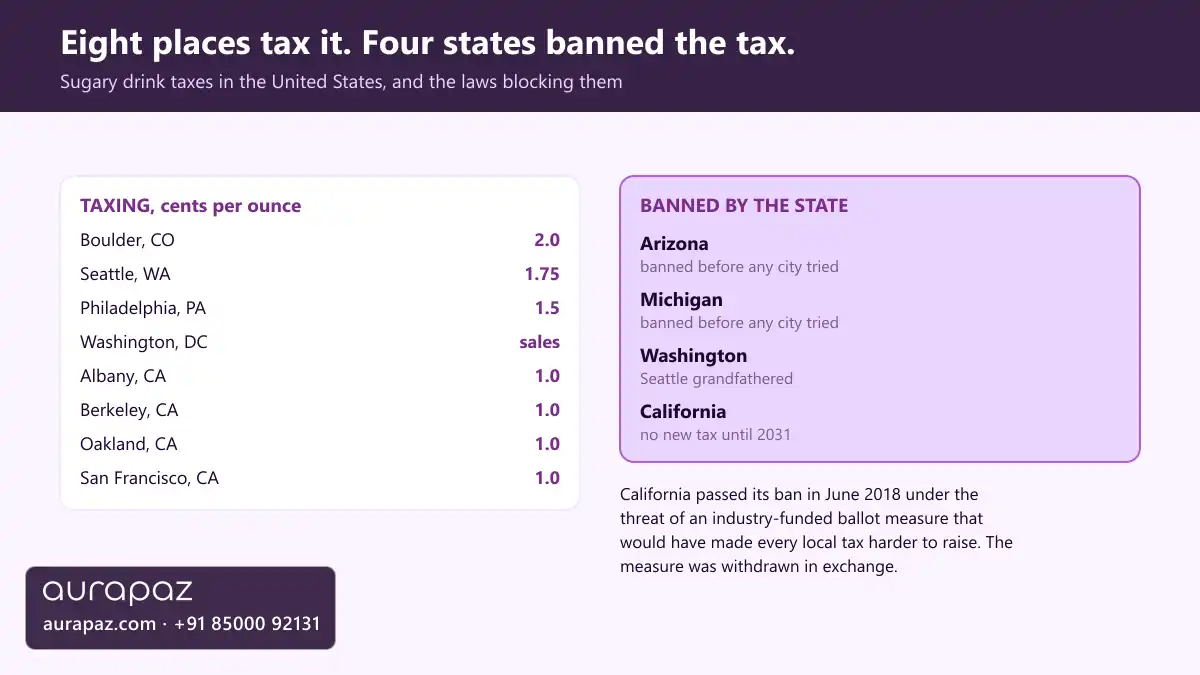
Eight American localities tax sugary drinks: Boulder at 2 cents an ounce, Seattle at 1.75, Philadelphia at 1.5, Washington DC through a sales surcharge, and Albany, Berkeley, Oakland and San Francisco at 1 cent.
Now the part that is genuinely hidden from most people. Four states have made it illegal for their own cities to introduce such a tax at all: Arizona, California, Michigan and Washington. In Arizona and Michigan the ban arrived before any city had tried. Washington grandfathered Seattle. And California, in June 2018, banned every locality in the state from adopting a new sugary drink tax for twelve years, until 2031.
Read how California’s ban happened. The legislature passed it under the threat of an industry-funded ballot initiative that would have made it drastically harder for any California city or county to raise any tax at all, for anything. The industry-backed group withdrew that measure in exchange for the soda tax ban. Legislators described voting for it with open reluctance. A state appeals court later struck down the clause that would have stripped charter cities of their sales tax revenue as punishment, but the ban itself still stands.
So the scoreboard in the United States is eight places that tax soda against four states where it is now against the law to start. That asymmetry did not come from a public health debate. It came from a negotiation.
What the trend says versus what the science says
| What the trend says | What the science says |
|---|---|
| Mexicans are addicted to Coca-Cola because of culture. | Consumption tracks water access, price and distribution. In Chiapas, where intake is highest in the world at 821 litres a head, about 56 per cent of people lack reliable safe water. Culture absorbed the product after it arrived, including into ceremony. |
| Warning labels fixed Mexico’s soda problem. | They did not. Consumption still rose after 2020, just less than in the United States over the same period, and among existing drinkers the volume did not change at all. |
| Soda taxes do not work, people just buy it anyway. | Mexico’s purchases fell 6 per cent in year one and 12 per cent by December, holding at two years. Philadelphia’s taxed volume roughly halved against a comparison city. Both effects were largest in lower-income households. |
| Soda taxes punish the poor. | The poorest households changed their purchasing the most, which is where the disease burden is heaviest, so they also gained the most health benefit. Whether that trade is fair is a political question, not a scientific one, and it deserves to be argued honestly. |
| Diet drinks are the obvious answer. | Mexico’s 2026 reform taxes artificially sweetened drinks too, at about half the rate. That was a deliberate policy choice, not an oversight, and it followed negotiation with the industry. |
| America is at least debating this openly. | Four states have preemptively banned their own cities from taxing sugary drinks. California’s ban was traded for the withdrawal of an industry-funded ballot measure and runs until 2031. |
Where this argument goes too far
Correlation is doing some heavy lifting
Chiapas is the poorest state in Mexico. It has the worst water infrastructure, the least healthcare, the highest indigenous population and the lowest incomes. Soft drinks are part of the picture, and pulling them out of that tangle and calling them the cause of the diabetes rate is more than the data supports.
The company is not the only variable
A bottling plant using a lot of water in a drought is a legitimate grievance about water policy and licensing. It is a separate question from what sugar does to a pancreas, and conflating them makes both arguments weaker. It is also worth saying that FEMSA is one of several companies drawing on the city supply rather than the only one, and that it says it provides 1,600 direct and about 15,000 indirect jobs in Chiapas. A fair criticism has to carry that too.
The label study is a natural experiment, not a trial
Nobody randomised anyone. Mexico and the United States differ in a hundred ways, and the pandemic sat in the middle of the comparison period. The authors controlled for what they could and were careful about their conclusions. So should we be.
Policy is not a personal plan
Even a good tax moves population averages by single-digit percentages. That matters enormously across 130 million people and hardly at all in your own kitchen tonight. Which is exactly why the next section exists.
What this means for your own kitchen
The most useful thing in all of this evidence is the split between the two interventions, because it tells you which lever works on which person.
If you drink a sugary drink occasionally, information is enough. You already know the numbers, and a label or an article like this will tip your decisions at the margin.
If you drink one or more every day, no label will reach you, and that is not a criticism. It is what the Mexican data shows about people in exactly that position. What moved behaviour there was friction: price at the moment of purchase. So the intervention that works is friction you install yourself.
- Stop keeping it in the house. This is the entire mechanism of a tax, reproduced for free. Make it a trip rather than an opening of a fridge door.
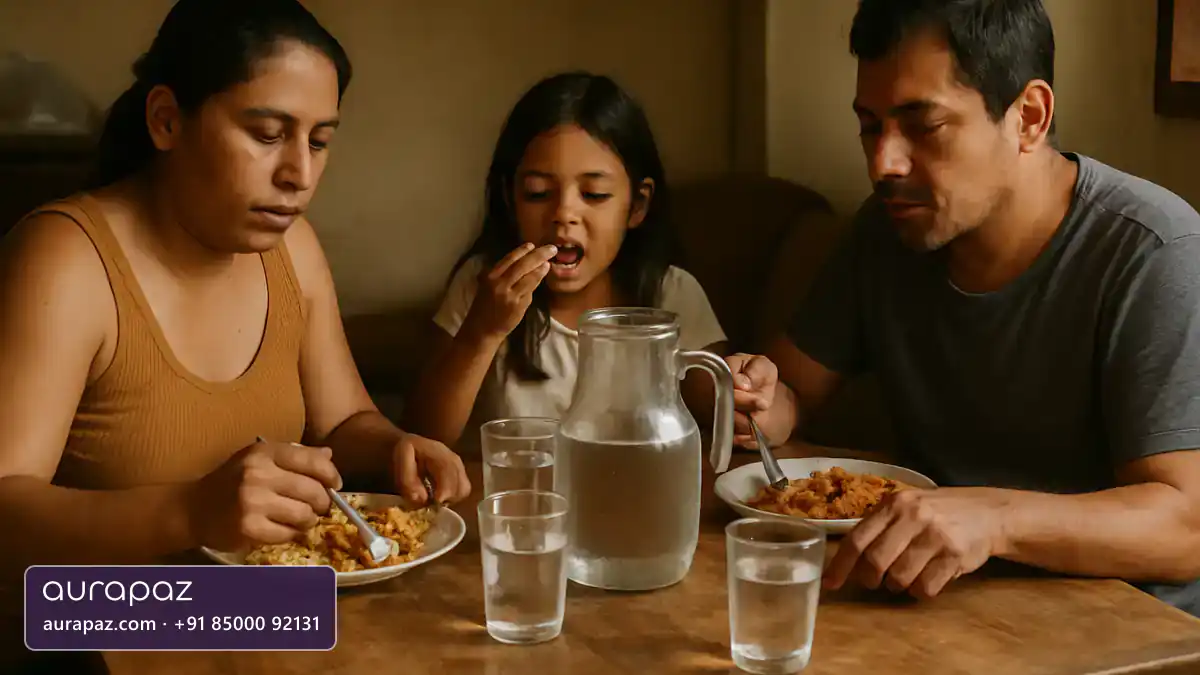
- Make the replacement available before you need it. A jug of cold water in the fridge, sparkling water if the fizz is the point, unsweetened iced tea. The Chiapas lesson is that availability beats intention.
- Do not start with elimination. Halve it first. Going from four a day to two is a bigger absolute change than going from one to zero, and it survives contact with a bad week.
- Treat fruit juice as what it is. It is not taxed in most places and it is not meaningfully different in sugar. I set out why liquid sugar behaves differently from the same sugar in food in this piece on blood sugar spikes.
- If you have children, deal with the house supply, not the child. Children in the United States already take about 64.8 per cent of their calories from ultra-processed food, and drinks are the easiest part of that to change without any negotiation.
- Watch the diet-drink swap honestly. Moving from full sugar to zero sugar is a genuine reduction in sugar and is not the same thing as drinking water. Use it as a step, not a destination.
The short version
- Chiapas drinks about 821 litres of soft drink per person per year against roughly 98 in the United States, in a state where 56 per cent lack reliable safe water.
- Vicente Fox ran Coca-Cola in Mexico from 1975 to 1979 and became President in 2000. A matter of record, not a theory.
- Mexico’s 2014 tax cut purchases 6 per cent in year one and 12 per cent by December, most in the poorest households, and the effect held at two years.
- Its 2020 warning labels changed whether and how often people drank soda, and did not change the amount among those who already drank it.
- On 1 January 2026 Mexico nearly doubled the tax and extended it to artificial sweeteners.
- Eight US localities tax sugary drinks. Four states have banned their own cities from doing so. California’s ban runs to 2031 and was traded for the withdrawal of an industry ballot measure.
- Information works on occasional drinkers. Friction works on daily ones. Build your own friction.
The reason I find this story worth telling is not that a corporation behaved like a corporation. It is that Mexico did nearly everything public health asked of it, at real political cost, and got a modest result. That should make anyone humble about labels and honest about what actually changes a habit. It also explains why my advice to a client is never a fact they already know. It is a change to what is within reach when they are tired, which is the only variable any of us reliably controls. The same logic runs through how the US food supply adds calories you never ordered and through what happens as middle-income countries industrialise their food.
References & Further Reading
- Contreras-Manzano A, Alsallum S, Davis RE, et al. Changes in Sugar-Sweetened Beverage Intake From Before to After Nutrition Labeling Policy Implementation: A Comparison of Mexico and the United States. Preventing Chronic Disease, 11 June 2026.
- Colchero MA, Rivera-Dommarco J, Popkin BM, Ng SW. In Mexico, Evidence Of Sustained Consumer Response Two Years After Implementing A Sugar-Sweetened Beverage Tax. Health Affairs, 2017.
- Silver LD, Ng SW, Ryan-Ibarra S, et al. Changes in prices, sales, consumer spending, and beverage consumption one year after a tax on sugar-sweetened beverages in Berkeley, California. PLOS Medicine, 2017.
- Global Food Research Program, UNC. Mexico’s front-of-package warning labels are improving nutrition of food supply and purchases.
- Mexico News Daily. With average daily consumption of 2.2 litres of Coca-Cola, Chiapas leads the world, reporting the CIMSUR study.
- Mexico News Daily. Drained dry: San Cristobal de las Casas and its potable water crisis.
- Encyclopaedia Britannica. Vicente Fox: Biography, Presidency and Facts.
- Crosbie E, Schmidt L. State Preemption to Prevent Local Taxation of Sugar-Sweetened Beverages.
- ChangeLab Solutions. Ruling Affirmed in California Sugary Drink Tax Preemption Lawsuit.
- Mexico Business News. Mexico Raises Health Taxes on Sugary Drinks and Tobacco for 2026.
- Berkeley Public Health. Taxes on sugar-sweetened drinks drive decline in consumption.