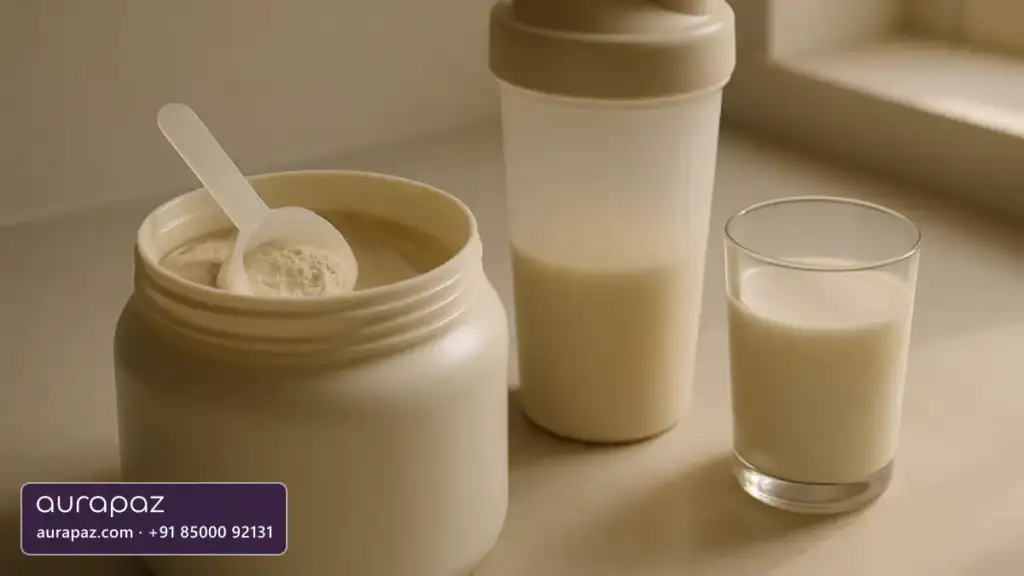
About a quarter of American adults drink a protein shake at least once a week. Almost none of them know that there is no legal limit on how much lead is allowed in the tub, that nobody checked the product before it went on sale, and that the manufacturer decides for itself what counts as an acceptable amount. That is not a conspiracy theory. It is how the law is written, and two large independent tests have now measured what it produces.
I am not going to tell you to throw your protein powder away. The honest answer is more useful than that, and it turns on one question almost nobody asks: safe according to whom?
What the tests actually found
Two separate investigations tested the American market within nine months of each other, using different sample sizes and different yardsticks.
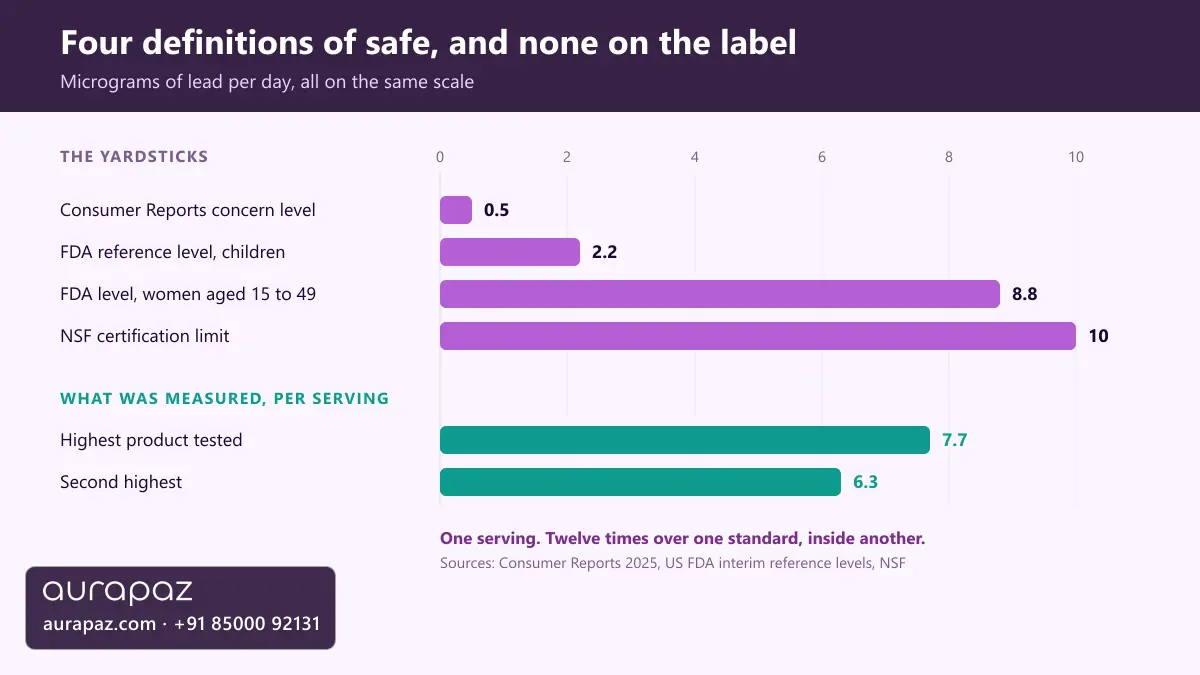
Consumer Reports bought 23 popular protein powders and ready-to-drink shakes and published in October 2025. More than two thirds of them contained more lead in a single serving than their food safety experts consider safe to consume in a whole day. The two worst carried 7.7 and 6.3 micrograms of lead per serving. Two products were flagged as ones they would not use at all. One contained 9.2 micrograms of cadmium against a 4.1 microgram daily safe level, and another contained 8.5 micrograms of inorganic arsenic, roughly twice its daily limit. The average lead level across the category was higher than when Consumer Reports ran the same test fifteen years earlier, and fewer products came back with undetectable amounts.
The Clean Label Project went wider. It bought 160 products from 70 of the best-selling brands, covering about 83 per cent of the market, and ran close to 36,000 individual tests for 258 contaminants through an independent laboratory. Forty seven per cent of products exceeded California’s Proposition 65 limit for lead, and 21 per cent came in at more than double it. That study did not name the brands, and the supplement industry publicly called it misleading.
Both tests agree on the direction and disagree on the detail. That is normal, and it is the reason to read the numbers rather than the headline. Where they conflict, I have said so below rather than picking whichever figure sounds worse.
Four numbers, and all of them are called safe
Here is the part that explains almost every confusing headline you have read on this subject. There is no single legal threshold for lead in a protein powder, so different organisations apply different ones, and they are not remotely close together.
- 0.5 micrograms a day. Consumer Reports’ level of concern, taken from California’s Proposition 65. Deliberately strict, on the reasoning that there is no known safe amount of lead.
- 2.2 micrograms a day. The FDA’s interim reference level for lead from food, for children.
- 8.8 micrograms a day. The same FDA reference level, for women of childbearing age.
- 10 micrograms a day. The limit NSF applies when it certifies a supplement.
So a powder delivering 7 micrograms a serving is a twelvefold breach of one standard, comfortably inside a second, and borderline on a third. Nobody is lying to you. They are using different rulers, and only one of them appears on any packaging, because none of them are required to.
The FDA’s reference levels are worth understanding properly, because they are the closest thing to an official number. They were set by two FDA scientists in 2022 and aligned to the CDC’s blood lead reference value of 3.5 micrograms per decilitre. Crucially they are a budget for the entire diet, not an allowance for one product. And the FDA’s own paper notes that American children eating above the average already risk exceeding the children’s level from ordinary food alone, before a single scoop of anything is added.
A protein powder that uses up your whole day’s lead budget on its own is not breaking any rule. There is no rule for it to break.
Why plant protein carries more, and why organic is not the fix
This is the finding that surprises people most, and both studies agree on it.
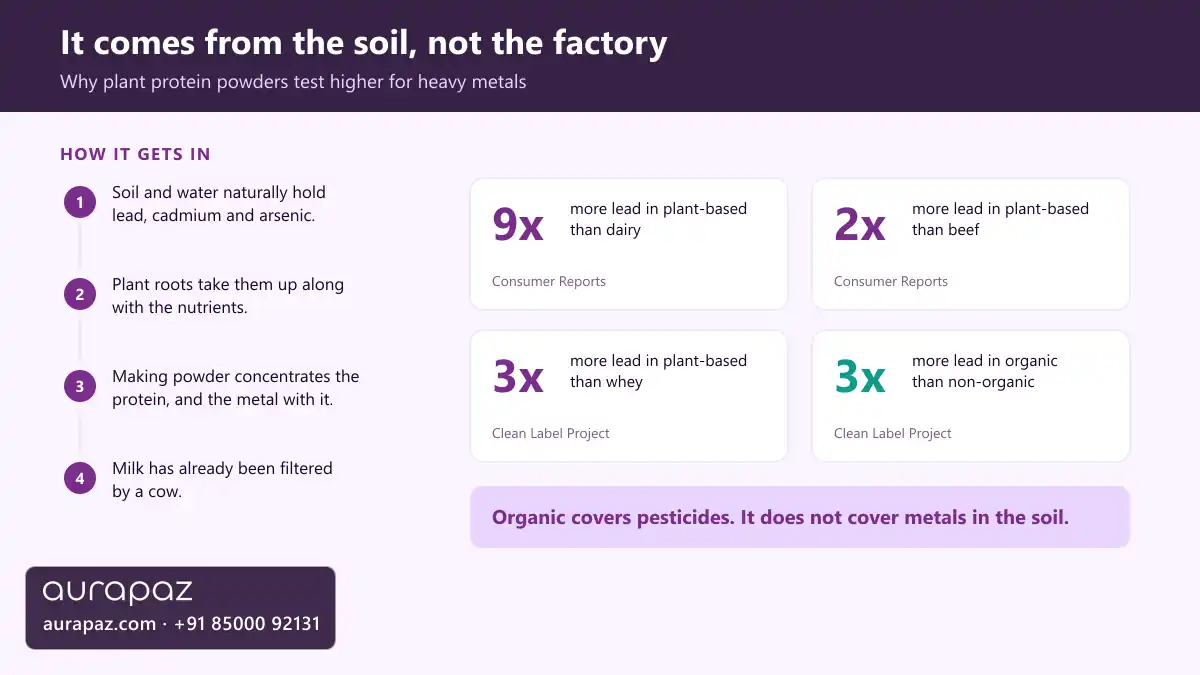
Consumer Reports found plant-based powders averaged nine times more lead than dairy-based ones, and twice as much as beef-based products. Nearly every plant-based product they tested came back elevated. The Clean Label Project measured the same effect at three times more lead than whey.
The mechanism is not sinister, it is agricultural. Lead, cadmium and arsenic sit naturally in soil and water. Plants take them up through their roots. Making a protein powder means concentrating the protein from a large volume of plant matter, and whatever came up with it concentrates too. Milk, by contrast, has already been filtered by a cow.
Which is why the next finding matters so much. The Clean Label Project found organic products averaged three times more lead and twice as much cadmium as non-organic ones. Organic certification governs pesticides, fertilisers and growing methods. It says nothing whatever about heavy metals in the soil, and organic plant proteins are often sourced differently in ways that can make the problem worse. The label most people read as “cleaner” is not measuring this at all.
The part nobody puts on the label
Under American law a dietary supplement does not need FDA approval before it goes on sale. The manufacturer is responsible for its own safety and its own testing, and it sets its own internal limit for contaminants because no external one exists.
Consumer Reports put a number on how much oversight follows. There are roughly 12,000 registered supplement manufacturers in the United States. The FDA inspected 600 of them last year. That is one in twenty, in a category where the only quality control is the one the company chooses to perform on itself and is under no obligation to publish.
A small number do publish. Consumer Reports singled out Momentous and Transparent Labs as brands that put their heavy metal testing results online. The fact that naming two companies counts as newsworthy tells you how rare it is.
What is about to change, and only in one state
On 11 February 2026, California State Senator Steve Padilla introduced Senate Bill 1033. If it becomes law, then from 1 January 2028 manufacturers selling protein products into California would have to test a representative sample of every production lot for arsenic, cadmium, lead and mercury, report the results to the California Department of Public Health, and publish the lot-specific results on their own website.
Lot-specific is the important word. A single certificate from 2023 tells you nothing about the tub in your hand, because contamination varies with the harvest and the soil it came from.
As of August 2026 the bill has cleared the Senate Health Committee and the Senate Environmental Quality Committee. It is not law. There is no federal equivalent, and the current administration’s food priorities have been aimed at ultra-processed food and ingredient transparency, which I wrote about in this piece on how the US food supply is built, rather than at supplements.
What the trend says versus what the science says
| What the trend says | What the science says |
|---|---|
| Chocolate protein powder is far worse than vanilla. | Genuinely unresolved. The Clean Label Project found four times more lead in chocolate. Consumer Reports measured 17.3 parts per billion for chocolate against 15.4 for vanilla, which is no meaningful difference. Cocoa is a known carrier of cadmium, so the effect is plausible, but one viral figure is not a finding. |
| Organic protein powder is the clean option. | For heavy metals it may be the worse option. Organic products averaged three times more lead and twice the cadmium in the larger study, because certification covers pesticides and not soil metals. |
| Plant protein is the healthier choice. | For fibre, cost and the environment there is a real case. For heavy metals it is the highest-risk category, at nine times the lead of dairy protein. |
| If it were dangerous, the FDA would have banned it. | The FDA does not approve supplements before sale, sets no enforceable heavy metal limit for them, and inspected 600 of about 12,000 manufacturers last year. |
| One serving over the limit means you have been poisoned. | No. Occasionally exceeding a daily reference figure is unlikely to cause harm. The risk from lead is cumulative, which means the thing that matters is the daily habit, not the single scoop. |
| Third-party certification guarantees a clean product. | It guarantees a product tested against that certifier’s threshold, which for NSF is 10 micrograms of lead a day, twenty times Consumer Reports’ figure. Certification is a real improvement on nothing. It is not the same as low. |
Where the alarm goes too far
C. Michael White, who chairs pharmacy practice at the University of Connecticut, published the most level-headed reading of these results, and I think he is right on every point.
Zero is not available
Heavy metals are in soil and water, so they are in food. High levels have been documented in cinnamon, dark chocolate, carrots, sweet potatoes, rice and legumes. If your standard is zero exposure, you will have to stop eating. The question is always dose and frequency, never presence.
The strictest number is aspirational, not a danger line
Consumer Reports’ 0.5 microgram figure describes where they would like exposure to be, not the point at which harm begins. Reporting “1,570 per cent of the safe limit” without saying which limit is how a real finding turns into a scare.
One bad day is not the problem
In White’s words, occasionally exceeding the daily recommended doses is unlikely to result in serious health issues. Repeated exposure is a different matter, and is linked to neurological damage, weakened bones and raised cardiovascular risk. That distinction is the whole of the practical advice: a shake now and then is not the concern, a daily scoop of the worst products for years is.
Both studies have limits
Consumer Reports tested 23 products, which is a small sample for a category this large. The Clean Label Project tested far more but did not name them, so nobody could check its work at the product level, and the industry attacked it on exactly that ground. Neither study measured anyone’s blood.
How to choose a powder, or skip it
In order of how much difference it actually makes:
- Get most of your protein from food. This is not a moral position, it is the only option with no contaminant question attached. Eggs, dairy, curd, paneer, fish, chicken, dal and pulses. Powder should be filling a gap, not carrying the day. If you are not sure how big your gap is, I set out the actual requirements in this guide to how much protein you really need.
- If you use powder daily, use a dairy-based one. Whey or casein. On both studies this is the single biggest reduction available, and it costs you nothing.
- If you need a plant protein, rotate the source and do not use it daily. Different plants pick up different metals, so varying between pea, soy and rice spreads the exposure rather than concentrating it.
- Look for NSF Certified for Sport, Informed Sport or USP. An imperfect threshold that someone verified beats an unverified claim on a tub.
- Prefer brands that publish lot-level results. Not a marketing page saying “third-party tested”, but actual numbers you can read. Very few do, and they deserve the business.
- Check the serving size on the scoop, not the label. Several of these products are dosed at two or three scoops. Every figure quoted above is per serving as the manufacturer defines it.
- Ignore the word organic for this purpose. It is answering a different question.
- Do not switch to a mass gainer casually. The two highest-lead products in the Consumer Reports test were high-volume products, which is what you would expect: more powder per serving means more of everything in it.

Who I would tell to be most careful
The reference levels themselves point at who this matters for. The FDA sets a figure four times lower for children than for adult women, because lead affects a developing nervous system in ways it does not affect a finished one.
I would not give a child a protein powder, and not because of the metals. Children who eat normally almost never need one, and I have written about how much protein children actually need. If a paediatrician has prescribed a supplement for a specific reason, follow that advice and choose a dairy-based, certified product.
If you are pregnant or trying to conceive, the same logic applies with more force, and it is worth a conversation with your doctor rather than a decision made in a supplement aisle. If you are an adult using a scoop a few times a week, dairy-based and certified, this is a genuinely small issue in the context of your whole diet.
The group I would actually worry about is the one nobody warns: adults using two or three servings of a plant-based powder every single day as a deliberate health strategy, often alongside other supplements. That is the pattern that turns a per-serving number into a cumulative exposure, and it is usually being done by the most conscientious people I see. The same thing happened with colostrum supplements and with half the powders on the shelf: the trouble starts when a supplement stops being an occasional top-up and becomes the foundation.
The short version
- More than two thirds of 23 powders tested by Consumer Reports exceeded its daily lead limit in one serving. A wider 160-product study found 47 per cent over California’s legal limit.
- There is no enforceable federal limit for lead in a protein powder, and four different bodies use figures ranging from 0.5 to 10 micrograms a day.
- Plant-based powders averaged nine times more lead than dairy. The metals come from soil, so this is agronomy, not adulteration.
- Organic tested worse, not better, because certification does not cover soil metals.
- Lead risk is cumulative. A weekly shake is not the problem. A daily plant-based scoop for years is the pattern worth changing.
- California’s SB 1033 would force lot-level testing and public disclosure from 2028. It is not law yet, and there is no federal version.
What bothers me about this story is not the lead. It is that a category marketed almost entirely on the promise of health has been allowed to police itself, and the only reason anyone knows these numbers is that two non-profits paid for the tests the law does not require. Until that changes, the useful skill is not avoidance. It is knowing which number someone is quoting at you, and asking who chose it.
References & Further Reading
- Consumer Reports. Protein Powders and Shakes Contain High Levels of Lead. October 2025.
- Consumer Reports. Answering Your Questions About High Lead Levels in Protein Powders and Shakes.
- Clean Label Project. Nearly Half of Top-Selling Protein Powders Exceed Safety Thresholds for Heavy Metal Contamination, and the full category whitepaper. January 2025.
- NutraIngredients. Clean Label Project puts protein powder under the microscope, critics call the report misleading. January 2025.
- White CM. Protein Powders and Shakes Contain High Amounts of Lead, New Report Says: A Pharmacologist Explains the Data. University of Connecticut, October 2025.
- NPR. Consumer Reports finds lead in popular protein powders. 16 October 2025.
- Flannery BM, Middleton KB. Updated interim reference levels for dietary lead to support FDA’s Closer to Zero action plan. Regulatory Toxicology and Pharmacology, 2022.
- California State Senator Steve Padilla. State Senate Advances Protein Safety Bill Targeting Heavy Metal Contamination. 2026.
- Environmental Working Group. California Senate health panel advances bill to test protein powders for heavy metals. March 2026.
- NSF. Supplement and Vitamin Certification.