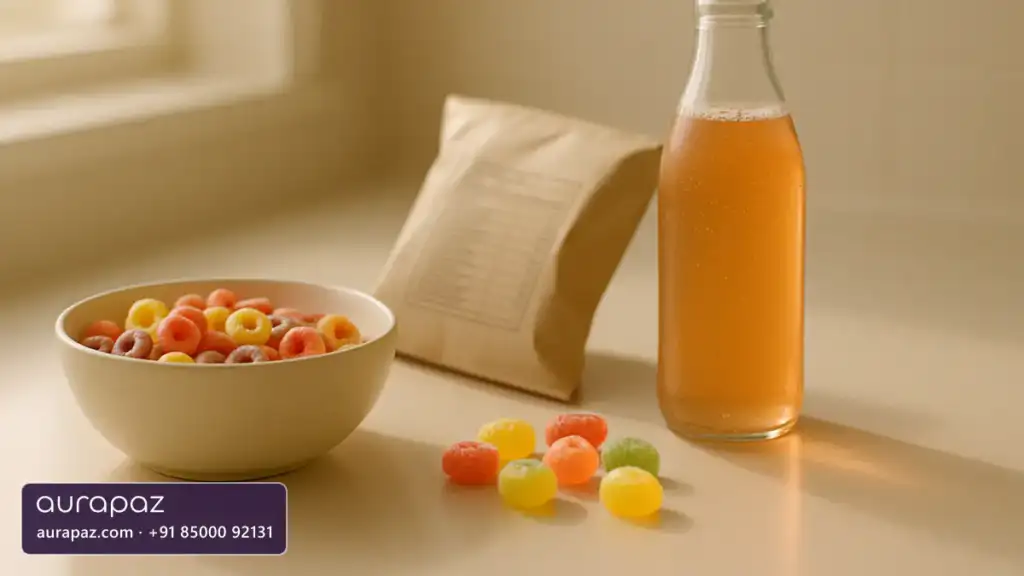
A packet of sweets in an American supermarket this month can carry the words “No artificial colors” on the front, contain added colour, and be exactly as sugary as the version sold last year. None of that is a loophole or a scandal. It is what the rules actually say, and the gap between what the label states and what a parent hears is where most of the confusion about food dyes now lives.
Over the past eighteen months the United States has moved faster on synthetic food colours than it has in decades. Headlines called it a ban. It is not a ban, and understanding the difference matters, because the change on your shelf is real but much narrower than the coverage suggests.
What actually changed, and what did not
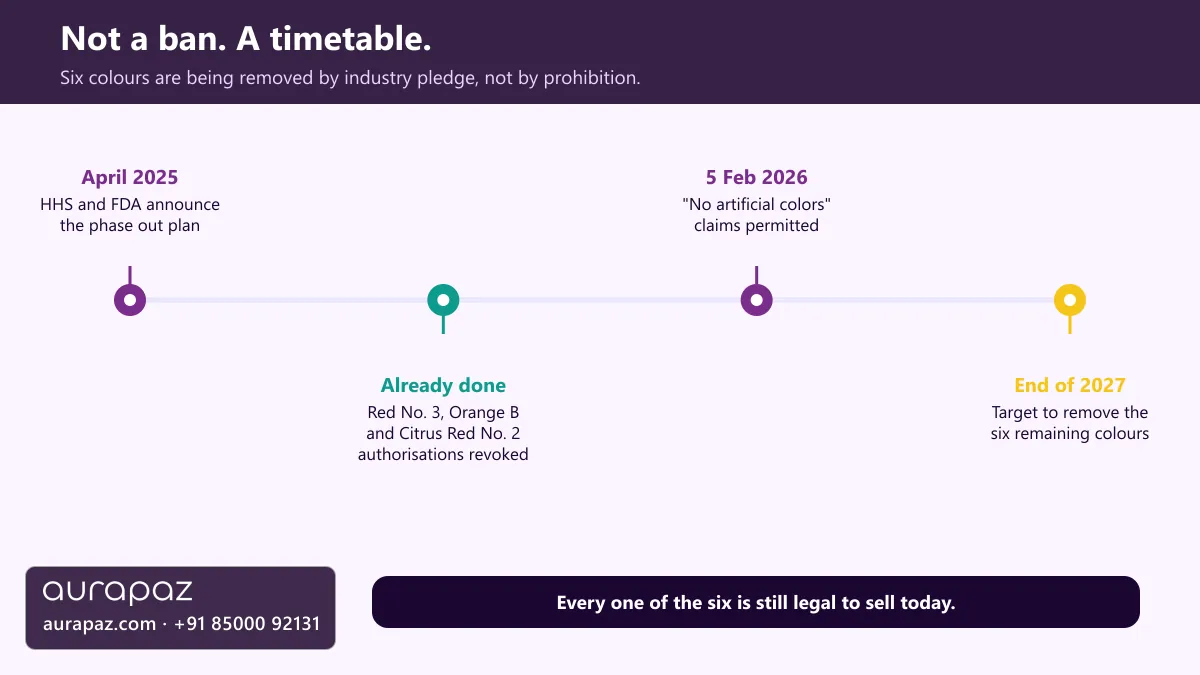
In April 2025 the Department of Health and Human Services and the Food and Drug Administration announced a plan to move the American food supply away from petroleum based synthetic colours. As of the FDA’s own tracker, updated on 11 August 2026, six certified colours are on the list to go: FD&C Green No. 3, Red No. 40, Yellow No. 5, Yellow No. 6, Blue No. 1 and Blue No. 2. The target is the end of 2027.
Here is the part that gets lost. The FDA describes itself as “working closely with food manufacturers, retailers, and trade associations” to eliminate those six. That is a voluntary programme built on company pledges, not a prohibition with a legal deadline. The agency publishes a tracker of who has promised what, which tells you something in itself: if these were banned, a tracker of promises would be unnecessary.
Two colours did go through a genuine regulatory route. The authorisations for Orange B and Citrus Red No. 2 have been revoked. So has the authorisation for FD&C Red No. 3, the one colour in this story that was actually withdrawn by regulation rather than by request. Red No. 3 is worth separating out, because its removal rested on a legal obligation about animal carcinogenicity, not on the behavioural evidence that drives most parental worry.
The short version: one colour was withdrawn by law, two had their authorisations revoked, and six are being phased out by agreement with industry by the end of 2027. Nothing about that timetable stops a manufacturer selling Red No. 40 today.
What “no artificial colors” is allowed to mean
On 5 February 2026 the FDA sent a letter to the food industry that changed the front of the pack more immediately than the phase out will. It said the agency does not intend to take enforcement action against three claims: “Made without artificial food colors/colorings”, “No artificial color/colors/coloring”, and “No added artificial color/colors/coloring”.
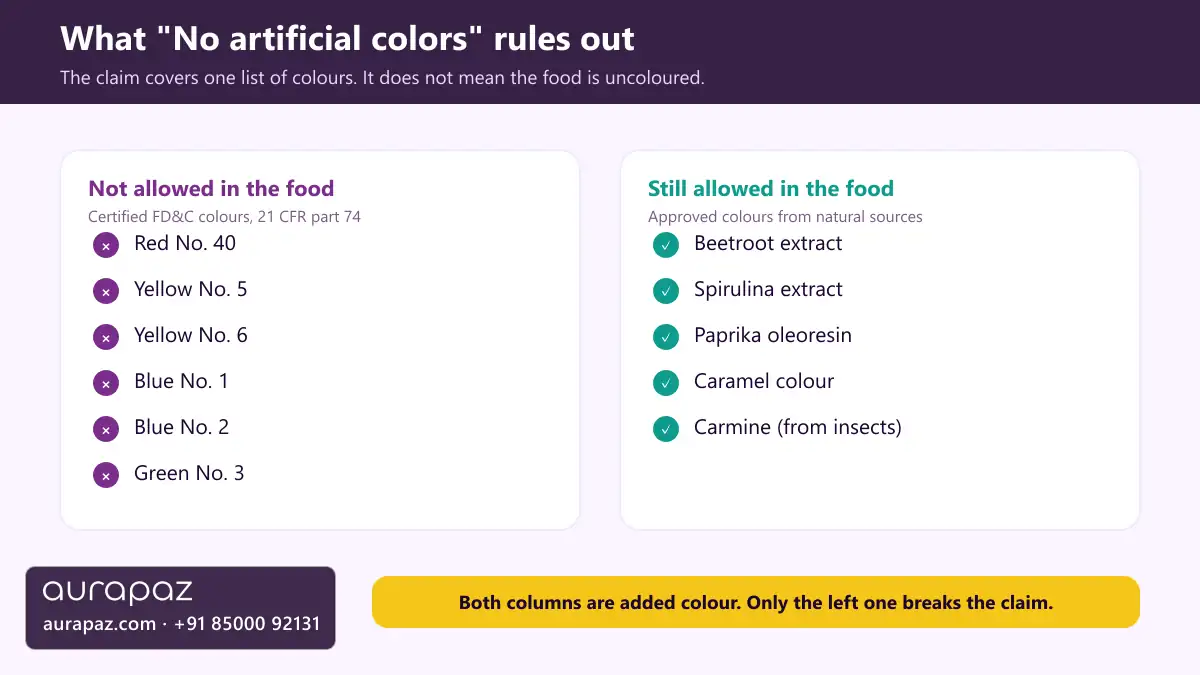
The condition is specific. The food must contain none of the certified colours listed in 21 CFR part 74. That is the list of synthetic FD&C colours. It is not a requirement that the food contain no added colour at all. The letter is explicit that colours derived from natural sources are still permitted, and must still be approved by the FDA under the separate petition process in 21 CFR part 71.
So a product carrying “No artificial colors” may well be coloured. It may contain beetroot extract, spirulina, paprika oleoresin, caramel colour or carmine, which comes from insects. Every one of those is an added colour additive. None of them is an FD&C certified colour, so none of them contradicts the claim.
This is not deception. It is a precise regulatory statement that happens to sound, to an ordinary shopper in a hurry, like a much broader promise about the food inside. Lawyers writing about the policy have been careful to point out that it offers flexibility rather than a legal safe harbour, and that state enforcement and private litigation risk have not gone away.
Myth versus science
| What the trend says | What the science says |
|---|---|
| “America has banned artificial food dyes.” | Six certified colours are being phased out by voluntary industry pledge, targeted at the end of 2027. Red No. 3, Orange B and Citrus Red No. 2 had authorisations revoked. The other six remain legal to sell today. |
| “‘No artificial colors’ means nothing was added to colour it.” | It means the food contains no FD&C certified colour from 21 CFR part 74. Approved naturally derived colours are still allowed, and still count as added colour additives. |
| “Dye free means the product is now a healthy choice.” | Replacing Red No. 40 with beetroot extract changes the colour source. It does not change the sugar, the salt, the fat or how heavily the product is processed. |
| “Food dyes cause ADHD.” | California’s health hazard assessment found synthetic dyes can affect activity and attention in some children, with sensitivity varying between individuals. Affecting attention in susceptible children is a different claim from causing a clinical disorder. |
| “If a colour is legal, it must be fine for children.” | The European Union has required a warning label on six colours since July 2010. American acceptable intake levels were set decades ago and, per the California review, may not have been set with children’s behaviour in mind. |
What the evidence on children actually says
The most careful public assessment of this question came from California’s Office of Environmental Health Hazard Assessment, whose final report was released on 16 April 2021. Its reviewers went through 27 clinical trials in children and concluded that eating synthetic food dyes can result in hyperactivity and other neurobehavioural problems in some children, that children differ considerably in how sensitive they are, and that the federal levels considered safe may not adequately protect children’s behavioural health, having been set decades earlier without this newer research in view.
That is a serious finding from a serious body, and it is the strongest reason to take the question seriously rather than dismiss it. It is also narrower than the way it usually travels. “Some children, with varying sensitivity” is not “all children”, and an effect on activity and attention is not a diagnosis.
Europe reached a similar place by a different route. Under Regulation (EC) No 1333/2008, since 20 July 2010, six colours known as the Southampton Six must carry the words “may have an adverse effect on activity and attention in children” on the label. Those six are tartrazine (E102), quinoline yellow (E104), sunset yellow (E110), carmoisine (E122), ponceau 4R (E124) and allura red (E129). Allura red is the same colour Americans know as Red No. 40.
The honest complication: the trial that prompted that label has been criticised on exposure grounds. Scientists at University College Dublin pointed out that reaching the intakes used in the study would require a child of seven to ten to eat roughly four 56 gram bags of sweets a day, which would put about half their daily calories into confectionery. If a child is eating that way, the colouring is not the first thing I would want to talk about.
A more useful way to think about it. The foods that carry the most synthetic colour are, almost without exception, the foods that also carry the most sugar and the least fibre: sweets, iced cereals, frosted bakery items, brightly coloured drinks. The dye is a marker of the category. Reducing that category helps for reasons that have nothing to do with the colour.
Why a dye free label is not a health claim
This is the point I make most often to parents, and it is the reason I think the labelling change deserves more scepticism than the phase out. When a manufacturer reformulates a bright pink cereal to use beetroot instead of Red No. 40, the cereal is not more nourishing. Its sugar content is unchanged. Its fibre content is unchanged. Its place in the day is unchanged.
What has changed is that the front of the pack can now carry a phrase that reads like reassurance. That is a genuine risk to families, because “no artificial colors” can quietly move a product from the occasional column into the everyday column in a parent’s mind. If you want a fuller account of how formulation choices shape how much we eat, I have written about how the American food supply is engineered to encourage overeating, and about what the ultra processed label does and does not tell you.
Nothing in the dye story changes the ordinary business of feeding a child well: enough protein, enough fibre, enough iron, a reasonable rhythm to the day. If protein is the part you are unsure about, my guide to protein for children covers the amounts and the practical sources. And the wider American dietary advice was itself rewritten this year, which I unpacked in what actually changed in the 2025 to 2030 Dietary Guidelines.

How to read a label without a chemistry degree
Turn the packet over. Every claim on the front is marketing that has been cleared by a regulator. The ingredients list on the back is the only part that has to tell you what is in the food.
- Look for colours by name, not by category. In the United States, certified colours are named: Red 40, Yellow 5, Blue 1. In Europe and much of Asia they appear as E numbers or INS numbers. Either way they sit near the end of the list.
- Treat “no artificial colors” as information about one ingredient class, and nothing else. It says nothing about sugar, salt, fat, fibre or processing.
- Read the sugar figure before you read any front of pack claim. It is the number most likely to matter for a child eating that product regularly.
- Naturally derived is not the same as inert. Carmine is a common cause of allergic reaction in a small number of people, and it is not vegetarian. If either matters in your household, the word “natural” will not tell you.
Who should pay closer attention
I would not ask a family with no particular concern to audit every packet for colour. The evidence does not support that level of anxiety, and it crowds out changes that matter more.
I would pay closer attention in three situations. If a child has a diagnosed attention difficulty and a parent has noticed a repeatable pattern around particular foods, a structured trial of removing the coloured items for two to three weeks is reasonable, and worth doing with your paediatrician rather than alone. If a child is eating brightly coloured confectionery or drinks most days, the issue is the quantity of that category. And if there is a known additive sensitivity or a carmine allergy in the family, the ingredients list is the only reliable guide.
None of this is a reason to remove a food a child depends on, or to build fear around eating. If a restrictive approach is being considered for a child with a diagnosis, please involve the clinician who made that diagnosis. Elimination without supervision costs more than it gains.
Key takeaways
- Six FD&C colours are being phased out in the United States by voluntary industry pledge, targeted at the end of 2027. Red No. 3, Orange B and Citrus Red No. 2 had authorisations revoked. The six are still legal to sell now.
- Since 5 February 2026 a “No artificial colors” claim means only that the food contains no certified FD&C colour. Approved naturally derived colours are still permitted.
- California’s 2021 assessment of 27 clinical trials found synthetic dyes can affect activity and attention in some children, with sensitivity varying. That is not the same as causing ADHD.
- The European Union has required a warning label on six colours since July 2010, including allura red, which is Red No. 40.
- Swapping a synthetic colour for a natural one changes the colour, not the sugar, the fibre or the degree of processing.
- Read the ingredients list, not the front of the pack. The claim is regulated, narrow, and easy to over-read.
References & Further Reading
- US Food and Drug Administration. Tracking Food Industry Pledges to Remove Petroleum Based Food Dyes. Updated 11 August 2026.
- US Food and Drug Administration. Letter to the Food Industry on “No Artificial Colors” Labeling Claims. 5 February 2026.
- California Office of Environmental Health Hazard Assessment. Health Effects Assessment: Potential Neurobehavioral Effects of Synthetic Food Dyes in Children. Final report, 16 April 2021.
- California Office of Environmental Health Hazard Assessment. Report Links Synthetic Food Dyes to Hyperactivity and other Neurobehavioral Effects in Children.
- European Union. Regulation (EC) No 1333/2008 on food additives, Annex V: colours requiring the activity and attention warning.
- University College Dublin. New EU food label to warn against hyperactivity in children based on inaccurate consumption levels, say scientists.
- US Food and Drug Administration. Color Additives: Information for Consumers.