
In 2019, twenty adults moved into a hospital ward at the National Institutes of Health and handed over control of their food for a month. Two weeks on meals built from ultra-processed products, two weeks on meals built from whole ingredients, and the two menus were matched on paper for calories offered, sugar, fat, salt, fibre and carbohydrate. Nobody was told to restrict anything. They ate as much or as little as they wanted. On the ultra-processed fortnight they ate about 500 calories a day more, and they gained just under a kilo. They did not report feeling hungrier. They did not report enjoying the food more. They simply ate more, and they did not notice.
That single study is the honest answer to a question I get from American clients almost every week, usually phrased as an accusation: are food companies making us eat three or four times what we need? The number is wrong, and I will come back to why. The suspicion behind it is not.
The 500 calories nobody ordered
The NIH trial matters because of what it removed. Most nutrition research asks people what they ate and then tries to correct for the fact that we all under-report. This one locked the door. Every gram was weighed, energy expenditure was measured in a respiratory chamber and by doubly labelled water, and the two menus were deliberately matched so that the usual suspects could not take the blame. Same calories on the table. Same sugar. Same salt. Same fibre. Same fat.
The difference was 508 calories a day, eaten voluntarily, by people who had no target to hit and no reason to perform. Two weeks later they had gained 0.9 kg. Over the whole-food fortnight the same twenty people lost the same amount. Kevin Hall, who ran the study, was careful about what he claimed afterwards: it proved the effect was real without proving which feature of the food caused it.
This is why “just eat less” lands so badly with people who are genuinely trying. In a locked metabolic ward, with matched nutrients on offer and no stress, no advertising and no supermarket, the processed menu still pulled an extra 500 calories a day out of people. Whatever that is, it is not a character flaw.
It is not the ingredients, it is the clock
The most useful follow-up came from Wageningen in 2023, and it is the study almost nobody quotes because it complicates the popular version of this argument. Eighteen adults ate four different one-day menus in a crossover design, and the researchers varied two things independently: how processed the food was, and how hard it was to chew.
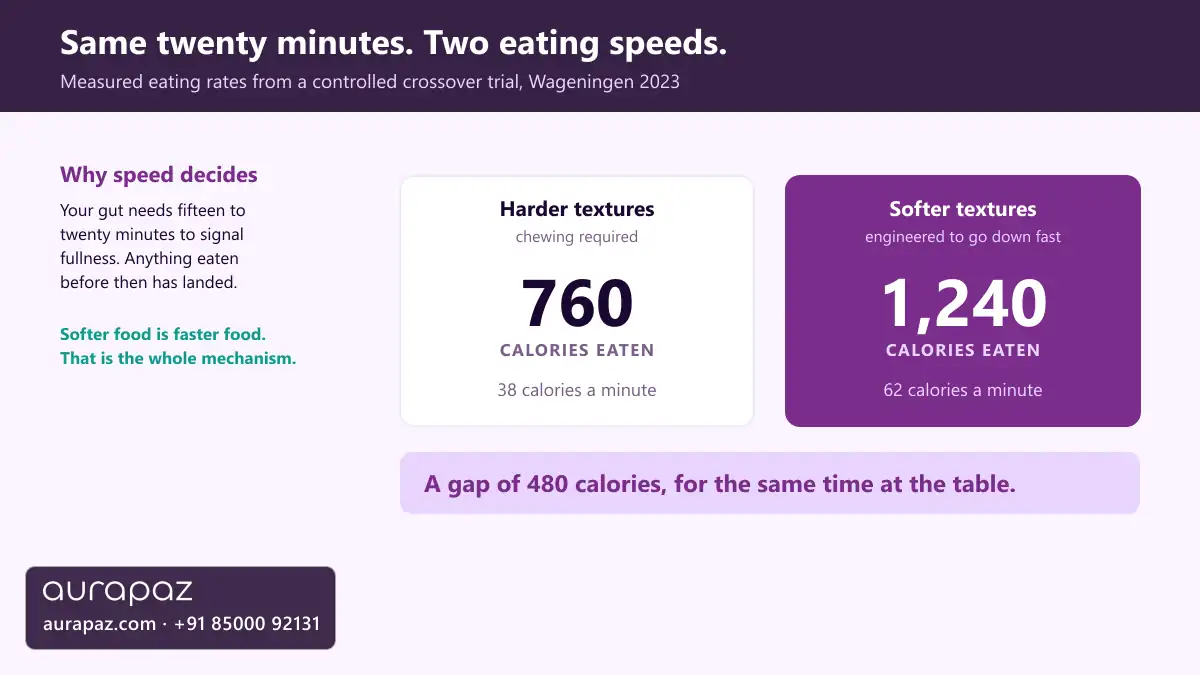
The soft menus produced 571 more calories a day than the hard menus, a difference of 33 per cent. Eating rate went from 30 grams a minute on the hard textures to 52 grams a minute on the soft ones. In energy terms, the hard menus delivered about 38 calories a minute and the soft ones delivered between 62 and 77.
Here is the part that should change how you read every viral post about additives and emulsifiers: once texture was accounted for, processing level on its own made no significant difference at all. The additives were not the calorie mechanism. Softness was.
Your gut needs roughly fifteen to twenty minutes to tell your brain it has had enough. Food engineered to be eaten at seventy calories a minute wins that race every time.
Work the arithmetic on their own measured numbers. Twenty minutes of eating at 62 calories a minute delivers about 1,240 calories. The same twenty minutes at 38 calories a minute delivers about 760. The gap is roughly 480 calories, which is almost exactly the surplus the NIH ward measured by a completely different route. Two studies, two methods, one answer.
Soft, quick, low-resistance food is not an accident of manufacturing. It is cheaper to produce, it lasts longer on a shelf, it appeals across every age group including people with poor teeth, and it is more pleasant to eat in a hurry. Every one of those is a legitimate commercial reason. The calorie consequence is a side effect that nobody has to intend for it to happen to you.
Your plate grew, and your sense of normal grew with it
The second mechanism is simpler and much older. We finish what we are served. Give someone a bigger container and they eat more from it without reporting greater fullness, and without adjusting the next meal downwards to compensate.
Marion Nestle and Lisa Young documented the American version of this in 2002. Marketplace portions started growing in the 1970s and rose sharply through the 1980s, and by the time they weighed them almost every category exceeded the federal serving standard, some by several multiples. The curve tracked body weight closely enough that they argued portion size deserved to be treated as a cause rather than a symptom.
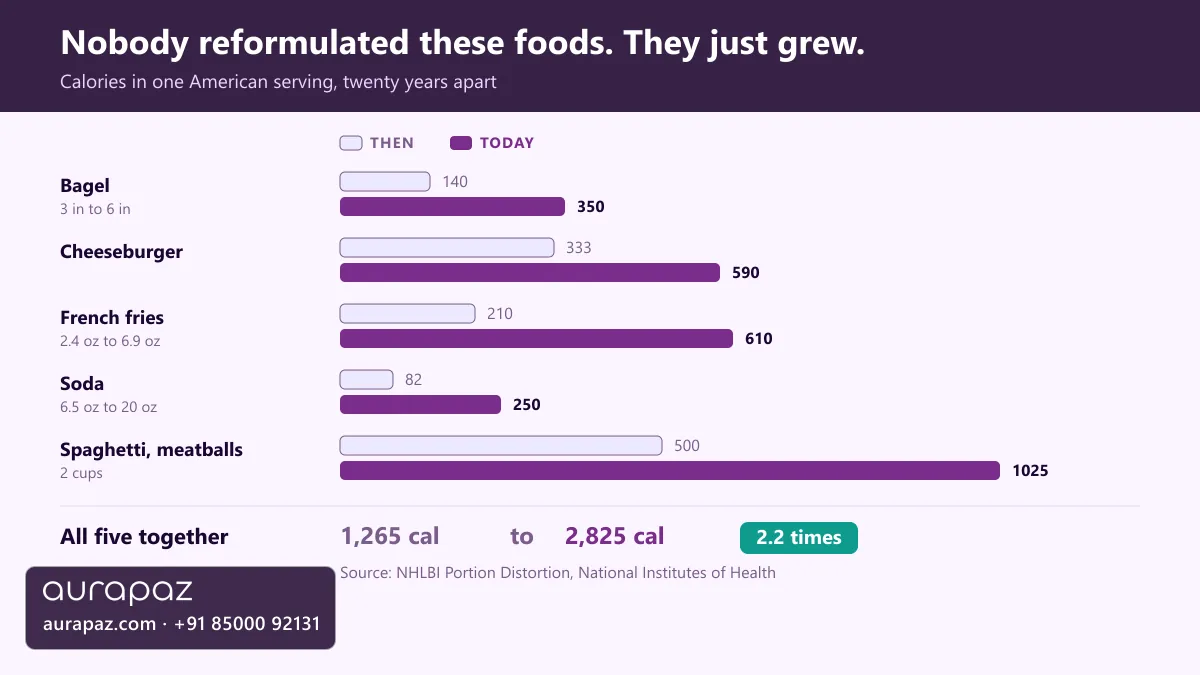
The National Heart, Lung, and Blood Institute turned the same data into a public quiz, and the individual comparisons are far more persuasive than any percentage:
| Same food | Twenty years ago | Today |
|---|---|---|
| Bagel | 3 inches, 140 cal | 6 inches, 350 cal |
| Cheeseburger | 333 cal | 590 cal |
| French fries | 2.4 oz, 210 cal | 6.9 oz, 610 cal |
| Soda | 6.5 oz, 82 cal | 20 oz, 250 cal |
| Spaghetti and meatballs | 500 cal | 2 cups, 1,025 cal |
Five foods. The old versions came to 1,265 calories, the current versions to 2,825. Nothing on that list was reformulated to be more fattening. It was only ever made bigger, and each increase was small enough at the time that it read as generous rather than absurd.
Go back further and the multiple gets closer to the number my clients throw at me. The CDC has put the average restaurant meal at roughly four times its 1950s size. An order of McDonald’s fries in 1955 was 2.4 ounces and today’s large is 5.9, with the old Supersize at 7.1. The only soda size on the 1950s menu was seven ounces, which is less than half of today’s small.
Fifty five per cent of American calories, and more for children
So how much of the American diet is now built this way? The CDC published the cleanest recent answer in August 2025, using national survey data collected between August 2021 and August 2023. Ultra-processed foods supplied 55.0 per cent of all calories for Americans aged one and over.
Split it by age and the picture sharpens into something I find much harder to be calm about. Adults sat at 53.0 per cent. Children and adolescents aged one to eighteen sat at 61.9 per cent. Six to eleven year olds were the highest group in the country at 64.8 per cent, with twelve to eighteen year olds just behind at 63 per cent.
Read that as a parent rather than as a statistician. Nearly two thirds of what the average American nine year old eats comes from products formulated to be eaten quickly. That child is not making a nutritional decision. They are eating what is in the house, in the lunch queue and in the vending machine, and in every one of those places the fastest-eaten option is also the cheapest and the most available. I have written separately about how much protein children actually need and why most lunchboxes miss it, and this is the same problem seen from the other side.

The industry has already told you how big this is
On 10 August 2026, the Department of Health and Human Services and the Department of Agriculture confirmed they had submitted the federal government’s first proposed definition of ultra-processed food for final review. They did not say what the definition was. Alongside it, HHS proposed that manufacturers should have to notify the FDA whenever they decide for themselves that an ingredient is generally recognised as safe, a determination they have been allowed to make privately for decades.
The response from the industry is the most revealing part of this whole story. The Consumer Brands Association, which represents PepsiCo, Nestle and Kraft Heinz, called the proposal fundamentally flawed. Their spokesperson’s exact objection was this: “Any so-called definition that captures 80% of the nation’s food supply while picking winners and losers is fundamentally flawed.”
Read that carefully. The trade association is not disputing the figure. It is not arguing that only a small corner of the supply would be caught. It is telling the government that 80 per cent of American food would fall inside the definition, and objecting that catching it would be unfair.
You do not need a conspiracy after that. You need a market in which the fast-to-eat version of every food is the cheapest, the most advertised, the most available and the most convenient, and in which the incentive to make food slower to eat does not exist because nobody is paid for satiety.
Meanwhile the labelling still is not there. The new Dietary Guidelines, published in January 2026, swapped the phrase “ultra-processed” for “highly processed” and then declined to define either, which I covered in detail in my breakdown of what actually changed in the new guidelines. The FDA’s proposed front-of-pack label, which would flag saturated fat, sodium and added sugars as low, medium or high, has been sitting in the rulemaking process since January 2025 and may be finalised this spring. Until it arrives, the back of the packet is the only honest label on it.
What the trend says versus what the science says
| What the trend says | What the science says |
|---|---|
| Food companies have Americans eating three to four times more calories than they need. | Reported intake averages about 2,155 calories a day against a need of roughly 2,000 to 2,200, and even correcting for heavy under-reporting that is nearer 1.3 times, not three. What genuinely grew three to four times is the serving, not the stomach. |
| Ultra-processed food is dangerous because of the additives. | In the only trial that separated the two variables, texture explained a 571 calorie a day difference and processing level on its own explained none of it. Additives may matter for other health reasons. They are not the calorie mechanism. |
| People overeat because they lack discipline. | Twenty adults in a locked metabolic ward, with both menus matched for calories offered, ate 508 calories a day more on the processed one and reported no difference in hunger or satisfaction. |
| Ultra-processed simply means packaged or frozen. | The classification is about industrial formulation, not packaging. Tinned pulses, frozen vegetables, plain yoghurt and dried pasta are not ultra-processed. A protein bar and a flavoured yoghurt drink are. |
| The answer is to eliminate all ultra-processed food. | It supplies 55 per cent of American calories, so total elimination is a time and money luxury most households do not have. Removing the fastest-eaten items does most of the work for a fraction of the effort. |
| Ultra-processed food is now legally defined in the United States. | As of August 2026 the first federal definition has only been submitted for final review and its contents have not been published. The current Dietary Guidelines use the phrase without defining it. |
Where this argument goes too far
I would be doing exactly what I am criticising if I overstated the evidence, so here is what it does not support.
The trials are small
The NIH study was twenty people for four weeks. The Wageningen study was eighteen people across four single days. Both are tightly controlled, which is precisely why they are convincing about mechanism, and both are far too small to tell you what happens across a population over years. They tell you the effect is real. They do not tell you its size in your kitchen.
The category is a research tool, not a shopping list
The classification everyone quotes puts shop-bought wholemeal bread, plain wholegrain breakfast cereal and supermarket hummus in the same bracket as a doughnut. That is defensible for epidemiology and useless at the shelf. Anyone telling you to avoid an entire category without distinguishing between the items inside it is not reading the research, they are reciting the headline. I unpicked where that panic is right and where it misleads in this piece on ultra-processed foods.
The observational data cannot carry the weight put on it
The studies linking ultra-processed intake to mortality and heart disease are largely observational. People who eat the most of it also tend to earn less, smoke more, sleep worse and eat fewer vegetables. Statistical adjustment helps, and it does not settle the question.
Engineered is not the same as poisoned
Nothing described here is illegal, secret or malicious. Cheap, shelf-stable, fortified food has kept an enormous number of people fed, and the same industrial capacity that softened the food supply also wiped out a long list of deficiency diseases. The problem is proportion, not the existence of the technology. That distinction matters, because “they are poisoning us” leads to paralysis, while “the default is fast and I can change the speed” leads to dinner.
What actually slows a meal down
Every recommendation below follows from the same two findings: resistance lowers eating rate, and eating rate decides how much food lands before satiety arrives. None of it requires you to identify an emulsifier.
- Pick the harder version of the same food. A whole apple instead of apple purée or juice. Steel-cut oats instead of instant. Whole nuts instead of nut butter. Chicken on the bone instead of mince. Roasted chickpeas instead of crisps. The nutrition label barely moves. The eating rate halves.
- Put one thing on the plate that has to be chewed. Raw carrot, cucumber, radish, a salad with stalks left in it, a piece of fruit with the skin on. It is the cheapest intervention available and it works simply by taking up time.
- Turn liquid calories back into food. A smoothie is a meal drunk in ninety seconds. Eat the fruit and drink water alongside it.
- Serve onto a plate and make seconds a separate decision. Not because willpower improves, but because the second decision gives satiety a chance to arrive before it is made.
- Buy the portion instead of portioning the purchase. The larger bag is better value per gram and worse value per calorie eaten, because almost nobody re-seals it.
- Give the meal twenty minutes on the clock. Not chewing counts, not a mindfulness script. Just twenty minutes, sitting down, food on a plate.
- Read the ingredient list, not the front of the pack. Until the federal definition and the front-of-pack label arrive, the ingredient list is the only part of the packaging that is not marketing.
- Lead with protein and fibre. Both slow gastric emptying and both take longer to eat. If you want the detail on why the glucose curve everyone is tracking follows from this, I covered it in this piece on blood sugar spikes.

Where I would start this week
If you change one thing, change breakfast. It is the meal most likely to be entirely ultra-processed and the one where a swap costs the least effort. Cereal, a flavoured yoghurt, a pastry and a juice can be eaten in four minutes and will not hold anyone until lunch. Eggs, plain yoghurt with whole fruit and nuts, or oats made from actual oats take fifteen minutes to eat and hold for four hours.
Try this for five days. Keep every meal you already like, but add one food per meal that has to be chewed, and give lunch and dinner twenty minutes at a table. Change nothing else. Most people tell me they are full on less food by day three, which is the whole mechanism working in your favour instead of against you.
The short version
- Americans are not eating three to four times what they need. Intake is around 1.3 times need. It is the serving that grew three to four times.
- In a controlled ward, a matched ultra-processed menu produced 508 extra calories a day with no reported increase in hunger.
- Soft texture, not additives, explained a 571 calorie a day difference in the one trial that tested them separately.
- Ultra-processed food supplies 55 per cent of American calories, and 64.8 per cent for six to eleven year olds.
- The industry’s own trade body says a federal definition would capture 80 per cent of the food supply.
- The lever you control is eating rate. Harder food, a plate, and twenty minutes.
This framing helps rather than depresses because it moves the problem away from your willpower, which does not respond to instruction, and onto the speed of your meals, which does. You cannot reformulate the American food supply from your kitchen. You can make dinner take twenty minutes, and on the measured numbers that is worth several hundred calories a day. The same pattern is now repeating across middle-income countries as their food supply industrialises, which I traced in this piece on obesity in developing countries.
References & Further Reading
- Hall KD, Ayuketah A, Brychta R, et al. Ultra-Processed Diets Cause Excess Calorie Intake and Weight Gain: An Inpatient Randomized Controlled Trial of Ad Libitum Food Intake. Cell Metabolism, 2019.
- Lasschuijt M, Camps G, Mars M, et al. Speed limits: the effects of industrial food processing and food texture on daily energy intake and eating behaviour in healthy adults. European Journal of Nutrition, 2023.
- National Center for Health Statistics. Ultra-processed Food Consumption in Youth and Adults: United States, August 2021 to August 2023. NCHS Data Brief No. 536, August 2025.
- National Heart, Lung, and Blood Institute. Portion Distortion Quiz. National Institutes of Health.
- Young LR, Nestle M. The Contribution of Expanding Portion Sizes to the US Obesity Epidemic. American Journal of Public Health, 2002.
- Johns Hopkins Bloomberg School of Public Health. What Are Ultra-Processed Foods? 2025.
- CNBC. HHS moves to tighten oversight of food ingredients as safety concerns mount. 10 August 2026.
- FoodNavigator USA. FDA ultra-processed food definition could reshape front-of-pack labels. June 2026.
- NBC News. FDA proposes putting nutrition info on the front of food packages.