
Somewhere in the last two years, a rise in blood glucose after eating stopped being ordinary physiology and became something to fear. Reels tell you to eat your vegetables first, drink vinegar before rice, never let a banana touch your lips alone. Continuous glucose monitors, once medical devices for people with diabetes, are now sold over the counter to people whose blood sugar is completely normal. I have had perfectly healthy clients arrive in tears because a sensor told them their morning poha caused a spike. So let me say the useful part first: blood sugar spikes are real, some of the advice circulating is genuinely sound, and a great deal of what surrounds it is being sold to you with far more confidence than the evidence allows.
What a blood sugar spike actually is
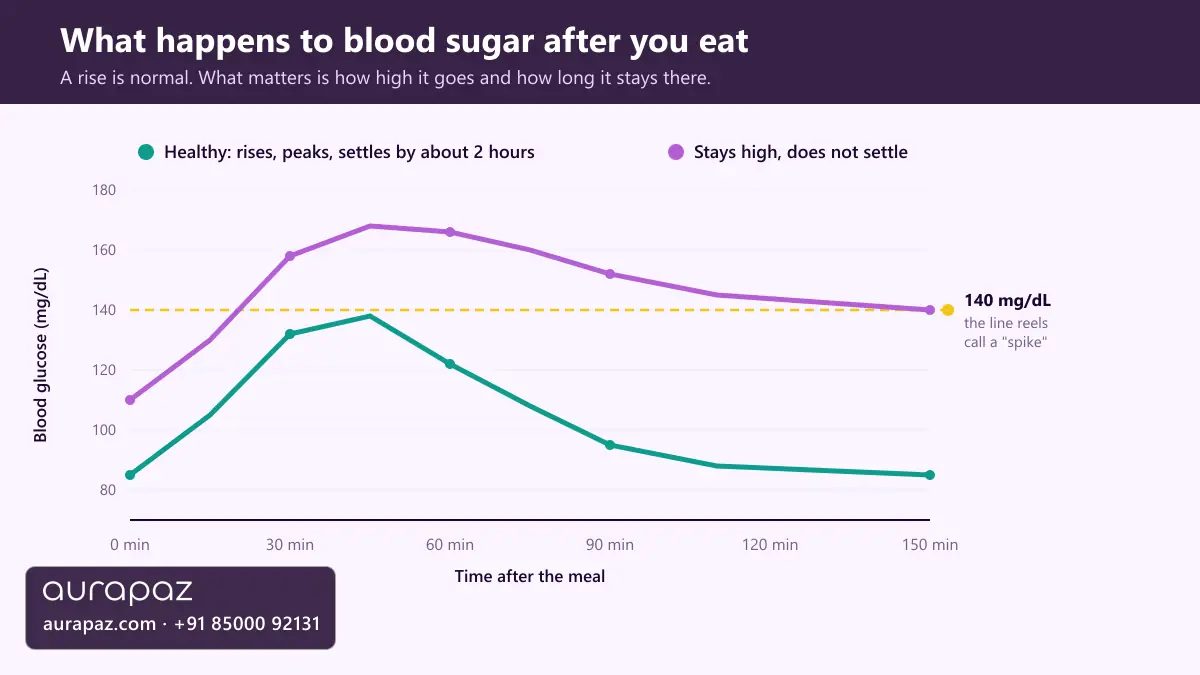
When you eat carbohydrate, your digestive system breaks it into glucose, which enters the bloodstream. Your pancreas releases insulin, which moves that glucose into cells to be used or stored. Blood glucose rises, peaks somewhere between thirty and ninety minutes later, then comes back down. That curve is not damage. That curve is your metabolism working exactly as designed.
The word “spike” does a lot of quiet work in wellness content. It makes a normal, expected rise sound like an injury. In clinical practice we do not worry about the existence of a rise. We look at how high it goes, how long it stays there, and whether the pattern repeats day after day for years. Blood sugar spikes matter in aggregate, over months and years, not one meal at a time.
Healthy people spike too, and more than you would think
This is the fact that undermines most of the fear content. When researchers put continuous monitors on people without diabetes, they find substantial variation. Healthy people do cross glucose levels that influencers label alarming, especially after a high carbohydrate meal, and they come back down without incident. Their bodies handle it. That is what metabolic flexibility means. A normal adult spends only a small fraction of the day above 140 mg/dL, but “only a small fraction” is not the same as “never”, which is what most spike content implies.
A sensor cannot tell you whether a rise is a problem. It shows you a line. Interpreting that line requires knowing the person’s fasting glucose, their HbA1c, their family history, their weight trend, their activity, and their age. Strip away that context and you are left with a number that generates anxiety rather than insight.
The devices themselves are not perfectly precise either. Continuous monitors read glucose in the fluid between cells, not in blood, so even after the sensor’s algorithm compensates, they trail a fingerprick by roughly five to ten minutes. Two sensors worn by the same person at the same time can disagree. Treating a single reading as a verdict on a specific food misunderstands what the device measures.

Myth versus reality: the glucose monitor trend
| What the trend says | What the science says |
|---|---|
| Everyone should wear a glucose monitor to optimise their health. | A 2026 meta-analysis of 23 studies in people without diabetes found monitors improved glucose control in those with prediabetes, but no appreciable glycaemic benefit in healthy people with normal readings. It also found no significant effect on body mass index. The authors position monitors as a tool inside a structured programme, not as standalone self-care. |
| Any spike damages your body. | A post-meal rise is normal physiology. What predicts harm is sustained high glucose over years, which is why diagnosis rests on fasting glucose and HbA1c, not on one afternoon’s curve. |
| Fruit spikes you, so avoid it. | Whole fruit arrives packaged with fibre, water and polyphenols. Cohort evidence consistently links whole fruit intake with lower type 2 diabetes risk. Fruit juice is a different matter. |
| Vinegar before a meal flattens your curve. | Small studies do show a modest blunting effect. The effect size is small, the trials are short, and it changes nothing if the rest of the diet is poor. |
| A flat glucose line is the goal. | A completely flat line in a person who eats normally would be unusual, not aspirational. Chasing flatness pushes people towards very low carbohydrate eating they cannot sustain. |
| The monitor tells you which foods are bad for you. | Responses vary between people, between days, and between sensors. A reading is affected by sleep, stress, illness, the previous meal and where the sensor sits. One curve is not a verdict. |
What the trend genuinely gets right
I am not dismissing all of this. Several of the habits that spread through glucose content are sound, and they were sound long before anyone wore a sensor.
Sequence your plate
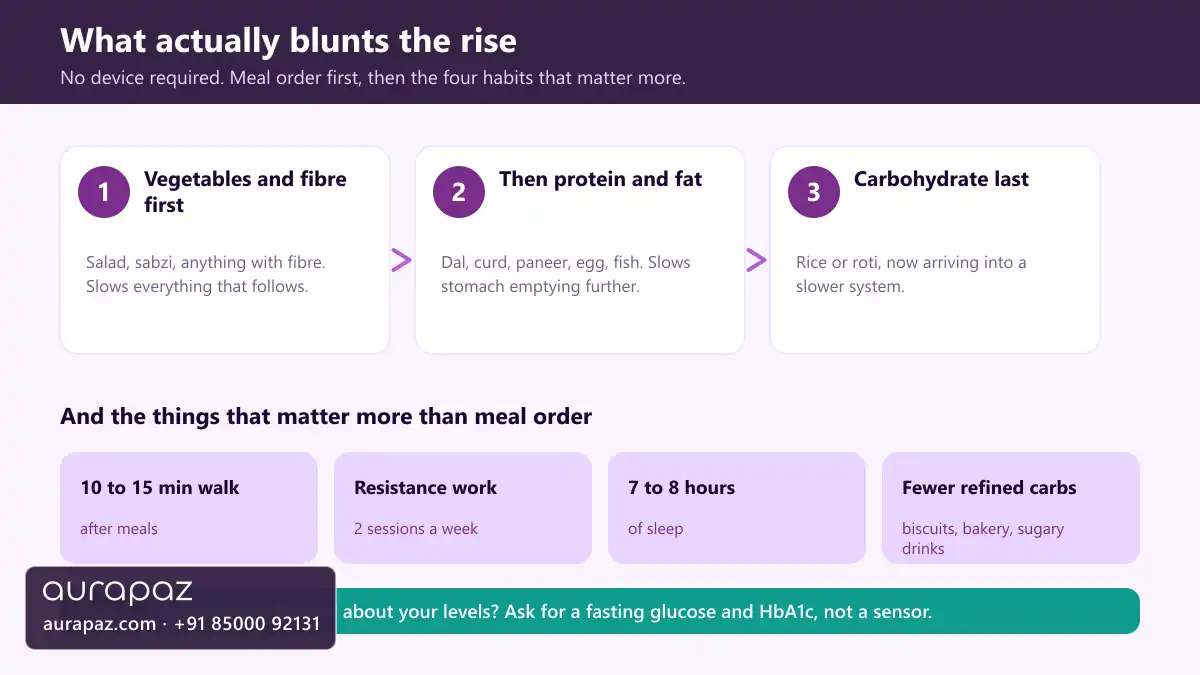
Eating vegetables and protein before the starch does moderately reduce the post-meal rise. It also slows the meal down and increases fullness. In an Indian context this is easy: start with the salad and the sabzi, then the dal and curd, then the rice or roti.
Never eat a naked carbohydrate
Plain white rice on its own behaves very differently from rice eaten with dal, curd and vegetables. Fat, protein and fibre all slow gastric emptying. Traditional Indian meal structure already does this well, which is worth remembering before importing anxiety about rice from elsewhere.
Walk after eating
This one has genuinely good support. Ten to fifteen minutes of easy walking after a meal helps muscles take up glucose without needing much insulin. It is free, it needs no device, and it works for almost everyone.
Prioritise fibre
Fibre slows carbohydrate absorption and feeds the gut bacteria involved in metabolic health. This is the mechanism behind much of what the trend recommends, and I have written about how to increase it sensibly in Fibermaxxing.

Where it misleads, and why that matters
A recent review compared what popular content claims about glucose spikes against what the medical literature actually supports, and found meaningful gaps between the two. That gap is where the harm sits.
The first problem is that the fear is aimed at the wrong foods. Bananas, mangoes, rice and potatoes get treated as hazards while the genuinely problematic pattern, a diet built on refined and heavily processed products, gets less attention because it is less surprising to talk about. If you want the more consequential conversation, it is the one about ultra-processed foods.
The second problem is psychological, and I see it in clinic. Wearing a device that scores every meal encourages a scrupulous, anxious relationship with food. For someone with any history of disordered eating, real-time feedback on every bite is not a neutral tool. Several clients have arrived having eliminated fruit, curd and whole grains entirely, chasing a flat line, and ended up with a narrower and less nourishing diet than they started with.
A monitor that makes you afraid of a mango while a packet of biscuits sits unquestioned in the cupboard has not made you healthier.
The third problem is that a flat curve becomes the goal rather than health. Persistent tiredness, for example, gets blamed on glucose swings when the cause is often somewhere else entirely, as I have set out in Why Am I Always Tired.
Who actually benefits from monitoring
Continuous monitoring is a genuinely valuable technology. It is simply aimed at specific people, and most of the people buying it are not those people.
- Type 1 diabetes: transformative, and standard care in much of the world.
- Type 2 diabetes treated with insulin: the strongest recommendation after type 1, for better control and fewer hypoglycaemic episodes.
- Type 2 diabetes on tablets alone: supported more weakly, and the hypoglycaemia argument largely does not apply to someone taking metformin only.
- Gestational diabetes: useful under supervision, where tight control matters over a short window.
- Prediabetes, with clinical guidance: can be a short diagnostic exercise to show how specific meals behave, ideally for two weeks rather than indefinitely.
- Insulin resistance and PCOS: sometimes helpful alongside a proper treatment plan, not instead of one.
This matters more in India than almost anywhere. National survey work by the Indian Council of Medical Research put around 101 million Indians living with diabetes and another 136 million with prediabetes. In that context, the answer to metabolic risk is not a consumer gadget. It is a fasting glucose test and an HbA1c, which cost very little, are validated, and tell your doctor something a fortnight of curves cannot.

What actually moves the needle
If you want better blood sugar control, these are the things that matter, roughly in order of impact. None of them require a device.
- Reduce refined carbohydrate volume, especially sugary drinks, biscuits, bakery items and white flour snacks. This single change outweighs every meal-sequencing trick combined.
- Build muscle. Muscle is where most glucose from a meal ends up. Two sessions of resistance work a week measurably improve insulin sensitivity.
- Walk after meals, particularly dinner, which is usually the largest and most sedentary meal of the Indian day.
- Sleep properly. A few nights of short sleep measurably worsens insulin sensitivity in healthy adults.
- Eat mixed meals. Protein, fat, fibre and carbohydrate together, which is what a traditional thali already is.
- Address weight around the middle, since abdominal fat drives insulin resistance more than overall weight does.
People often ask whether food alone can do what the new weight loss injections do. It is a fair question, and I have answered it honestly in GLP-1 Foods vs Ozempic.
Signs and risk factors worth testing for
Skip the sensor and speak to a doctor about a fasting glucose and HbA1c if you recognise several of these. The first group are symptoms. The second are risk factors, which do not mean anything is wrong now, only that testing is sensible.
Symptoms:
- Persistent thirst or noticeably increased urination, particularly at night
- Unexplained weight loss
- Blurred vision
- Fatigue that does not lift with rest
- Recurrent skin, gum or urinary infections, or cuts that heal slowly
- Darkened velvety patches of skin at the neck, underarms or groin, which commonly accompanies insulin resistance
Risk factors:
- Weight carried around the abdomen
- A parent or sibling with type 2 diabetes, which raises your risk substantially
- Gestational diabetes in a previous pregnancy
For context, the usual diagnostic thresholds are a fasting plasma glucose of 126 mg/dL (7.0 mmol/L) or above, or an HbA1c of 6.5 percent or above, with prediabetes sitting below those and above normal. A post-meal reading crossing 140 mg/dL (7.8 mmol/L) is frequently labelled a “spike” online, yet healthy people cross it too. Your doctor interprets these together, which is precisely what a sensor on its own cannot do.
What to take away
- A rise in glucose after eating is normal. Healthy people spike, sometimes considerably.
- Pooled evidence shows monitors help people with prediabetes, with no appreciable glycaemic benefit reported in people whose readings are already normal.
- Sensors lag real blood glucose and disagree with each other, so one reading is not a verdict on a food.
- The sound advice (fibre first, mixed meals, walking after eating) predates the devices and needs none of them.
- Fearing fruit while ignoring refined and ultra-processed food gets the priorities backwards.
- If you are worried, ask for a fasting glucose and HbA1c. They are cheap, validated and interpretable.
Technology that shows you your own body in real time is genuinely appealing, and I understand the pull. But a number without context is not knowledge, and for most people a fortnight of anxiety about poha is a poor substitute for the boring, effective things: more fibre, more muscle, less refined carbohydrate, a walk after dinner, and a proper blood test when something feels off.
References & Further Reading
- A Scoping Review of Glucose Spikes in People Without Diabetes: Comparing Insights from Grey Literature and Medical Research. PubMed
- Continuous glucose monitoring in non-diabetic populations: a systematic review of observational and interventional studies with meta-analysis. European Journal of Medical Research. link.springer.com
- Non-Invasive Continuous Glucose Monitoring in Patients Without Diabetes: Use in Cardiovascular Prevention, A Systematic Review. Sensors. mdpi.com
- Anjana RM et al. Metabolic non-communicable disease health report of India: the ICMR-INDIAB national cross-sectional study (ICMR-INDIAB-17). Lancet Diabetes Endocrinol, 2023. PubMed
- Muraki I et al. Fruit consumption and risk of type 2 diabetes: results from three prospective longitudinal cohort studies. BMJ, 2013. PubMed
- World Health Organization. Classification of Diabetes Mellitus (diagnostic criteria). who.int
- Centers for Disease Control and Prevention. Diabetes Testing. cdc.gov
- Harvard T.H. Chan School of Public Health. Carbohydrates and Blood Sugar. hsph.harvard.edu
- National Health Service (UK). Type 2 diabetes. nhs.uk
- World Health Organization. Diabetes fact sheet. who.int