Tingling feet, a tongue that feels sore for no clear reason, a tiredness that sleep does not touch. Signs like these are easy to put down to a busy household or “just stress”, until a blood report flags vitamin B12. In India that result is common, and the reasons go deeper than whether or not you eat meat.
How common is low B12 in India?
The clearest national picture for young people comes from the Comprehensive National Nutrition Survey (CNNS), carried out across India between 2016 and 2018. Using the WHO cut-off of a serum B12 below 203 pg/mL, researchers found deficiency in 13.8 per cent of children aged 1 to 4, 17.3 per cent of those aged 5 to 9 and 31.0 per cent of adolescents aged 10 to 19. Among adolescent girls it was 27.0 per cent, and boys were higher still, at 35.0 per cent.
There was no rural and urban difference, and some richer states with high dairy consumption, such as Punjab and Gujarat, had higher rates, a pattern the authors called hard to explain.
Data for adults, including women, is patchier, but it points the same way. A 2001 study of 204 adults in Pune found that 47 per cent had low blood B12 and about three quarters showed metabolic signs of deficiency. Those signs turned up in non-vegetarians as well as vegetarians, and the authors concluded diet only partly explained them. In the Pune Maternal Nutrition Study, two thirds of pregnant women from six villages had low B12.
So a vegetarian diet does raise the risk: a review of 40 studies found high rates of deficiency in vegetarians, and higher still in vegans. But eating meat is no guarantee either. If you read my piece on vitamin D deficiency in India, the theme will feel familiar: a nutrient many of us assume we are getting, and quite a few of us are not.
How your body absorbs B12
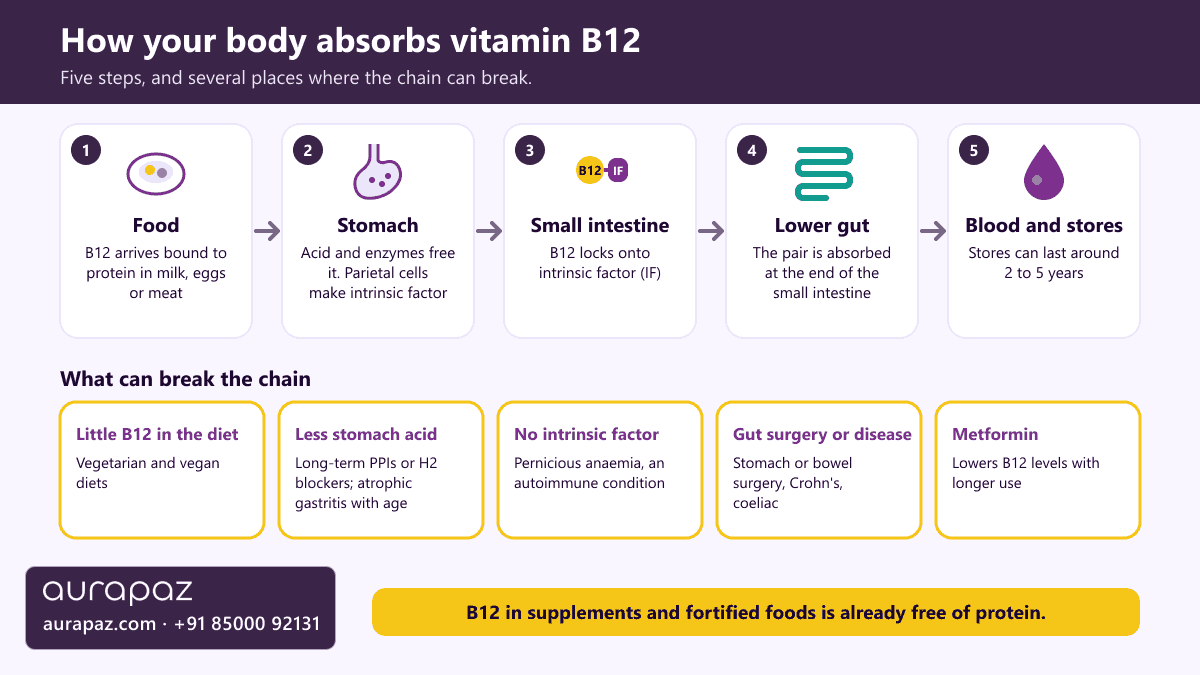
B12 has an unusually complicated journey. In food, it is bound to protein. Stomach acid and digestive enzymes release it, and a carrier protein called haptocorrin picks it up. Meanwhile, cells in the stomach lining called parietal cells make a protein called intrinsic factor. In the first part of the small intestine, B12 moves from haptocorrin onto intrinsic factor, and the pair travels to the far end of the small intestine, the ileum, where it is absorbed.
- There is a limit per meal. The intrinsic factor route is estimated to saturate at about 1.5 to 2 micrograms of B12 in one sitting, so spreading B12 foods across your meals works better than one large serving.
- B12 in supplements and fortified foods is already free, so it does not need stomach acid to release it.
- The body keeps a store that can last around 2 to 5 years, according to the NHS. Problems can take years to show after a change in diet or a new medicine.
You may have read that hormones or a vague “leaky gut” shut down intrinsic factor, and that the answer is to “fix your gut”. Neither holds up. When intrinsic factor or stomach acid goes missing, the cause is a specific problem a doctor can diagnose, such as autoimmune damage to the stomach lining, a medicine or surgery.
Who is most likely to run low
These are the risk factors from the UK’s 2024 NICE guideline and the NIH that matter most for Indian families.
Vegetarian and vegan diets
Natural sources of B12 are limited to animal foods. Lacto-vegetarians get some from milk, curd and paneer, and egg eaters a little more. Vegans who take no supplement or fortified foods are at the highest risk. NICE specifically mentions diets that exclude meat for religious reasons.
Pregnancy and breastfeeding
A baby builds its B12 reserves from its mother. The NIH notes that deficiency during pregnancy and breastfeeding may cause neural tube defects, developmental delays, failure to thrive and anaemia in the baby, and that exclusively breastfed babies of mothers who eat no animal foods can become deficient very early. If you are pregnant or planning to be, ask your doctor about B12, not only iron and folic acid.
Older adults and pernicious anaemia
Atrophic gastritis reduces both stomach acid and intrinsic factor. The NIH puts it at 2 per cent of the general population but 8 to 9 per cent of adults aged 65 and over.
Pernicious anaemia is an autoimmune condition in which the immune system attacks the stomach cells that make intrinsic factor, so very little B12 is absorbed however good your diet. The NHS notes it is more common in women around 60, in people with a family history of it and in those with another autoimmune condition such as vitiligo. No amount of milk will fix this one; it needs medical care.
Metformin and acid-lowering medicines
Metformin, the most widely used diabetes medicine, lowers B12 over time. In a large US diabetes prevention study, each extra year of metformin was linked to a higher risk of deficiency, and the UK medicines regulator now lists low B12 as a common side effect that may affect up to 1 in 10 people who take it.
In a study comparing more than 25,000 people with B12 deficiency against people without it, two or more years of proton pump inhibitors (PPIs, such as omeprazole or pantoprazole) was linked to about 65 per cent higher odds of deficiency, and H2 blockers to about 25 per cent higher odds. Many of us take these “gas tablets” for years.
Please do not stop metformin or an acid-lowering medicine because of this. The UK regulator advises that metformin can be continued while B12 is corrected. If you have taken either for a long time, ask your doctor whether a B12 check makes sense for you.
Gut surgery and gut conditions
Weight-loss surgery, operations on the stomach or the end of the small intestine, coeliac disease and some cases of Crohn’s disease can all reduce absorption. NICE notes deficiency is highly likely after removal of the whole stomach or the end of the small intestine unless B12 is replaced.
Symptoms, and why the nerve ones matter
Low B12 develops slowly. The NHS lists tiredness and weakness, breathlessness, headaches, palpitations, loss of appetite, a sore or red tongue, mouth ulcers, problems with vision, and problems with memory and judgement. B12 also keeps nerves healthy, and deficiency can cause:
- pins and needles or numbness, often in the hands and feet
- muscle weakness
- problems with balance, coordination or walking
- low mood, anxiety or confusion
- in more advanced cases, incontinence
These nerve symptoms can appear without any anaemia, so a normal haemoglobin does not rule out B12 deficiency. The NHS also warns that some damage can become permanent if deficiency is left untreated, and the longer it goes on, the higher that chance. Folic acid adds a trap: it can improve the anaemia while B12 deficiency carries on underneath, which is why doctors check B12 before prescribing it.
Tiredness alone has many causes, so if that is your main complaint, my guide to the common causes of chronic fatigue is a good place to start.
See a doctor promptly if you have numbness, pins and needles, trouble with balance or walking, or changes in memory or mood, especially if you are vegetarian, pregnant, over 60, or take metformin or acid-lowering tablets. For suspected B12-related anaemia with nerve symptoms, NICE advises that treatment should not wait for test results.

Testing: what the numbers can and cannot tell you
The usual first test is total serum B12. NICE suggests these bands, while allowing labs to use their own validated cut-offs:
- Below 180 ng/L: deficiency confirmed.
- 180 to 350 ng/L: indeterminate, so deficiency is possible.
- Above 350 ng/L: deficiency unlikely.
Indian reports often use pg/mL, which gives the same number as ng/L. Cut-offs vary between labs, and the CNNS used 203 pg/mL. You may have seen claims that everyone should aim for 400 to 600 pg/mL; no major guideline sets that target.
Why one number is not the whole story
Some people have symptoms with a normal level, and others have a low level with no symptoms. NICE flags two common distortions: B12 tablets or injections can raise the result without fully correcting a deficiency, and the combined contraceptive pill can lower it without causing one. Tell your doctor about both before the test. Depending on your result, your doctor may add:
- Methylmalonic acid (MMA): the most sensitive marker, useful in the grey zone, though it also rises with kidney problems.
- Homocysteine: rises when B12 is low, but also with low folate and declining kidney function.
- Active B12 (holotranscobalamin): NICE suggests it as the first test in pregnancy, when total B12 naturally falls.
- A full blood count, to look for anaemia and unusually large red blood cells.
- Tests for pernicious anaemia, if the cause is not clearly diet.
NICE also reminds doctors that a vegetarian diet may not be the cause, or the only cause, of a deficiency, so let your doctor interpret the results.

Treatment: tablets, injections and which form
How a deficiency is corrected depends on its cause, and that is your doctor’s decision. These are general options, not a guide to dosing.
Injections bypass the gut, so they are the usual choice when absorption is the problem, as in pernicious anaemia, and when there are nerve symptoms. The NHS notes that people whose deficiency is not caused by diet usually need injections for life.
Tablets can work too, because a small share of a large oral dose is absorbed without intrinsic factor. A 2018 Cochrane review of three trials found high-dose oral B12 and injections had similar effects on blood levels, though the evidence was of low quality. When diet is the cause, NICE suggests tablets for many people, with injections considered for nerve or blood problems or if taking tablets regularly is difficult.
Methylcobalamin or cyanocobalamin?
Methylcobalamin is often marketed in India as the “active” or “better” form. It is one of the two forms your cells use directly, but cyanocobalamin is converted into those forms in the body. Supplements often use cyanocobalamin, and the NIH states there is no evidence that absorption differs between forms. NICE lists cyanocobalamin, methylcobalamin and adenosylcobalamin as suitable. Neither is a shortcut.
Before you take a B12 supplement: US experts have set no upper limit for B12 because its risk of toxicity is low, but self-treating can hide the cause, such as pernicious anaemia, and make a later blood test hard to read. Talk to your doctor first, mention metformin, acid-lowering medicines or the pill, and ask specifically about B12 if you are pregnant, breastfeeding or planning a pregnancy.
Food sources for vegetarians, and what boiling milk does
ICMR-NIN’s 2020 nutrient requirements set the Recommended Dietary Allowance of B12 at 2.2 micrograms a day for adult women, up from 1 microgram in 2010. The figures below come from US food data compiled by the NIH, so treat them as a guide; Indian milk, much of it from buffaloes, may differ.
- Milk: about 1.3 micrograms in a cup (around 240 ml).
- Plain yoghurt, similar to curd: about 1.0 microgram in a 170 g pot.
- Egg: about 0.5 micrograms in one large egg, though egg B12 is poorly absorbed.
- Cheese: about 0.5 micrograms in 42 g of cheddar. I could not find a dependable figure for paneer, so I have not quoted one, but as a milk product it contributes too.
On paper, a glass of milk and a bowl of curd come close to the daily figure, and the NIH notes B12 from dairy appears to be absorbed about three times better than from meat. If you buy paneer often, my article on analogue paneer versus real paneer explains why some “paneer” is not a milk product at all.
The habit of boiling milk again and again
Many of us boil milk, let it rise, boil it again and keep it for later. A 2012 study from Punjab in the Indian Journal of Public Health found that boiling cut the B12 in milk by 21 per cent, and storage cut it by a further 18 to 26 per cent depending on conditions.
Loose, unpasteurised milk still needs proper boiling for safety. Packaged pasteurised milk does not need repeated or prolonged boiling: heat it once if you prefer, cool it, refrigerate it and use it up promptly. For more on everyday kitchen safety, see my guide to safe food practices at home.
Fortified foods
Under FSSAI rules, fortified atta and rice carry 0.75 to 1.25 micrograms of B12 per kilogram, so a 100 g serving gives only about 0.08 to 0.13 micrograms. For strict vegetarians and vegans, the review of vegetarian studies concluded that supplements deserve strong consideration, a conversation to have with your doctor.

Myth vs Reality: B12 on an Indian plate
| What the trend says | What the science says |
|---|---|
| “Only vegetarians get B12 deficiency.” | Vegetarians are at higher risk, but a Pune study found signs of deficiency in non-vegetarians too, and medicines and stomach conditions affect anyone. |
| “Hormones or a leaky gut stop you making intrinsic factor, so fix your gut first.” | Intrinsic factor is lost mainly through autoimmune damage to the stomach (pernicious anaemia), atrophic gastritis or surgery. These need a diagnosis, not a gut “reset”. |
| “Methylcobalamin is the only form your body can use.” | Cyanocobalamin is converted into the active forms. The NIH finds no evidence that absorption differs by form, and NICE accepts both. |
| “You need a B12 level of 400 to 600 to feel well.” | No major guideline sets that target. NICE treats below 180 ng/L as deficiency and 180 to 350 as uncertain, judged with symptoms and further tests. |
| “Tablets never work; you always need injections.” | A Cochrane review found high-dose oral B12 raised blood levels much like injections, though injections are preferred in some situations. |
| “If my haemoglobin is normal, my B12 must be fine.” | Nerve symptoms of B12 deficiency can appear without anaemia. |
Like iron, B12 needs planning on a vegetarian plate; my piece on chai and iron absorption is a useful companion.
Key takeaways
- Low B12 is common in India: 31 per cent of adolescents, and 27 per cent of adolescent girls, were deficient in the national CNNS survey.
- Absorption depends on stomach acid and intrinsic factor, so pernicious anaemia, ageing, metformin, long-term PPIs and gut surgery can cause deficiency even with a good diet.
- Numbness, pins and needles and balance problems can appear without anaemia. See a doctor promptly, as some nerve damage can become permanent.
- A serum B12 of 180 to 350 ng/L is a grey zone; your doctor may add MMA, homocysteine or a blood count before deciding.
- Milk, curd, eggs and cheese help vegetarians towards the 2.2 microgram RDA. Avoid boiling milk repeatedly, and let your doctor decide on tablets or injections.
References & Further Reading
- Shalini T, et al. Prevalence of vitamin B12 and folate deficiencies in Indian children and adolescents. Nutrients, 2023; 15(13): 3026.
- Refsum H, et al. Hyperhomocysteinemia and elevated methylmalonic acid indicate a high prevalence of cobalamin deficiency in Asian Indians. American Journal of Clinical Nutrition, 2001; 74(2): 233 to 241.
- Yajnik CS, et al. Vitamin B12 and folate concentrations during pregnancy and insulin resistance in the offspring: the Pune Maternal Nutrition Study. Diabetologia, 2008; 51(1): 29 to 38.
- Pawlak R, Lester SE, Babatunde T. The prevalence of cobalamin deficiency among vegetarians assessed by serum vitamin B12: a review of literature. European Journal of Clinical Nutrition, 2014; 68(5): 541 to 548.
- Watanabe F. Vitamin B12 sources and bioavailability. Experimental Biology and Medicine, 2007; 232(10): 1266 to 1274.
- Aroda VR, et al. Long-term metformin use and vitamin B12 deficiency in the Diabetes Prevention Program Outcomes Study. Journal of Clinical Endocrinology and Metabolism, 2016; 101(4): 1754 to 1761.
- Lam JR, et al. Proton pump inhibitor and histamine 2 receptor antagonist use and vitamin B12 deficiency. JAMA, 2013; 310(22): 2435 to 2442.
- Wang H, et al. Oral vitamin B12 versus intramuscular vitamin B12 for vitamin B12 deficiency. Cochrane Database of Systematic Reviews, 2018; 3: CD004655.
- Bahman S, et al. Impact of household practices on the nutritional profile of milk. Indian Journal of Public Health, 2012; 56(1): 82 to 87.
- NICE. Vitamin B12 deficiency in over 16s: diagnosis and management (NG239). 6 March 2024.
- MHRA. Metformin and reduced vitamin B12 levels: new advice for monitoring patients at risk. Drug Safety Update, 20 June 2022.
- NIH Office of Dietary Supplements. Vitamin B12: fact sheet for health professionals.
- NHS. Vitamin B12 or folate deficiency anaemia (symptoms, causes, diagnosis and treatment).
- ICMR National Institute of Nutrition. A brief note on nutrient requirements for Indians. 2020.
- FSSAI. Food Safety and Standards (Fortification of Foods) Regulations, 2018: compendium. 2021.