A month’s supply of colostrum powder now costs more than most Indian families spend on a week of vegetables, and the promise on the tub is enormous: rebuild your gut lining, borrow a newborn’s immunity, glow from the inside out. Four clients asked me about it this month. Two were already taking it, and neither could tell me why beyond “everyone on my feed is on it”.
So let us do this properly, because bovine colostrum is not snake oil. There is real research behind it, some of it genuinely decent. But the distance between what the trials measured and what the marketing implies is among the widest I have seen. The people most likely to benefit are, awkwardly, not the ones buying it most.
What colostrum actually is
Colostrum is the thick, yellowish first milk a mammal produces in the day or two after giving birth. It is not ordinary milk: it carries far higher concentrations of immunoglobulins (mostly IgG), lactoferrin and growth factors. Almost every supplement on the shelf is bovine colostrum, collected from dairy cows after calving, then usually heat treated and spray dried into powder. How much heat it goes through varies between brands, and as we will see, that turns out to matter more than anything printed on the label.
For a newborn calf, this stuff is genuinely life or death. Miss the narrow window in which it can absorb its mother’s antibodies and the animal is far more likely to sicken and die. That biology is not in dispute, and it is where the industry gets its most emotive marketing line.
The phrase you will see everywhere is “liquid gold”. Accurate for what colostrum does for a calf. Not for what a spray dried version does for a healthy 34 year old in Pune.
Myth versus reality: the colostrum boom
| What the trend says | What the science says |
|---|---|
| It gives you a newborn’s immune protection. | Newborn calves absorb intact antibodies through the gut for a day or two, then gut closure ends it. Humans close this route before birth, around mid gestation, and receive maternal IgG across the placenta instead. Swallowed IgG is not restocking anyone’s bloodstream. |
| It heals and rebuilds your gut microbiome. | A 2024 systematic review found no beneficial effect on faecal microbiota diversity. That rests on only two studies, so treat it as an absence of good evidence. Either way, nothing supports the claim on the label. |
| It stops you falling ill. | The best evidence is a meta-analysis in people in regular training, where it cut self reported upper respiratory symptom days by roughly 44 per cent. Four of the five trials carried a moderate to high risk of bias. |
| Any colostrum product will do. | Across twenty commercial products for human use, the most and least active differed about six fold in cell based activity, and heating a powder can strip its activity while leaving the label numbers untouched. |
| It is a natural dairy food, so it is safe for everyone. | It contains casein and whey, so it is unsuitable for anyone with cow’s milk protein allergy, and it still contains lactose. |
| It builds muscle and strips fat. | There is no good evidence. One small 2001 trial reported a lean mass gain and nothing has replicated it. Its effect on IGF-1 is unsettled, and IGF-1 is an anabolic marker, not a fat loss mechanism. |
Why the newborn comparison does not transfer to you
This is the single most important thing to understand, and once you have it, most of the advertising stops working on you.
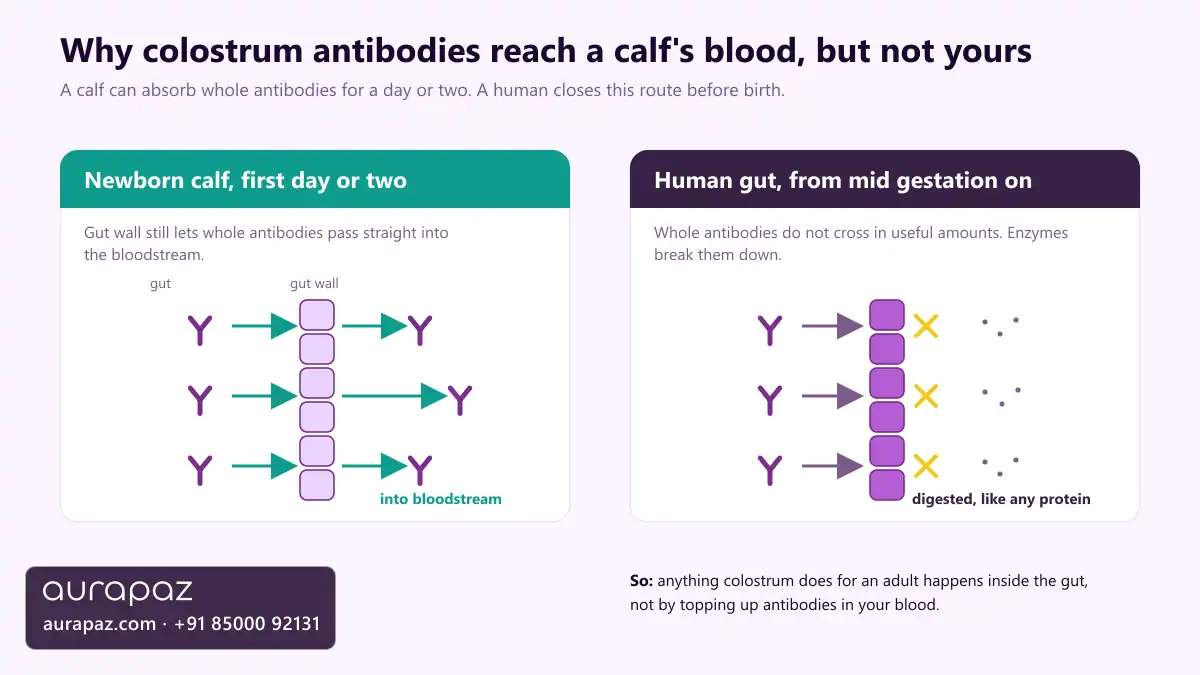
A newborn calf is born essentially without antibodies of its own. For its first day or two, its intestine can take up large intact molecules and pass them into the circulation, which is exactly how its mother’s antibodies travel from colostrum into its bloodstream. The window shuts fast. Once feeding has begun, at around one to two days old, that transport of intact macromolecules ceases, and researchers call the moment gut closure.
Here is the part the marketing never mentions. Humans do not do this at any age. In our species, gut closure happens before birth, around mid gestation. A full term human baby already arrives with an essentially adult type intestinal lining and very little of the receptor machinery that ferries whole antibodies across it. Human infants get their mother’s IgG earlier and by a completely different route: across the placenta, while still in the womb.
Colostrum is not restoring an ability you lost as an adult. It is selling you a mechanism human beings never had after birth in the first place.
In a mature intestine a little macromolecular transfer does still happen, but it is limited and confined to specialised patches of tissue rather than the whole gut surface. So when you stir colostrum powder into water, you are not topping up your antibody supply. Most of that IgG meets your stomach acid and digestive enzymes and is treated like what it is: protein.
That is not nothing. Plenty happens inside the gut itself, and that is the most plausible route for whatever the trials picked up. But it is a far smaller claim than “newborn immunity in a scoop”.
Where the evidence is genuinely decent
Fewer respiratory symptoms in people who train
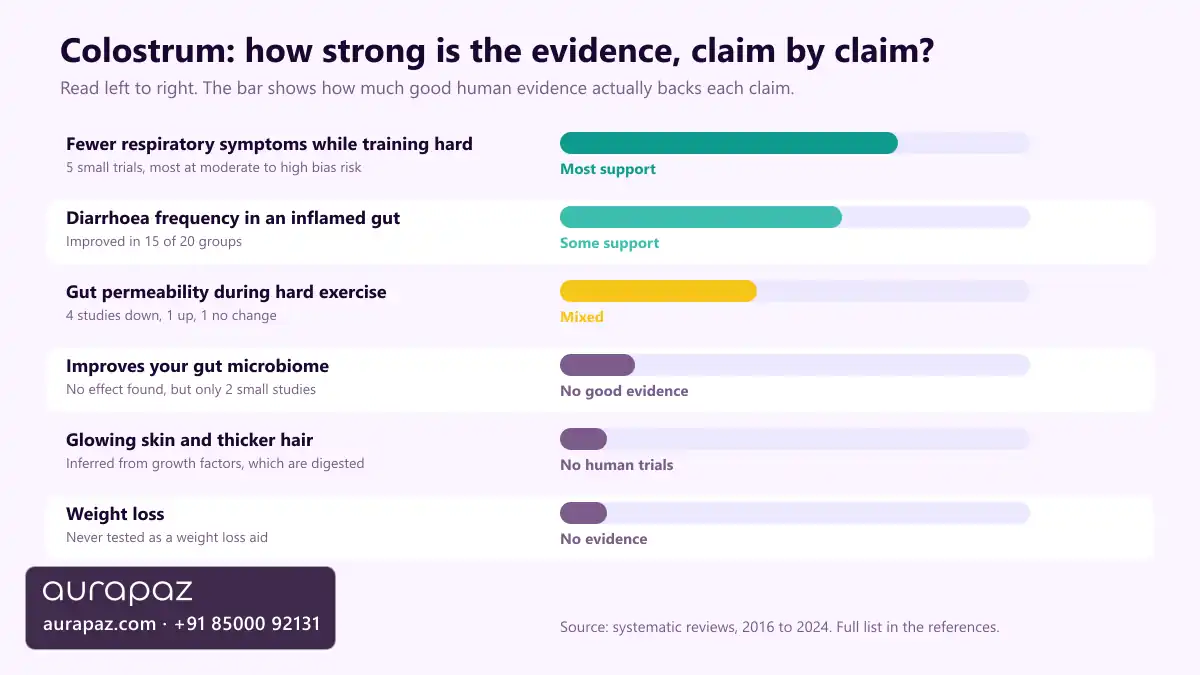
The strongest single finding comes from a 2016 systematic review and meta-analysis of randomised controlled trials in people undergoing exercise training. Colostrum supplementation reduced the rate of upper respiratory symptom days (rate ratio 0.56, 95 per cent confidence interval 0.43 to 0.72), and reduced symptom episodes (rate ratio 0.62, 95 per cent confidence interval 0.40 to 0.99).
A 44 per cent reduction sounds impressive, and it is the number every brand quotes. The authors are markedly more careful than their marketing readers. The pooled analysis rested on five trials and 152 participants, symptoms were self reported with no doctor confirming anything and no test identifying a pathogen, and four of the five trials carried a moderate or high risk of bias. The review’s own recommendation was that this needs an adequately powered trial.
It is worth being honest about who was studied, because it is not only elite sport. Across the five pooled trials the participants were highly trained cyclists, elite swimmers, recreational distance runners, and people who were simply recreationally active. So the bar is lower than “professional athlete”, but it is still a training population, not someone who walks in the evenings.
Gut permeability under hard exercise
Intense exercise, particularly in heat, genuinely does increase intestinal permeability, and this is where colostrum has been studied most seriously. A 2022 review of athletes concluded it may be beneficial for gut permeability, but the detail matters: of the six that used the sugar test, four found permeability decreased, one found it increased, and one found no change. Doses ranged wildly from 1 g to 60 g a day, which tells you how unsettled the science still is.
One limitation deserves flagging for anyone reading this site in particular. Of the nine studies in that review, only one included women at all. This evidence base is very largely built on male athletes, a familiar and frustrating pattern in sports nutrition research.
Diarrhoea and recovery of a damaged gut
The 2024 review of colostrum in gastrointestinal disease is the most useful paper for ordinary readers, because it separates outcomes rather than lumping them together. Diarrhoea frequency fell in 15 of 20 intervention groups. All seven studies looking at stool frequency pointed the same way. Abdominal pain is more of a coin toss: it improved in four intervention arms and showed no improvement in five others.
The pattern is consistent: colostrum shows most promise when a gut is already inflamed, infected, or injured. A broader 2021 review across sick and healthy people landed similarly, describing benefits for intestinal and respiratory recovery, while stating plainly that it could not provide strong evidence for its use in any single situation.
Where the evidence falls apart
The microbiome claim
This is the one that irritates me most, because it is on nearly every label and the research does not support it. The 2024 review reported no beneficial effect on faecal microbiota diversity. To be fair, that rests on two studies, one in eight children with autism and one in 275 infants in Malawi, so it is closer to an absence of good evidence than proof that nothing happens. Which is rather the point: there is nothing here supporting the sentence on the tub. The same review found no benefit against Helicobacter pylori, and no significant difference for necrotising enterocolitis, though each of those rests on a single small trial too. Diarrhoea duration, as opposed to frequency, mostly did not change either.
If you want to influence your microbiome, the boring answer still wins, and it is far cheaper. Fermented foods and a wide range of plant fibres have a much better evidence base than any powder. I have written about the practical version of this in how to heal your gut naturally.
Skin, hair and “glow”
There is no meaningful human trial evidence that colostrum improves skin or hair. The claim is built by inference: colostrum contains growth factors, growth factors act on tissue, therefore glow. That chain breaks at the first link, for the same reason the antibody claim does. Growth factors are proteins, and they are digested.
Weight loss
Colostrum has been drifting into weight loss marketing, often positioned near the GLP-1 conversation. There is no good evidence for it, and the IGF-1 argument people reach for is genuinely unsettled in both directions. One trial gave 20 g a day to male and female athletes for two weeks and saw serum IGF-1 rise significantly. A later set of studies in recreationally active men, at 20 g a day for four weeks and twelve weeks, found no increase at all. Either way it was never the right argument, because IGF-1 is an anabolic marker rather than a fat loss mechanism. If you are looking at that category honestly, our piece on GLP-1 foods versus Ozempic is a more useful place to start.
The problem nobody puts on the label
Suppose you decide the training evidence applies to you and you want to try it. Here is the catch almost no article mentions: two tubs of colostrum are not the same product.
Researchers tested twenty commercially available bovine colostrum products intended for human use and measured biological activity rather than trusting the label. In cell based tests, the most and least active samples differed roughly six fold. In live animals the gap narrowed but did not close, to two or three fold, with the most active sample producing an 86 per cent reduction in gastric injury against 48 per cent for the least active.
Then comes the unsettling detail. When researchers heated colostrum powder, the measurable quantities of IgG, IGF-1 and growth factors did not change. Biological activity fell by more than 40 per cent. The molecules were still there, still countable, still reportable on a certificate of analysis. They had simply stopped working. Which is why the authors argued that assessing bioactivity beats counting growth factors.
So a label can be entirely honest about what a tub contains and still tell you nothing about whether it works, and there is no way to tell from the outside which one you have bought.
If you do buy, favour brands that publish batch level third party testing rather than one certificate of analysis, and treat an “IgG per cent” figure as a starting question. The more useful question is how much heat the product went through.
Showing my working: the bioactivity comparison and the study finding no IGF-1 rise involve researchers tied to Pantheryx, a commercial colostrum supplier. The 2016 meta-analysis that produced the 44 per cent figure has its own link, since its lead author’s doctorate was part funded through a collaboration with a colostrum supplier, and one of the five pooled trials was his. None of that makes the findings wrong, and the bioactivity paper is notably unflattering to the industry it came from. It is worth knowing when a field is this small.
Who should be careful, and who should skip it
Colostrum comes out of trials looking reasonably well tolerated, and reviewers describe relatively few side effects. That is not the same as none. Across the studies in the 2024 review, participants reported nausea, flatulence, stomach ache and increased gassiness, and one paediatric trial recorded skin rashes and itching. Mild and mostly digestive, but worth knowing before you spend.
- Cow’s milk protein allergy: avoid entirely. Colostrum contains casein and whey, the same proteins that trigger the reaction.
- Lactose intolerance: proceed cautiously. Colostrum contains lactose, and given how common lactose malabsorption is across South Asia, digestive complaints are a realistic outcome. Several trials deliberately excluded lactose intolerant volunteers, which tells you something.
- Competitive athletes who get tested: this one is counter intuitive. Colostrum naturally contains small amounts of IGF-1, which sits on the World Anti-Doping Agency prohibited list. WADA notes the quantities in natural animal products are very small, referred the question to its List Committee, and in the meantime warns that athletes using such products do so at their own risk. If your career depends on a sample, check with your own anti-doping authority rather than an article.
- Inflammatory bowel disease or coeliac disease: colostrum is not a treatment for either and must not displace one. If it helps symptoms alongside proper management, fine, but tell your gastroenterologist.
- Pregnancy, breastfeeding, immunosuppression, or infants: not enough evidence. Ask your doctor rather than your feed.
- Anyone on a tight budget: Colostrum is expensive, and almost everything it might plausibly do for a healthy adult comes more reliably and far more cheaply from food and sleep.
If you are taking colostrum for a persistent gut problem and it is helping you tolerate a situation you have not had investigated, please get the underlying issue looked at. Ongoing changes in bowel habit, blood in the stool, unexplained weight loss, or pain that wakes you are all reasons to see a doctor, not to add a supplement.
What I actually tell clients
My position is not “never”. It is “you are probably not the person in the study”.
If you train consistently and hard, to the point where you get one respiratory infection after another and your gut misbehaves during long sessions in Indian heat, colostrum is one of the more reasonable things in the supplement aisle to trial. Give it a defined test: eight to twelve weeks, one product, and something measurable written down at the start, such as training days lost. If nothing shifts, stop and keep your money.
If you are a generally healthy adult who saw it on Instagram, buy vegetables instead. That is not dismissiveness, it is where the return on the same spend is larger. What actually moves immune resilience is unglamorous: enough protein, enough sleep, iron and B12 sufficiency, consistent movement. For the same logic applied elsewhere, our magnesium piece works through it, and creatine for women covers a supplement where the evidence genuinely is strong.
And if what you are really chasing is fewer illnesses this season, start with food. Our guide to immunity boosting foods and herbs and the truth about protein both cover more ground for less money than any tub will.
Key takeaways
- The newborn analogy is broken twice over. Calves absorb intact antibodies through the gut for a day or two only, and humans lose that ability before birth, around mid gestation. We get maternal IgG through the placenta, not by drinking it.
- The best evidence is narrow: fewer self reported upper respiratory symptoms in people in regular training, from five small trials, most at moderate to high risk of bias.
- Stool and diarrhoea frequency improved most consistently in gut disease. Abdominal pain was a coin toss. Nothing showed benefit for microbiota diversity, H. pylori or diarrhoea duration, though each of those nulls rests on very small studies.
- Heat can strip a powder’s biological activity by over 40 per cent while leaving the IgG and growth factor numbers on the label completely unchanged.
- Skip it if you have cow’s milk protein allergy. Be cautious with lactose intolerance, and if you are drug tested, check with your anti-doping authority first.
- For a healthy adult with no specific problem, food, sleep and consistency beat it comfortably on cost and on evidence.
References & Further Reading
- Guberti M, et al. “Bovine Colostrum Applications in Sick and Healthy People: A Systematic Review.” Nutrients, 2021. PMID 34202206.
- Jones AW, March DS, Curtis F, Bridle C. “Bovine colostrum supplementation and upper respiratory symptoms during exercise training: a systematic review and meta-analysis of randomised controlled trials.” BMC Sports Science, Medicine and Rehabilitation, 2016. PMID 27462401.
- Hajihashemi P, et al. “Therapeutics effects of bovine colostrum applications on gastrointestinal diseases: a systematic review.” Systematic Reviews, 2024. PMID 38409162.
- Dziewiecka H, et al. “A Systematic Review of the Influence of Bovine Colostrum Supplementation on Leaky Gut Syndrome in Athletes: Diagnostic Biomarkers and Future Directions.” Nutrients, 2022. PMID 35745242.
- Weström B, Arévalo Sureda E, Pierzynowska K, Pierzynowski SG, Pérez-Cano FJ. “The Immature Gut Barrier and Its Importance in Establishing Immunity in Newborn Mammals.” Frontiers in Immunology, 2020. PMID 32582216.
- Playford RJ, Cattell M, Marchbank T. “Marked variability in bioactivity between commercially available bovine colostrum for human use; implications for clinical trials.” PLoS One, 2020. PMID 32555629. (See also the correction, PMID 33022011, which revises Table 1 product details and does not affect the figures cited here.)
- Mero A, et al. “IGF-I, IgA, and IgG responses to bovine colostrum supplementation during training.” Journal of Applied Physiology, 2002. PMID 12133885.
- Antonio J, Sanders MS, Van Gammeren D. “The effects of bovine colostrum supplementation on body composition and exercise performance in active men and women.” Nutrition, 2001. PMID 11312068.
- Davison G, Jones AW, Marchbank T, Playford RJ. “Oral bovine colostrum supplementation does not increase circulating insulin-like growth factor-1 concentration in healthy adults: results from short- and long-term administration studies.” European Journal of Nutrition, 2019. PMID 31123862.
- World Anti-Doping Agency. “WADA Statement on the prohibited substance IGF-1.” 2013. wada-ama.org.