
Spend a few minutes on any wellness feed and someone will offer you a food, a powder or a capsule that supposedly works “just like Ozempic”. It is an understandable hope, so let me be straight with you from the start: no food, spice or supplement is an alternative to a prescribed GLP-1 medicine. What food can do is real but smaller, and worth understanding properly.
What GLP-1 actually does in your body
GLP-1, short for glucagon-like peptide-1, is a hormone your own gut makes every day. Specialised cells in the lining of the small intestine and colon, called L-cells, release it when food arrives. It prompts insulin release when blood sugar rises, holds back glucagon (which raises blood sugar), slows stomach emptying and acts as a fullness signal.
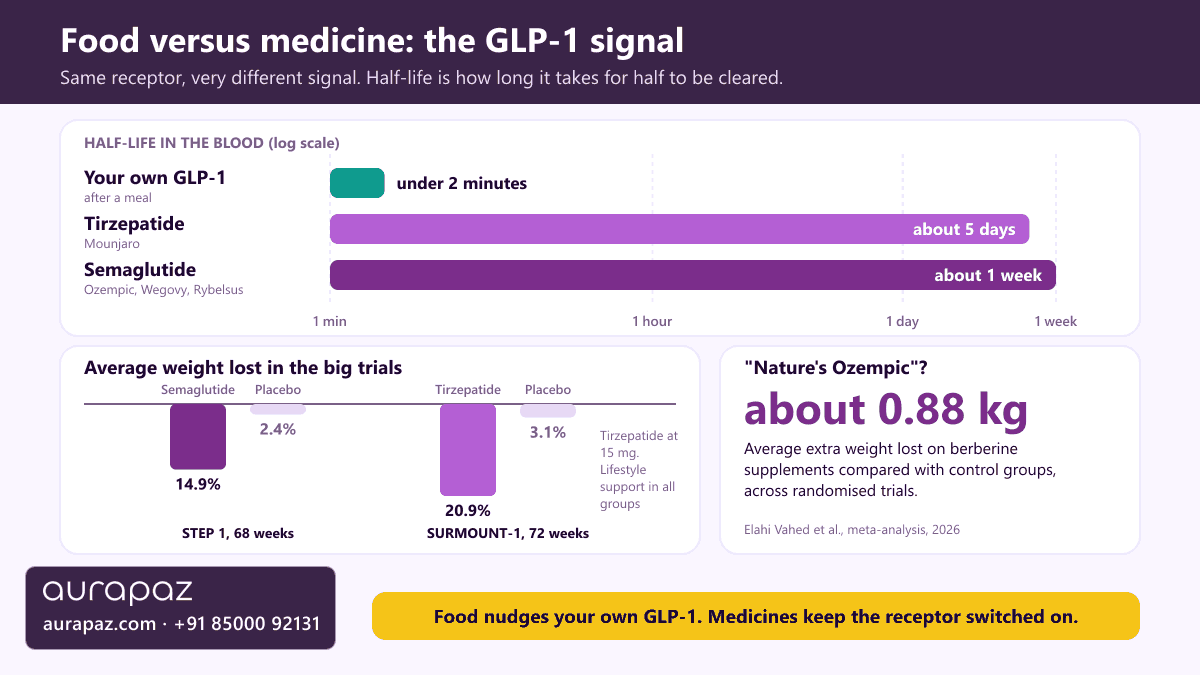
The catch is that natural GLP-1 is fleeting. An enzyme called DPP-4 breaks it down so quickly that the active hormone has a circulating half-life of under two minutes. Much of it is inactivated before it has even left the gut.
If blood sugar is already on your mind, my piece on blood sugar spikes and glucose monitors covers the other half of this story.
Why the medicines work on a completely different scale
Minutes versus a week
Semaglutide (Ozempic and Wegovy as weekly injections, Rybelsus as a daily tablet) is built to resemble your own GLP-1. The European Medicines Agency’s product information describes it as having 94 per cent sequence similarity to human GLP-1, with two key differences: it binds to albumin in the blood, and it resists breakdown by DPP-4. The result is an elimination half-life of about one week, against under two minutes for the natural hormone. After the last dose, it stays in the circulation for about seven weeks.
Tirzepatide (Mounjaro) goes a step further. It acts on two hormone receptors, GLP-1 and GIP (another gut hormone), and has a half-life of about five days.
Food prompts a physiological release: a modest rise in your own GLP-1 around mealtimes that fades quickly. The drugs supply a pharmacological signal, keeping the same receptors activated round the clock for as long as they are taken. No breakfast can do that.
What the trials found
The size of the effect matches. In the STEP 1 trial, 1,961 adults with obesity or overweight (without diabetes) took weekly semaglutide 2.4 mg or a placebo for 68 weeks, both groups alongside lifestyle support. Average weight change was 14.9 per cent with semaglutide against 2.4 per cent with placebo. In the SURMOUNT-1 trial of tirzepatide, average weight change at 72 weeks was 20.9 per cent on the highest dose against 3.1 per cent on placebo.
The flip side is also clear. In a one-year follow-up of STEP 1, people who stopped semaglutide (and the lifestyle programme) regained about two-thirds of the weight they had lost. Decisions about starting and stopping belong with a doctor.
What food can genuinely do for fullness
None of this makes food irrelevant. Several habits influence your own satiety hormones and help you feel full on less. The effects are modest and work best together.
Fibre, and what your gut bacteria make of it
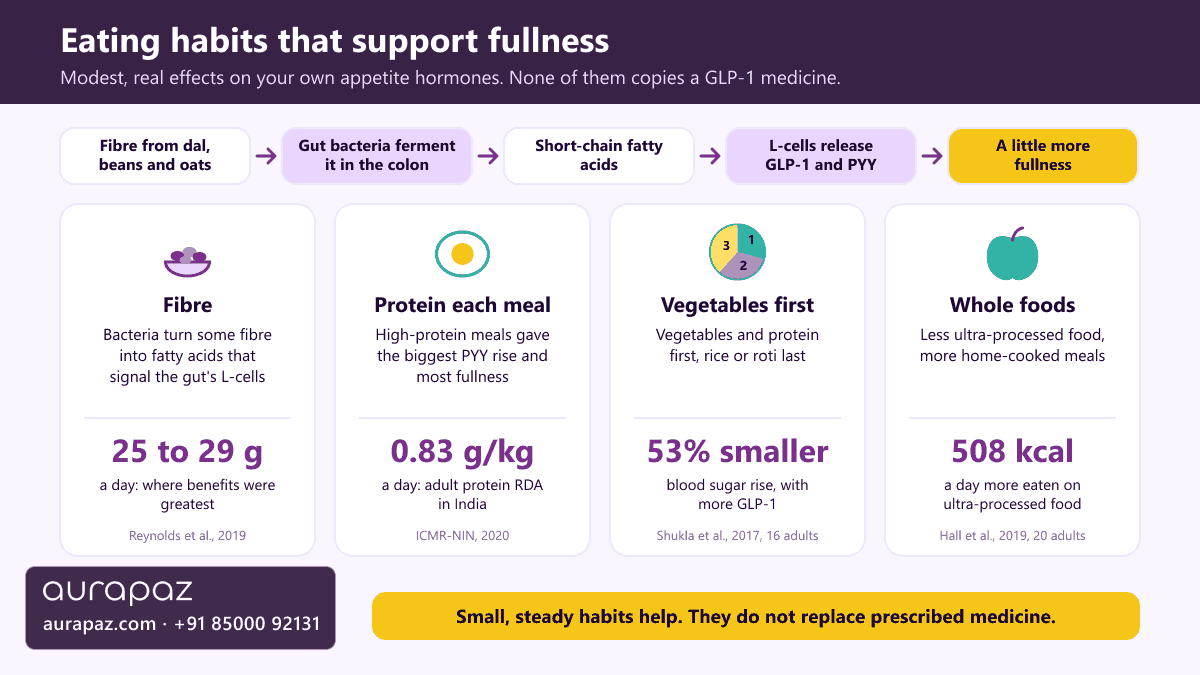
Fibre and short-chain fatty acids are often muddled together online. Fibre is the part of plant food we cannot digest ourselves. Some types, found in dals, rajma, chana, oats, whole grains, vegetables and fruit, travel to the colon, where gut bacteria ferment them. That fermentation produces short-chain fatty acids such as acetate, propionate and butyrate. It is these fatty acids, not the fibre itself, that can nudge L-cells to release GLP-1 and a second fullness hormone, PYY.
A study at Imperial College London tested this directly. In lab cells from the human colon, propionate stimulated the release of PYY and GLP-1. In volunteers, a special fibre built to deliver propionate to the colon raised both hormones after a meal and reduced how much people ate. Over 24 weeks in 60 adults with overweight, it reduced weight gain compared with plain fibre. That is an engineered ingredient slowing weight gain, not weight loss on the scale of a medicine.
Fibre also has a strong track record of its own. A large set of reviews, partly funded by the World Health Organization, found that people eating the most fibre had 15 to 30 per cent lower rates of heart disease, stroke, type 2 diabetes and bowel cancer than those eating the least, with the greatest benefits seen at 25 to 29 g a day. In its trials, higher fibre intakes went with lower body weight. My guide to the fibermaxxing trend explains how to raise fibre gradually without bloating.
Protein at every meal
Protein tends to be the most filling macronutrient. In a study led by researchers at University College London, high-protein meals produced the biggest release of PYY and the strongest sense of fullness in both normal-weight volunteers and volunteers with obesity. In Indian kitchens, that means dal, rajma, chana, paneer, curd, eggs, fish or chicken at each meal, not a plate that is mostly rice or roti. ICMR-NIN’s 2020 requirements set the protein allowance for healthy Indian adults at 0.83 g per kg of body weight a day, and note that people eating cereal-heavy diets with lower-quality protein need about 1 g per kg.
Vegetables and protein before the rice or roti
Meal order seems to matter too. In a small trial in New York, 16 adults with type 2 diabetes ate the same meal three ways. When they ate the protein and vegetables first and the carbohydrate ten minutes later, the rise in blood sugar was 53 per cent smaller than when they ate the carbohydrate first, and their GLP-1 response was higher. A Japanese trial found something similar: eating fish or meat before rice slowed stomach emptying and raised GLP-1, and in the participants with type 2 diabetes it flattened the glucose curve.
These studies were small and short, and they measured single meals, not long-term weight. Still, starting with sabzi, salad and dal before the rice is free and unlikely to do harm.
Whole foods over ultra-processed: the NIH inpatient trial
The most quoted study here comes from the US National Institutes of Health. In 2019, Kevin Hall’s team admitted 20 adults to the NIH Clinical Center for four weeks. Each ate an ultra-processed diet and an unprocessed one for two weeks each, in random order. The meals offered were matched for calories, sugar, salt, fat, fibre and protein, and people could eat as much or as little as they liked.
On the ultra-processed diet, people ate about 508 kcal a day more and gained 0.9 kg. On the unprocessed diet, they lost 0.9 kg. They also ate the ultra-processed meals faster. The appetite-curbing hormone PYY was higher, and the hunger hormone ghrelin lower, during the unprocessed fortnight than at the start, yet people did not report feeling any hungrier or fuller on either diet.
Read it carefully. It was small, short and set in a hospital, and its authors say it was not designed to identify why people overate. It does not show that ultra-processed food “blocks” GLP-1. I unpack the wider evidence in what the ultra-processed food panic gets right, and the food-industry side in how the US food supply is engineered to overeat.
“Nature’s Ozempic” and “GLP-1 friendly”: reading the marketing
Berberine
Berberine, a bitter yellow compound found in plants such as goldenseal and coptis (huanglian), is the supplement most often sold as “nature’s Ozempic”. The evidence does not support the nickname. A 2026 meta-analysis of randomised trials found that berberine lowered body weight by an average of about 0.88 kg compared with control groups. Set that beside the 12.7 kg extra lost on semaglutide versus placebo in STEP 1, and the comparison falls apart. The US National Center for Complementary and Integrative Health (NCCIH) also notes that very little berberine taken by mouth may be absorbed.
Berberine is also not harmless. In a small study of healthy volunteers, it slowed three liver enzymes (CYP2D6, CYP2C9 and CYP3A4) that process many common medicines, which can raise their levels. In a separate study, goldenseal, a berberine-containing herb, lowered metformin levels by about 25 per cent in healthy adults, which could affect blood sugar control.
Before trying berberine: avoid it if you are pregnant or breastfeeding, and never give it to babies, because berberine can push bilirubin off its carrier protein and NCCIH warns it can be harmful to newborns. If you take any prescription medicine, especially for diabetes, talk to your doctor first, because berberine can change how the body handles many medicines. Never use it in place of a medicine you have been prescribed.
Labels on packets
Food companies have noticed too. In 2025, the US brand Healthy Choice said it was the first major food brand to put “GLP-1 friendly” wording on its packs, with an “On Track” badge on 26 frozen meals that are high in protein, low in calories and a good source of fibre. The company said none of the recipes had changed. A “GLP-1 friendly” or “Ozempic-friendly” label is marketing for existing nutrition features, not a sign that a food acts like the medicine. Judge the food on its protein and fibre.
GLP-1 medicines in India today
Oral semaglutide (Rybelsus) was launched in India in January 2022 for type 2 diabetes. Eli Lilly launched tirzepatide (Mounjaro) in March 2025, Novo Nordisk launched Wegovy for weight management in June 2025, and Ozempic followed in December 2025 for type 2 diabetes.
Novo Nordisk’s patent on semaglutide expired in India in March 2026, and several Indian drug makers launched generic semaglutide injections soon after, at launch prices well below the branded versions. Lower prices help access but also make self-medication tempting.
Semaglutide and tirzepatide are prescription medicines that need medical supervision to check side effects and adjust the dose. They are not used in pregnancy or while breastfeeding. Buy them only on a valid prescription from a registered pharmacy. In 2024 the WHO issued an alert about falsified Ozempic found in the UK, Brazil and the US, warning that fake products may contain the wrong dose or unknown ingredients.
If you take a GLP-1 medicine: eating to stay strong
When appetite drops sharply, the quality of what you do eat matters more. In 2025, four US professional bodies, including the American Society for Nutrition and The Obesity Society, published a joint advisory on nutrition for people on GLP-1 medicines.
Protect your muscle
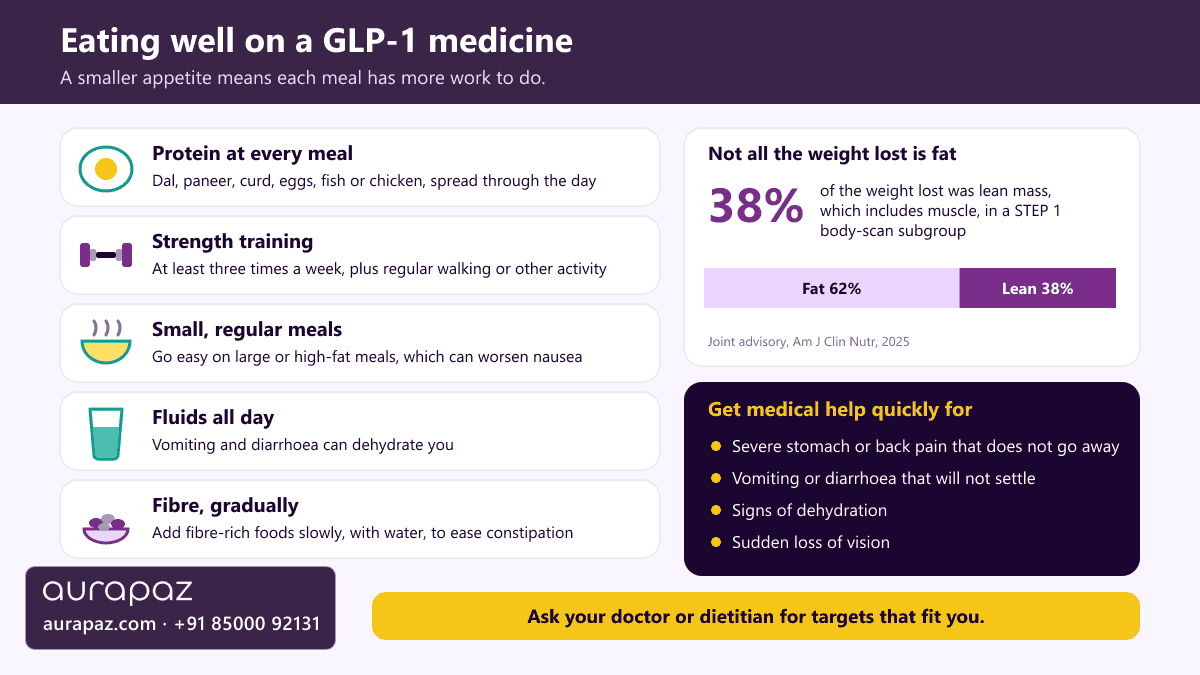
Some of the weight lost on these medicines is not fat. In a body-scan subgroup of STEP 1, about 38 per cent of the weight lost was lean mass, which includes muscle as well as other non-fat tissue. The advisory recommends strength training at least three times a week alongside regular aerobic activity, and enough protein spread across the day. It notes that targets of 1.2 to 1.6 g of protein per kg a day have been proposed during active weight loss. Ask your doctor or dietitian what suits you, especially if you have kidney disease.
Do not let small meals become poor meals
Eating very little for months raises the risk of running short of nutrients. The advisory names iron, calcium, magnesium, zinc, vitamin D, vitamin B12 and others as nutrients of concern, especially at very low calorie intakes. Build small meals around protein, vegetables, pulses, fruit and dairy rather than biscuits and namkeen, and ask your doctor whether you need blood tests or a supplement.
Handling nausea, constipation and diarrhoea
Nausea, vomiting, diarrhoea and constipation are among the most common side effects, usually mild to moderate and most noticeable while the dose is being increased. The advisory suggests smaller meals every few hours with enough fluids, and going easy on large or high-fat meals, since vomiting is more likely after a large meal. Drink steadily through the day: the European product information warns that vomiting and diarrhoea can cause dehydration, which in rare cases can harm the kidneys. For constipation, add fibre-rich foods gradually along with enough water. It is best to avoid alcohol, as the NHS notes it can worsen nausea.
When to call your doctor: get urgent help for severe stomach or back pain that does not go away (a possible sign of pancreatitis), vomiting or diarrhoea that will not settle, signs of dehydration, or a sudden loss of vision. If you also take insulin or a sulfonylurea for diabetes, the risk of low blood sugar is higher, so ask your doctor how to recognise and handle it.
Myth vs Reality: foods that “work like Ozempic”
| What the trend says | What the science says |
|---|---|
| “These foods are a natural alternative to Ozempic.” | Natural GLP-1 has a half-life under two minutes; semaglutide, about a week. Food supports fullness but does not replace medicine. |
| “Berberine is nature’s Ozempic.” | A 2026 meta-analysis found about 0.88 kg of extra weight loss on average. Berberine also affects liver enzymes that handle many medicines, and should be avoided in pregnancy and by newborns. |
| “Fibre boosts GLP-1 directly.” | Gut bacteria ferment some fibres into short-chain fatty acids, and those fatty acids can signal L-cells. The effect is real but modest. |
| “Ultra-processed food blocks your GLP-1.” | In the NIH inpatient trial people ate about 508 kcal a day more on ultra-processed food. It did not show GLP-1 being blocked. |
| “A ‘GLP-1 friendly’ label means the food acts like the drug.” | It is a marketing badge for protein, fibre and calorie content. One brand stated none of its recipes changed. |
| “On the injection, food barely matters.” | Part of the weight lost is lean mass, so protein, nutrients, fluids and strength training matter more. |
Key takeaways
- Your own GLP-1 has a half-life under two minutes. Semaglutide lasts about a week, which is why its effects are far larger.
- Fibre, protein, eating vegetables and protein first, and less-processed food all modestly support fullness.
- No food or supplement replaces a prescribed GLP-1 medicine. Berberine averaged under 1 kg in trials and interacts with medicines.
- In India, semaglutide (now also generic) and tirzepatide are prescription medicines. Use them only under a doctor’s care.
- On these medicines, prioritise protein, nutrient-rich small meals, fluids and strength training.
References & Further Reading
- Holst JJ. The physiology of glucagon-like peptide 1. Physiological Reviews, 2007; 87(4): 1409 to 1439.
- Ahrén B, Schmitz O. GLP-1 receptor agonists and DPP-4 inhibitors in the treatment of type 2 diabetes. Hormone and Metabolic Research, 2004; 36(11 to 12): 867 to 876.
- European Medicines Agency. Wegovy (semaglutide): product information.
- European Medicines Agency. Mounjaro (tirzepatide): product information.
- Wilding JPH, et al. Once-weekly semaglutide in adults with overweight or obesity. New England Journal of Medicine, 2021; 384(11): 989 to 1002.
- Jastreboff AM, et al. Tirzepatide once weekly for the treatment of obesity. New England Journal of Medicine, 2022; 387(3): 205 to 216.
- Wilding JPH, et al. Weight regain and cardiometabolic effects after withdrawal of semaglutide: the STEP 1 trial extension. Diabetes, Obesity and Metabolism, 2022; 24(8): 1553 to 1564.
- Chambers ES, et al. Effects of targeted delivery of propionate to the human colon on appetite regulation, body weight maintenance and adiposity in overweight adults. Gut, 2015; 64(11): 1744 to 1754.
- Reynolds A, et al. Carbohydrate quality and human health: a series of systematic reviews and meta-analyses. The Lancet, 2019; 393(10170): 434 to 445.
- Batterham RL, et al. Critical role for peptide YY in protein-mediated satiation and body-weight regulation. Cell Metabolism, 2006; 4(3): 223 to 233.
- Shukla AP, et al. Carbohydrate-last meal pattern lowers postprandial glucose and insulin excursions in type 2 diabetes. BMJ Open Diabetes Research and Care, 2017; 5(1): e000440.
- Kuwata H, et al. Meal sequence and glucose excursion, gastric emptying and incretin secretion in type 2 diabetes: a randomised, controlled crossover, exploratory trial. Diabetologia, 2016; 59(3): 453 to 461.
- Hall KD, et al. Ultra-processed diets cause excess calorie intake and weight gain: an inpatient randomized controlled trial of ad libitum food intake. Cell Metabolism, 2019; 30(1): 67 to 77.
- Elahi Vahed I, et al. The effect of berberine on obesity indices: a systematic review and meta-analysis. International Journal of Obesity, 2026; 50(1): 53 to 73.
- Guo Y, et al. Repeated administration of berberine inhibits cytochromes P450 in humans. European Journal of Clinical Pharmacology, 2012; 68(2): 213 to 217.
- Chan E. Displacement of bilirubin from albumin by berberine. Biology of the Neonate, 1993; 63(4): 201 to 208.
- National Center for Complementary and Integrative Health. Goldenseal.
- Mozaffarian D, et al. Nutritional priorities to support GLP-1 therapy for obesity: a joint advisory from the American College of Lifestyle Medicine, the American Society for Nutrition, the Obesity Medicine Association, and The Obesity Society. American Journal of Clinical Nutrition, 2025; 122(1): 344 to 367.
- ICMR National Institute of Nutrition. A brief note on nutrient requirements for Indians. 2020.
- NHS. Semaglutide.
- World Health Organization. Medical Product Alert N°2/2024: falsified Ozempic (semaglutide). 19 June 2024.
- BioSpectrum India. Novo Nordisk launches world’s most prescribed GLP-1 drug Ozempic in India. 12 December 2025.
- Indian Pharma Post. Novo Nordisk India launches world’s first and only GLP-1 RA, oral semaglutide. 20 January 2022.
- BioSpectrum India. Eli Lilly introduces Mounjaro (tirzepatide) for treatment of obesity and type 2 diabetes. 20 March 2025.
- Business Today. India’s weight loss drug moment: what happens when semaglutide goes generic. 20 March 2026.
- Outlook Business. Sun Pharma, Dr Reddy’s, Glenmark launch generic semaglutide injection in India. 21 March 2026.
- FoodNavigator. GLP-1 compatible food labels launched by giant as “industry first”. 2 January 2025.