
Almost every parent meets the fussy eater eventually. The toddler who happily ate dal rice last month now pushes the plate away. The five-year-old picks every fleck of coriander out of the sabzi. Dinner turns into a nightly negotiation, and you start to wonder whether you are doing something wrong. Usually, you are not. Fussy eating is most often a normal stage of development, and the research on how to respond to it is clearer and kinder than most of the advice handed down at family gatherings.
Why children become fussy eaters
Researchers separate two related behaviours. Food neophobia is reluctance to try anything new. Picky eating is rejecting a good share of foods, including familiar ones. There is no single agreed definition of picky eating, which is one reason published prevalence figures vary so widely. Three forces drive most of what parents see.
Caution around new food is built in
Developmental neophobia is usually described as a natural stage between roughly two and six years, the age when children become more independent about food. The usual explanation is evolutionary: a newly mobile child who distrusts unfamiliar things is less likely to swallow something harmful. It is a feature of growing up, not a flaw in your child or your cooking.
Children really do taste things differently
Research from the Monell Chemical Senses Center shows that children prefer higher levels of sweetness than adults do, and that they are more sensitive to bitterness than adults with the same genes. That heightened bitterness shows up in exactly the foods they reject, such as green vegetables. So when a child recoils from methi or karela, they may be tasting something genuinely harsher than you are. Texture matters too: a curry where everything is mixed together can feel like too much at once.
Appetite slows and independence grows
According to the ICMR National Institute of Nutrition, a baby’s birth weight roughly triples in the first year, but in the second year a toddler gains only about two kilograms. Slower growth means a smaller appetite, and toddler appetites swing a great deal from one day to the next. Add a growing sense of independence and refusing food becomes one of the few real choices a small child gets to make.
What the research says actually works
Feeding fussy children has been studied carefully, including in randomised trials. Three findings stand out.
Repeated, low-pressure tasting changes minds
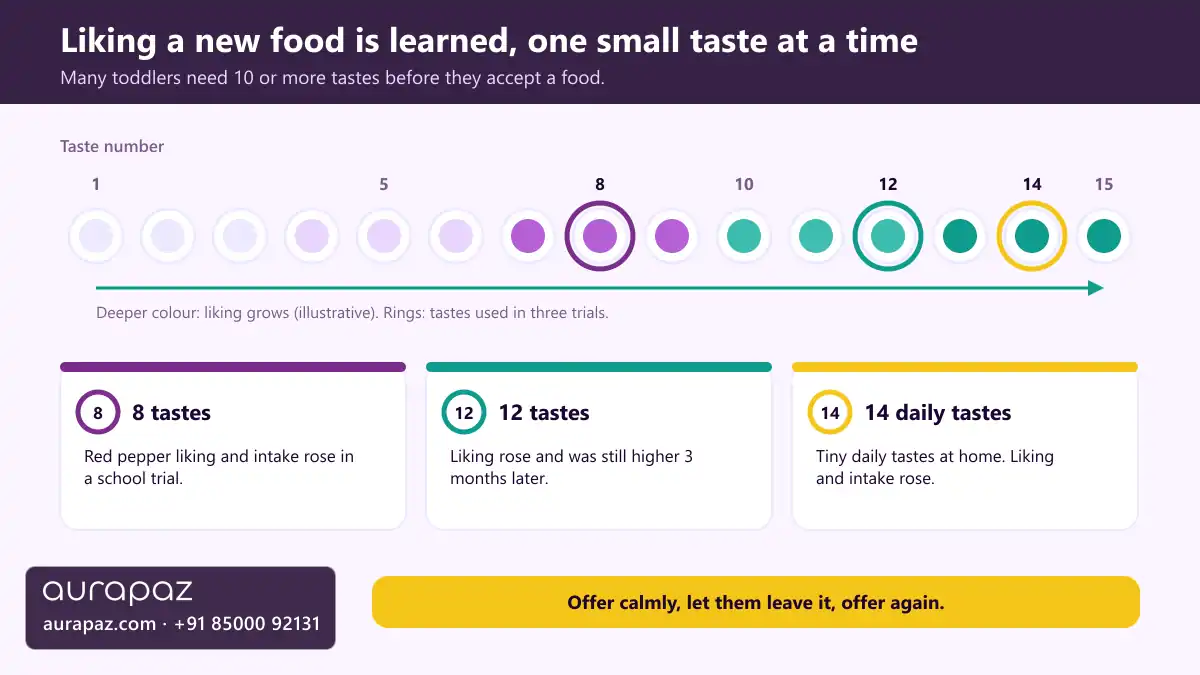
Children like what is familiar, and familiarity comes from contact. In one randomised trial, parents of children aged two to six offered a tiny taste of a vegetable their child disliked every day for 14 days. Compared with families given only nutrition advice or nothing at all, those children showed bigger increases in liking and in how much of the vegetable they ate. A separate school study in London used eight daily tastes of raw red pepper and found the same pattern. A later trial using 12 daily tastes of a disliked vegetable found the gain in liking was still there three months on.
The American Academy of Pediatrics puts it plainly: it can take 10 or more tastes before a toddler accepts a food. Two refusals tell you almost nothing.
Pressure backfires
“Just finish your plate” feels harmless, but it has been tested directly. In a study of preschoolers, children ate significantly more when they were not pressured, and made far fewer negative comments about the food. When asked to finish, they ate less and complained more. Pressure turns food into a contest, and children usually win.
Rewards are more nuanced than you have heard
You may have read that rewards always ruin motivation. In one trial, though, pairing daily tastes with a sticker or with simple praise did not harm liking, and children in the reward groups kept eating more of the vegetable three months later. The problem is using food as the prize. The NHS advises against using food as a reward, because “finish your sabzi and you can have ice cream” teaches that vegetables are a chore and sweets are the trophy.
The Division of Responsibility: the one rule worth keeping
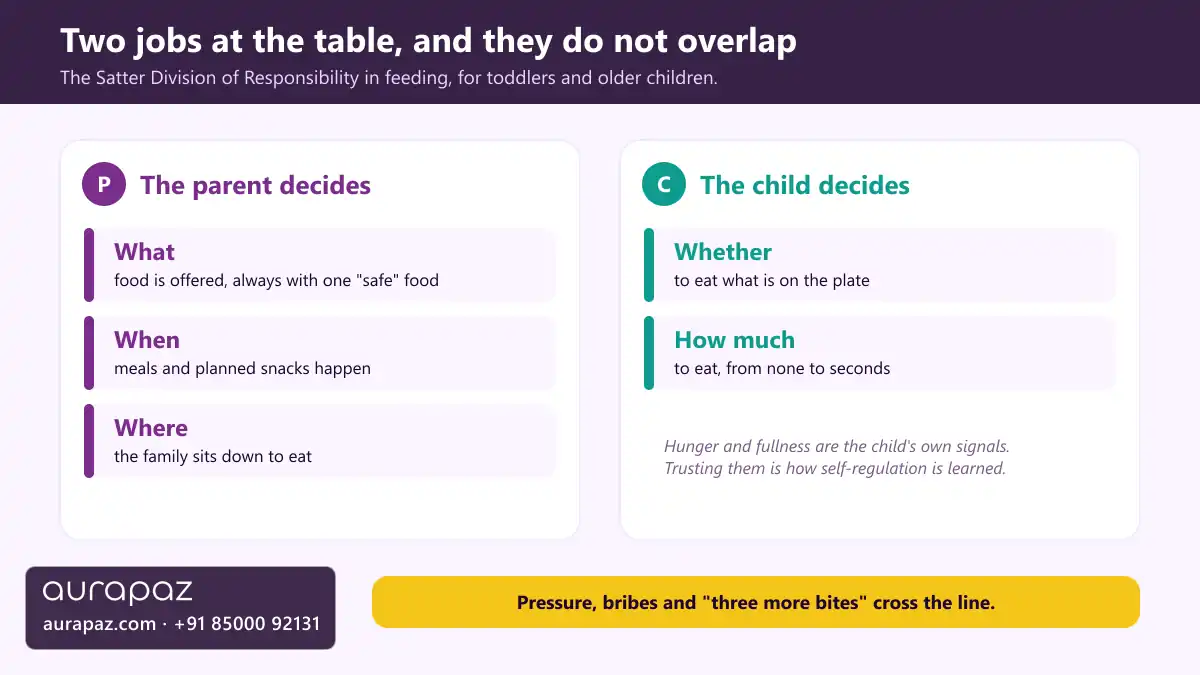
If you take one idea from this guide, take this one. The Satter Division of Responsibility in feeding, developed by dietitian Ellyn Satter, splits mealtime into two jobs that do not overlap.
- The parent decides what food is offered, when meals and snacks happen, and where they are eaten.
- The child decides whether to eat, and how much.
Your job is to put balanced, varied food on the table at predictable times, always including one or two foods your child usually eats, and to sit down together. Your child’s job is to listen to their own hunger and fullness. The Satter Institute is specific about what crossing the line looks like: bribing, cheerleading, insisting on a set number of bites, or making a separate meal to order. Satter also advises against rewards; the trial evidence above suggests a sticker for tasting does no harm, and food rewards are the ones to avoid. The Satter Institute also suggests offering only water between meals and snacks, so that children arrive at the table ready to eat.
This can feel like doing less. In practice it removes the tug of war that often keeps fussiness going.
Myth vs Reality: what fussy eating is and is not
| What the trend says | What the science says |
|---|---|
| “A fussy eater is just being stubborn.” | Wariness of new food is a recognised developmental stage, and children are more sensitive to bitter tastes than adults. Much of the rejection is biology, not defiance. |
| “She refused it twice, so she simply doesn’t like it.” | It can take 10 or more tastes before a toddler accepts a food. Trials that improved liking used 8 to 14 small daily tastes. |
| “A few more bites and then you can go.” | Preschoolers who were pressured to finish ate less and made more negative comments about the food than when left to decide. |
| “Any reward ruins a child’s relationship with food.” | A sticker or praise for tasting did not reduce liking in a randomised trial. Using sweets or dessert as the prize is what health bodies advise against. |
| “Hide the vegetables and the problem is solved.” | Grated carrot in a paratha adds nutrients, but a child learns to accept a vegetable by meeting it as itself, again and again. |
| “If he skips dinner, an extra glass of milk will make up for it.” | Too much cow’s milk blunts appetite and lowers iron absorption. Guidance for toddlers aged one to two is about two cups a day. |
What “balanced” means for a child’s plate
What matters is the balance across a week, not a single plate. A child’s day pulls from four building blocks:
- Energy foods: rice, roti, poha, idli, dosa, oats and potato.
- Body-building foods: dal, rajma, chana, eggs, paneer, curd, chicken or fish. My guide to protein for children covers how much they actually need and the easiest sources.
- Protective foods: a rotating mix of fruit and vegetables for vitamins, minerals and fibre.
- Healthy fats: a little ghee or oil in cooking, plus ground nuts and seeds in forms that are safe for your child’s age.
Iron needs a little planning
Iron deserves particular attention in selective eaters. The ICMR National Institute of Nutrition notes that iron deficiency in children raises susceptibility to infection and impairs learning, and that iron from plant foods is absorbed poorly. Pair dal, green leafy vegetables and pulses with a vitamin C source such as guava, orange, lemon or a coriander chutney. And keep tea away from meals, because it binds iron; the guidelines suggest avoiding it for at least an hour before, during and soon after eating. If your child has a small cup of chai with breakfast, that habit is worth rethinking.
Watch the milk
Milk is a wonderful food, and also a common reason a toddler is “never hungry” at meals. Nemours KidsHealth advises limiting milk to about 16 ounces (around two cups) a day for toddlers aged 12 to 24 months, and 16 to 24 ounces (two to three cups) for those over two. Beyond filling small stomachs, cow’s milk reduces iron absorption and, in some toddlers, irritates the gut lining enough to cause small, steady iron losses.
A sample day, and how the week balances out
Here is a realistic day for a young child in an Indian household: a pattern, not a prescription. The ICMR guidelines advise no added sugar at all for children under two, so keep sweets and sweetened drinks off the menu entirely at that age.
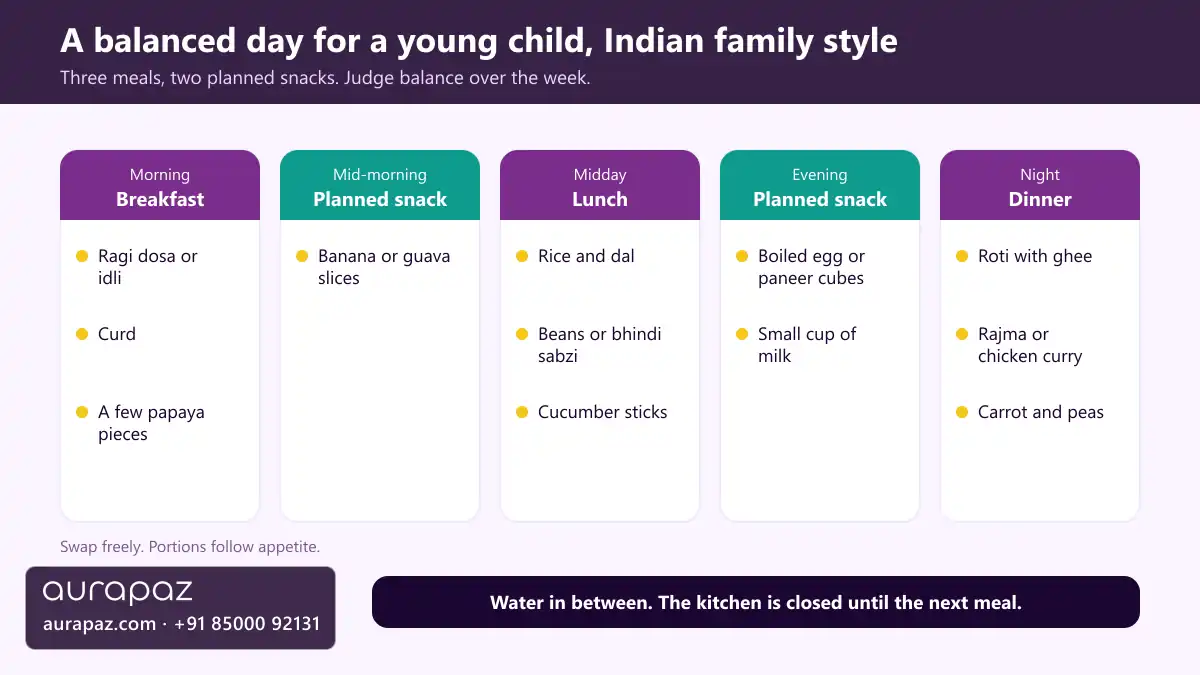
Across a week, aim for dal or another pulse most days, eggs, paneer, fish or chicken several times if your family eats them, a green leafy vegetable two or three times, a millet such as ragi or jowar a few times, and fruit every day. If Tuesday was all rice and curd, Wednesday can lean on vegetables. Tracking the week instead of each plate lowers the pressure at the table. If you are still in the earlier weaning stage, my post on when to start solids covers the early foundations.
Practical strategies for the family table
- Serve small and say little. Put a spoonful of the new food on the plate beside familiar ones. No commentary. Being ignored still counts as exposure.
- Deconstruct the meal. For a texture-sensitive child, keep components separate: rice here, dal there, cucumber sticks on the side, rather than one mixed bowl.
- Eat together. The NHS notes that children learn to enjoy new foods by copying you.
- Bring them into the kitchen. In a small experiment with children aged six to ten, those who helped prepare lunch ate noticeably more salad than those whose parent cooked alone. Washing vegetables, tearing coriander or rolling a wonky roti all count.
- Protect the rhythm. Three meals and two planned snacks at roughly set times, then the kitchen closes. A child grazing on biscuits, juice or milk rarely arrives hungry.
- Do not become a short-order cook. Always include one accepted food, then serve the family meal.
- Stay neutral. No drama for refusing and no over-the-top celebration for eating. Both turn food into an emotional lever.
- Mind the packet foods. Ultra-processed snacks are designed to be easy to like, which can make ordinary food seem dull. See the truth about ultra-processed foods and how sugar affects your skin and body.

When fussy eating is more than a phase
Ordinary fussiness is frustrating but rarely dangerous, and most fussy children keep growing steadily along their own curve. Speak to your paediatrician if you notice any of the following:
- Weight or height dropping across the lines of the growth chart, or weight loss
- A very short list of accepted foods that keeps shrinking
- Gagging, choking, vomiting or apparent pain when eating
- Tiredness, pale skin or frequent illness, which can point to iron or other deficiencies
- Intense distress at the sight, smell or texture of food that disrupts family life, nursery or school
One condition worth knowing by name is avoidant restrictive food intake disorder (ARFID). According to the UK eating disorder charity Beat, ARFID can affect people of any age and any weight. It may be driven by sensory sensitivity, by fear of what might happen after eating (for example after a choking episode), or by very low interest in food. Unlike anorexia, it is not about weight or body shape. It is often mistaken for fussiness, and in children it can cause poor growth. It needs specialist assessment, not stricter rules at home.
Please do not start supplements or restrictive diets for a selective child without professional advice. If you are worried about iron, ask your paediatrician about a blood test rather than guessing.
Key takeaways
- Fussy eating is usually a normal developmental stage. Wariness of new food is common between about two and six years.
- Children are more sensitive to bitter tastes than adults, so rejecting greens is partly biology.
- It can take 10 or more calm tastes before a toddler accepts a food. Trials have used 8 to 14 daily tastes.
- Pressure to eat reduces intake and enjoyment. Food as a reward is the kind of reward to avoid.
- Follow the Division of Responsibility: you decide what, when and where; your child decides whether and how much.
- Judge balance over the week, pair plant iron with vitamin C, keep tea away from meals and cap toddler milk at about two cups a day.
- Faltering growth, a shrinking food list or real distress around food deserve a paediatric assessment.
References & Further Reading
- Ellyn Satter Institute. The Satter Division of Responsibility in Feeding.
- Ellyn Satter Institute. Picky Eating.
- Wardle J, Cooke LJ, Gibson EL, et al. Increasing children’s acceptance of vegetables; a randomized trial of parent-led exposure. Appetite. 2003;40(2):155-62.
- Wardle J, Herrera ML, Cooke L, Gibson EL. Modifying children’s food preferences: the effects of exposure and reward on acceptance of an unfamiliar vegetable. Eur J Clin Nutr. 2003;57(2):341-8.
- Cooke LJ, Chambers LC, Añez EV, et al. Eating for pleasure or profit: the effect of incentives on children’s enjoyment of vegetables. Psychol Sci. 2011;22(2):190-6.
- Galloway AT, Fiorito LM, Francis LA, Birch LL. ‘Finish your soup’: counterproductive effects of pressuring children to eat on intake and affect. Appetite. 2006;46(3):318-23.
- Cooke L. The importance of exposure for healthy eating in childhood: a review. J Hum Nutr Diet. 2007;20(4):294-301.
- Dovey TM, Staples PA, Gibson EL, Halford JC. Food neophobia and ‘picky/fussy’ eating in children: a review. Appetite. 2008;50(2-3):181-93.
- Białek-Dratwa A, Szczepańska E, Szymańska D, et al. Neophobia: a natural developmental stage or feeding difficulties for children? Nutrients. 2022;14(7):1521.
- Mennella JA, Bobowski NK. The sweetness and bitterness of childhood: insights from basic research on taste preferences. Physiol Behav. 2015;152(Pt B):502-7.
- Taylor CM, Wernimont SM, Northstone K, Emmett PM. Picky/fussy eating in children: review of definitions, assessment, prevalence and dietary intakes. Appetite. 2015;95:349-59.
- van der Horst K, Ferrage A, Rytz A. Involving children in meal preparation. Effects on food intake. Appetite. 2014;79:18-24.
- American Academy of Pediatrics, HealthyChildren.org. 10 Tips for Parents of Picky Eaters.
- NHS. Fussy eaters.
- Nemours KidsHealth. Nutrition Guide for Toddlers.
- ICMR National Institute of Nutrition. Dietary Guidelines for Indians, revised edition 2024 (PDF).
- Beat Eating Disorders. Avoidant/restrictive food intake disorder (ARFID).