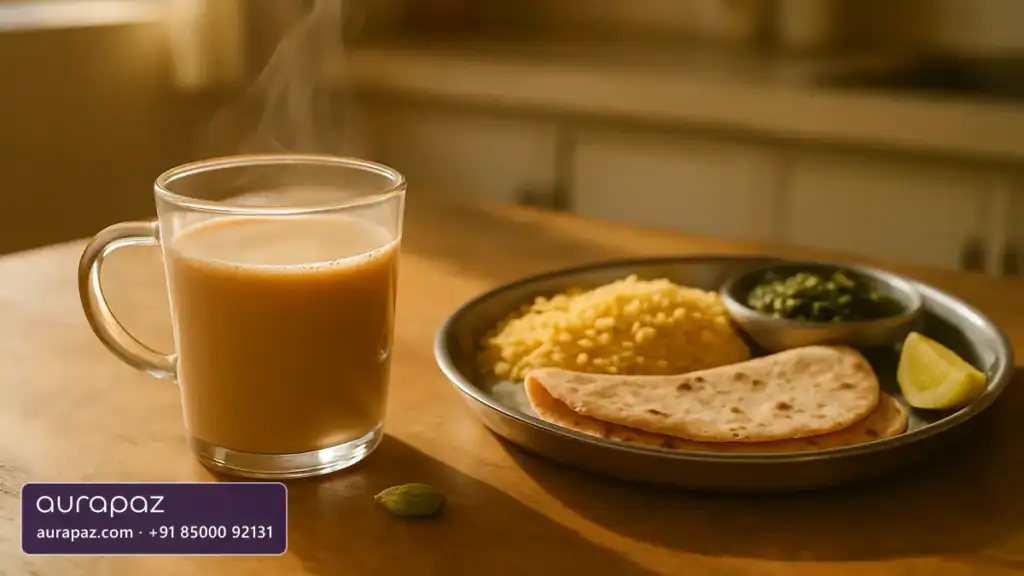
Few things are as settled in an Indian home as the cup of chai. It arrives with breakfast, follows lunch, rescues the afternoon and often turns up again after dinner. So when someone tells you that your chai is “blocking your iron”, it can feel like being told to give up something that is part of the family. The good news is that you almost certainly do not have to. The more useful news is that when you drink it matters a great deal more than whether you drink it at all.
The science here is old, solid and surprisingly practical. Tea really does reduce how much iron you absorb from a meal. The effect is large enough to matter for many Indian women, and manageable with a change of timing and a squeeze of lemon. Here is what the research shows, and how to keep your chai without short-changing your blood.
Why chai and iron matter so much in India
Anaemia is remarkably common in India, and it falls hardest on women. According to the fifth National Family Health Survey (NFHS-5, 2019 to 21), 57 percent of women aged 15 to 49 are anaemic. Among adolescent girls aged 15 to 19 the figure is 59.1 percent, among pregnant women 52.2 percent, and among breastfeeding women 60.6 percent. A quarter of men in the same age group are anaemic too. The trend is moving the wrong way: the previous survey, NFHS-4 (2015 to 16), found 53 percent.
For comparison, the World Health Organization estimates that around 30 percent of women aged 15 to 49 are anaemic worldwide. Anaemia has several causes, including low folate or vitamin B12, infections and heavy periods, but the WHO names iron deficiency as the most common nutritional cause. Add a habit of tea with most meals and a diet where most iron comes from dal and greens, and the question deserves a proper answer. If you are vegetarian and have been told your haemoglobin is low, it is worth reading my piece on vitamin B12 deficiency in Indian women as well, because the two can overlap and the symptoms feel similar.
What tea actually does to iron
The tannin effect
Tea is rich in polyphenols, the same family of plant compounds that gives it colour, body and much of its antioxidant reputation. Some of these, often grouped loosely as tannins, bind to iron in the gut. As far back as 1975, researchers publishing in the journal Gut showed that tea reduced iron absorption from bread, from a rice meal and from iron solutions, and they put the effect down to insoluble iron and tannate complexes that the body cannot take up.
The size of the effect is not trivial. In a 1999 study in the British Journal of Nutrition, black tea served with a bread meal cut iron absorption by 79 to 94 percent compared with the same meal taken with water. Coffee, cocoa and several herbal teas also reduced absorption; peppermint tea by 84 percent and camomile by 47 percent. The more polyphenols a drink contained, the stronger the effect. A separate Swedish study that served tea with a mixed meal containing meat found a smaller, but still large, 62 percent reduction. Coffee in that study reduced absorption by 35 percent.
Those numbers come from single test meals in a laboratory. They show that tea at the table pulls iron absorption down sharply. They do not show that every tea drinker becomes anaemic, and that is where most of the online panic goes wrong.
Haem iron and non-haem iron
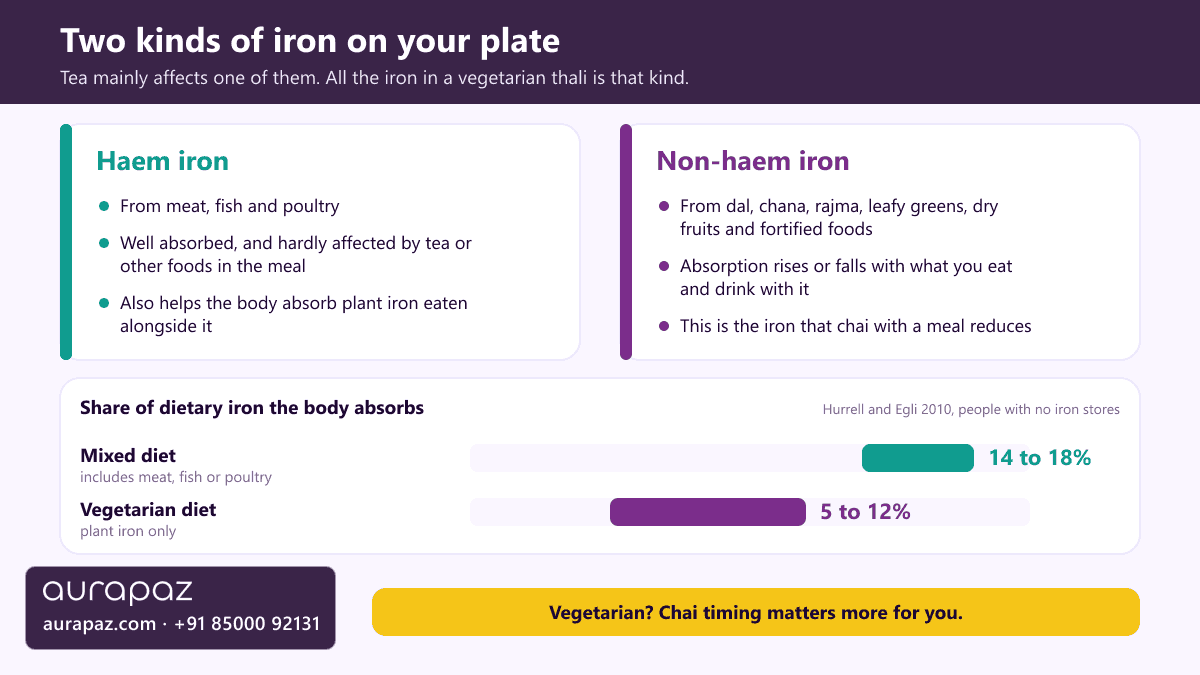
Iron in food comes in two forms. Haem iron is found in meat, fish and poultry. It is well absorbed and is hardly influenced by tea or other foods eaten with it. Non-haem iron is the form found in dal, chana, rajma, green leafy vegetables, dry fruits and fortified foods, and its absorption rises or falls depending on what shares the plate. Tea’s effect falls almost entirely on this second kind.
That matters because all the iron in a vegetarian thali is non-haem. A review by researchers at ETH Zurich puts absorption, for people with no iron stores, at roughly 14 to 18 percent of the iron from a mixed diet, compared with 5 to 12 percent from a vegetarian diet. If your plate is vegetarian, you are already working with the less absorbable form, so anything that pushes absorption further down deserves more attention.
Timing changes the picture
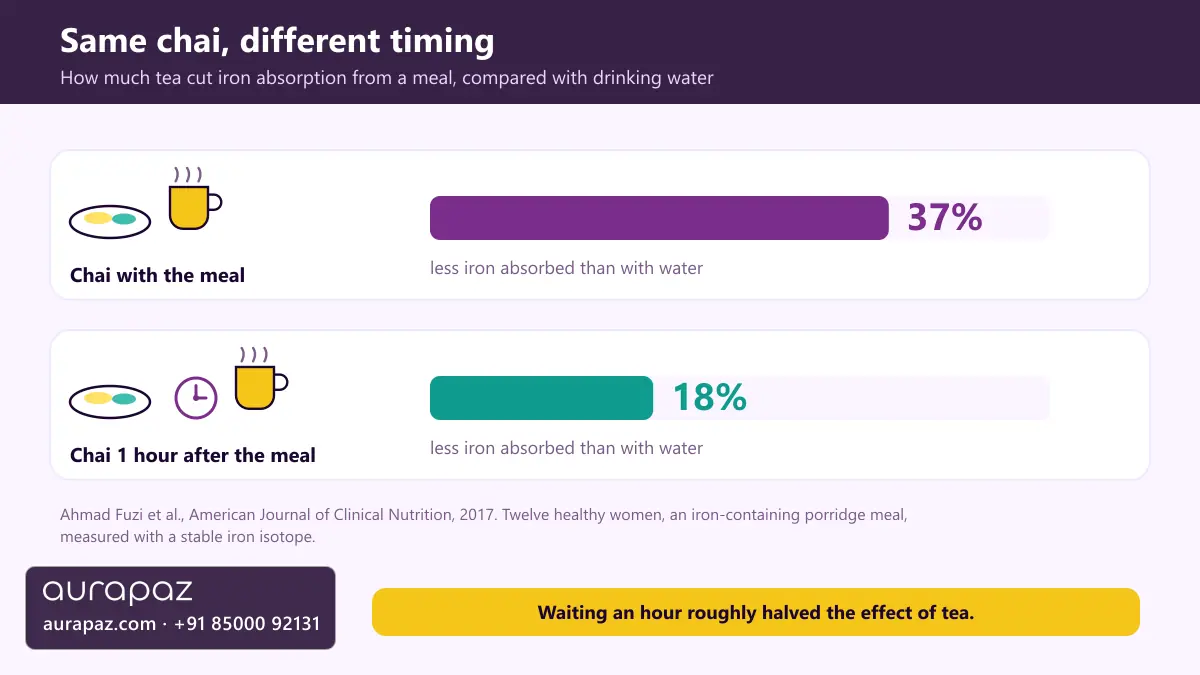
If tea only interferes with the iron it meets in the gut, the obvious question is what happens when the two simply do not meet. A 2017 trial published in the American Journal of Clinical Nutrition tested exactly that. Twelve healthy, iron-replete women in the UK ate the same iron-containing porridge meal on three occasions: once with water, once with tea at the same time, and once with tea an hour after eating. The iron was labelled with a stable isotope so the researchers could measure precisely how much reached the blood.
Tea drunk with the meal reduced iron absorption by about 37 percent compared with water. When the same tea was drunk one hour later, the reduction fell to about 18 percent. In other words, a one-hour gap roughly halved the effect. It did not remove it, and the study was small and tested a single time gap, so we cannot say whether two hours would be better. Still, it is the clearest human evidence that simply moving your cup makes a measurable difference.
This is also what Indian guidance now recommends. The ICMR National Institute of Nutrition’s Dietary Guidelines for Indians (2024) states that tea and coffee should be avoided for at least one hour before and after meals because their tannins interfere with iron absorption. For pregnant women, the same guidelines add that tea should be avoided before, during or soon after a meal, and while taking iron and folic acid supplements.
Myth vs Reality: chai and iron
| What the trend says | What the science says |
|---|---|
| “Drinking chai causes anaemia.” | Tea reduces iron absorption from the meal it is drunk with. A review of 16 studies found no link between tea and iron status in groups with adequate iron stores. The link showed up mainly in people whose iron was already marginal. |
| “Adding milk to chai cancels out the tannins.” | In the 1999 British Journal of Nutrition study, adding milk to tea or coffee had little or no influence on their inhibitory effect. Milky chai at a meal still reduces iron absorption. |
| “Tea blocks all iron, including the iron in meat.” | Tea mainly affects non-haem iron. Haem iron from meat, fish and poultry is hardly affected, which is why the timing question matters far more for vegetarians. |
| “Herbal or green tea is a safe swap with meals.” | Many herbal teas also reduced iron absorption in controlled studies, peppermint by 84 percent and camomile by 47 percent. Green tea is also rich in polyphenols. A different tea is not the fix; a different time is. |
| “If I add lemon, I can drink tea with every meal.” | Vitamin C can counteract much of the inhibition, but in a 1975 study published in Gut, tea still reduced absorption from a meal even when vitamin C was present. Lemon helps. It is not a free pass. |
What helps your body absorb plant iron
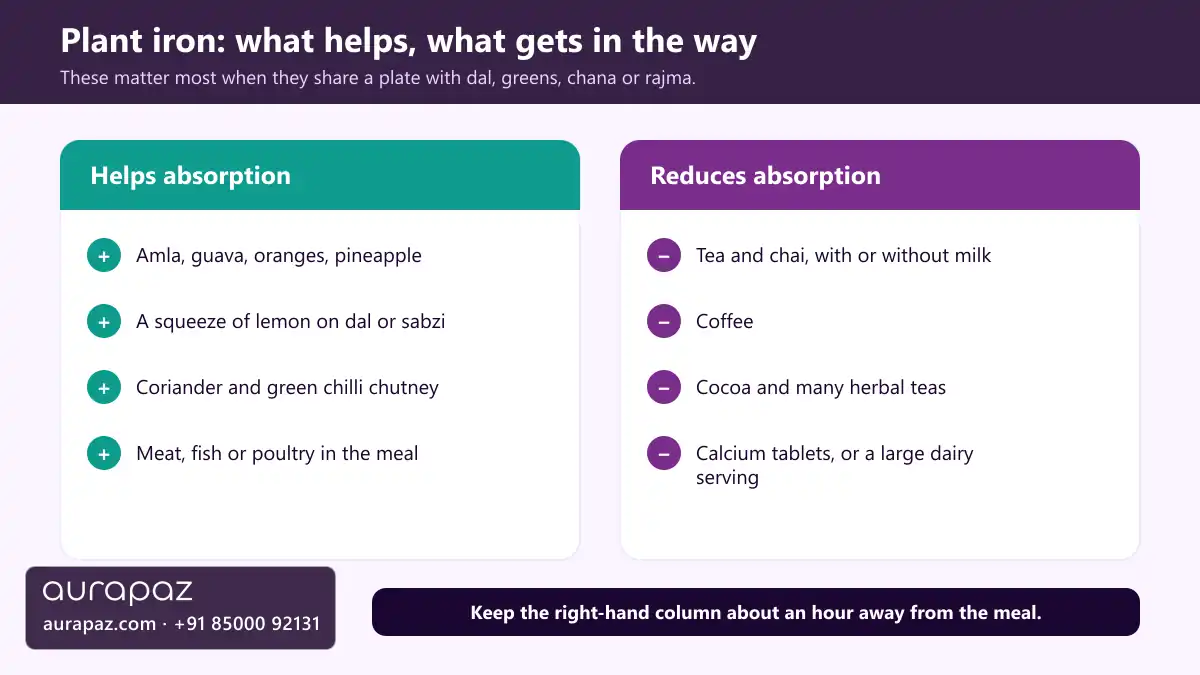
Vitamin C is the most powerful everyday ally non-haem iron has. It keeps iron in a soluble form and helps convert it into the ferrous form the gut can take up. In a Swedish study from 1982, orange juice served with a meal increased non-haem iron absorption by 85 percent, the mirror image of what tea did to the same kind of meal. Milk served as a drink with the meal, interestingly, had no significant effect in that study.
Vitamin C also pushes back against tea’s compounds directly. Researchers in Johannesburg, testing nearly 200 volunteers, found that the inhibitory effect of tannic acid on iron absorption rose with the dose, and estimated that at least 50 mg of vitamin C would be needed to overcome the effect of a meal containing more than 100 mg of tannic acid. Vitamin C works best as a regular companion to iron-rich food, not an occasional rescue.
The ICMR-NIN guidelines name foods that fit easily into Indian meals: guava, amla, pineapple, citrus fruits such as lemon and orange, and chutneys made with coriander and green chillies. Meat, fish and poultry also help the body absorb the plant iron eaten alongside them. If you want more ideas for building nutrient-dense vegetarian plates, my guide to how much protein you need and the best sources pairs naturally with this, since dal, chana and rajma do double duty for protein and iron.
On the other side, the British Dietetic Association and the NHS both list tea and coffee as drinks that make iron harder to absorb, and the NHS adds milk and dairy. Calcium is a recognised inhibitor, so calcium tablets are best kept away from an iron-rich meal or an iron tablet.
Who should take chai timing seriously
A thorough review published in the European Journal of Clinical Nutrition looked at 16 studies of tea drinking and iron status. In groups where iron deficiency was uncommon, mostly men and older adults, tea drinking was not linked with lower iron stores or haemoglobin. In groups where deficiency was common, such as infants, children and premenopausal women, a link appeared, although much of it disappeared once the rest of the diet was taken into account. Tea mainly mattered where iron status was already marginal.
Given the NFHS-5 figures, that describes a great many Indian women. I would treat chai timing as a genuine priority if you are:
- Menstruating, particularly with heavy periods, because regular blood loss steadily raises how much iron you need to replace.
- Pregnant or breastfeeding, when needs rise sharply and the ICMR-NIN advice on tea is explicit.
- Vegetarian or vegan, because all of your iron is the non-haem kind that tea affects.
- An adolescent girl, since growth and the start of menstruation arrive together, and almost six in ten girls aged 15 to 19 are anaemic.
- Diagnosed with iron deficiency or taking iron tablets, when every meal’s absorption counts.
If you are a man, or a woman past menopause, with a varied diet and normal blood results, there is no evidence that your usual chai is harming your iron. The one-hour habit costs nothing, but there is no reason for anxiety.
One honest caution: tiredness is not proof of low iron. It has many possible causes, which I have explored in the most common causes of chronic fatigue. The NHS lists tiredness, shortness of breath, a pounding or fluttering heartbeat, pale skin and headaches among the common symptoms of iron deficiency anaemia. If these sound familiar, the right next step is a blood test, not a supplement.
A chai routine that protects your iron
None of this requires giving up tea. It asks you to move it. In practice, these are the small changes I suggest most often, because they fit around a normal Indian day:
- Leave about an hour between chai and your main meals. If morning tea is non-negotiable, have it on waking and eat breakfast later, or move it to mid-morning.
- Make the after-lunch chai an afternoon chai. Moving it to four o’clock keeps the ritual and gets it out of the way of the iron in your dal and sabzi.
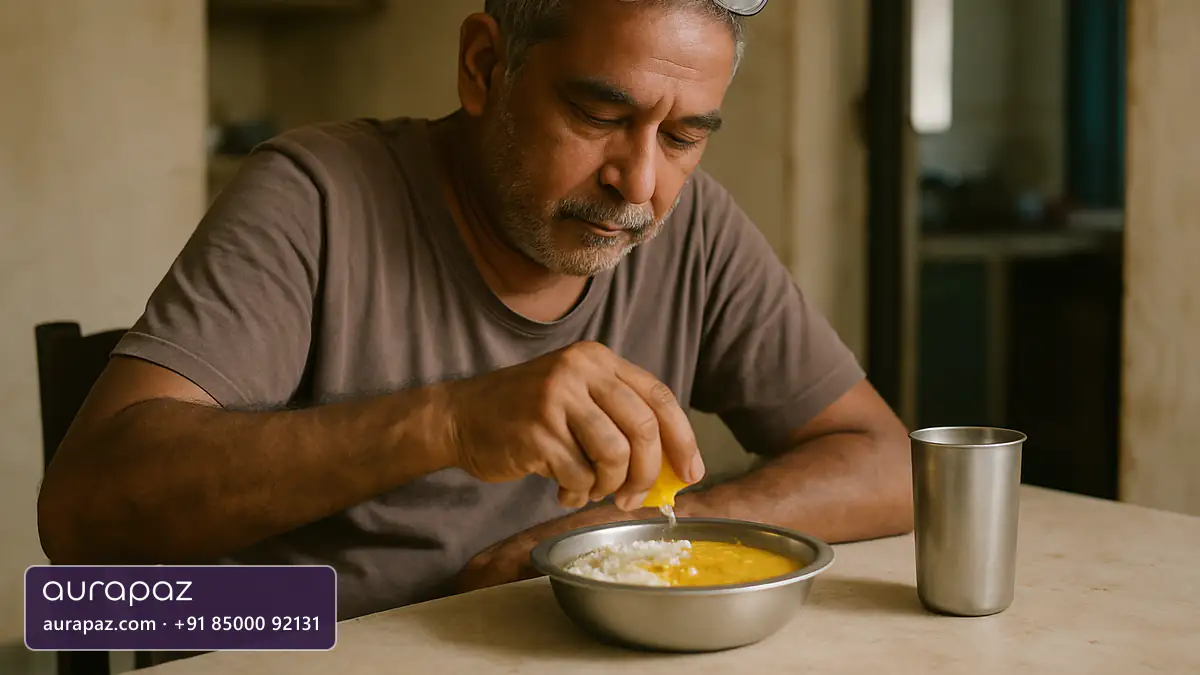
- Add a vitamin C food to iron-rich meals. Lemon on dal or poha, amla or guava after lunch, a coriander and green chilli chutney, or a fresh orange.
- Drink water or nimbu pani with meals rather than tea or coffee. Keep large servings of milk or curd for a different meal from your most iron-rich one if your iron is low.
- Take iron tablets the way your doctor advises, away from tea, coffee and calcium tablets. The NHS notes that a glass of orange juice after the tablet may help absorption.
- Build meals around good iron sources: pulses, green leafy vegetables, dry fruits, fortified foods and, if you eat them, meat, fish and poultry. Food is the foundation, a theme I come back to in food as medicine.
Please do not start iron supplements on your own. The NHS notes that high doses can cause constipation, nausea, vomiting and stomach pain, and that very high doses can be fatal, particularly if taken by children. Keep them well out of reach. Symptoms that look like anaemia can have other causes, including low vitamin B12 or folate. If you feel persistently tired, breathless or unusually pale, ask your doctor for a blood test such as a full blood count, which can be paired with a measure of your iron stores. Let the result, and your doctor, decide whether you need supplements and at what dose.
Key takeaways
- Tea polyphenols bind non-haem iron, the kind in dal, greens and grains. Milk does not cancel the effect. Haem iron from meat, fish and poultry is hardly affected.
- Drinking tea one hour after a meal roughly halved its effect on iron absorption in a 2017 trial, and ICMR-NIN advises keeping tea and coffee at least an hour away from meals.
- Vitamin C foods such as amla, guava, lemon and coriander chutney help the body absorb plant iron.
- With healthy iron stores, tea has not been linked with lower iron status. Timing matters most in menstruation, pregnancy, adolescence, vegetarian diets and existing low iron.
- 57 percent of Indian women aged 15 to 49 are anaemic (NFHS-5). If you have symptoms, get a blood test before taking any supplement.
References & Further Reading
- Hurrell RF, Reddy M, Cook JD. Inhibition of non-haem iron absorption in man by polyphenolic-containing beverages. British Journal of Nutrition, 1999; 81(4): 289 to 295.
- Disler PB, Lynch SR, Charlton RW, et al. The effect of tea on iron absorption. Gut, 1975; 16(3): 193 to 200.
- Ahmad Fuzi SF, Koller D, Bruggraber S, et al. A 1-h time interval between a meal containing iron and consumption of tea attenuates the inhibitory effects on iron absorption. American Journal of Clinical Nutrition, 2017; 106(6): 1413 to 1421.
- Hallberg L, Rossander L. Effect of different drinks on the absorption of non-heme iron from composite meals. Human Nutrition: Applied Nutrition, 1982; 36(2): 116 to 123.
- Siegenberg D, Baynes RD, Bothwell TH, et al. Ascorbic acid prevents the dose-dependent inhibitory effects of polyphenols and phytates on nonheme-iron absorption. American Journal of Clinical Nutrition, 1991; 53(2): 537 to 541.
- Hallberg L, Brune M, Rossander L. The role of vitamin C in iron absorption. International Journal for Vitamin and Nutrition Research Supplement, 1989; 30: 103 to 108.
- Zijp IM, Korver O, Tijburg LB. Effect of tea and other dietary factors on iron absorption. Critical Reviews in Food Science and Nutrition, 2000; 40(5): 371 to 398.
- Temme EH, Van Hoydonck PG. Tea consumption and iron status. European Journal of Clinical Nutrition, 2002; 56(5): 379 to 386.
- Hurrell R, Egli I. Iron bioavailability and dietary reference values. American Journal of Clinical Nutrition, 2010; 91(5): 1461S to 1467S.
- International Institute for Population Sciences and ICF. National Family Health Survey (NFHS-5), 2019 to 21: India Report. Chapter 10, Nutrition and Anaemia.
- ICMR National Institute of Nutrition. Dietary Guidelines for Indians. Revised edition, 2024.
- World Health Organization. Anaemia fact sheet. 10 February 2025.
- NHS. Iron: vitamins and minerals.
- NHS. Iron deficiency anaemia.
- British Dietetic Association. Iron: Food Fact Sheet.