
Most Indian kitchens run on habits handed down from mothers and grandmothers: cook fresh, boil the milk, wash everything. Many of those habits are genuinely protective. A few are not, and some newer ones, like washing chicken under the tap or leaving the dal on the stove overnight, quietly undo the good work. Food safety at home is less about buying special products and more about knowing which everyday routines actually matter.
None of this is a reason to feel anxious about your kitchen. What keeps a family well is mostly simple, cheap and already within reach.
Why the home kitchen deserves attention
We tend to link food poisoning with street food or a wedding buffet, yet most meals are cooked, stored and reheated at home. The World Health Organization’s food safety fact sheet, updated in June 2026, estimates that 866 million people, almost 1 in 9 people in the world, fall ill after eating contaminated food each year. Children under five carry 29% of the health burden from unsafe food, and WHO notes that infants, pregnant women, older people and anyone already unwell usually feel the effects more severely.
The good news is that WHO boils the subject down to five habits, its Five Keys to Safer Food: keep clean, separate raw and cooked, cook thoroughly, keep food at safe temperatures, and use safe water and raw materials. Almost everything in this article fits under one of them.
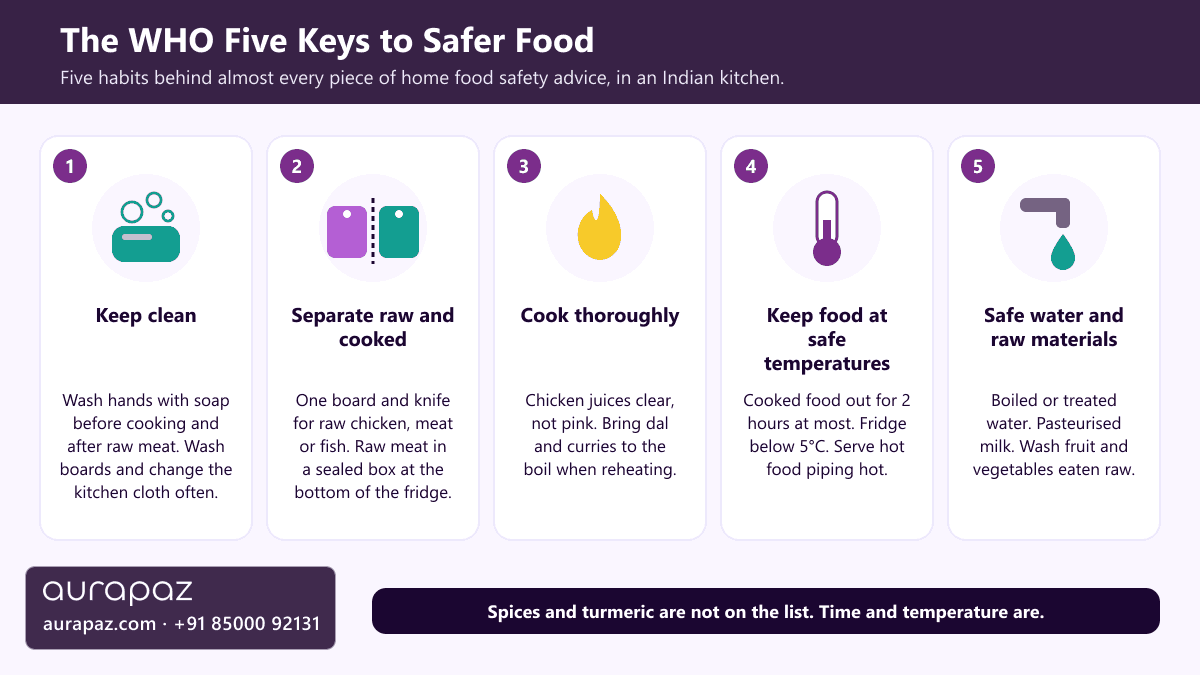
Myth vs Reality: what Indian kitchens get right and wrong
Here is the short version, before we go through each habit.
| What the trend says | What the science says |
|---|---|
| “Reheat it until it is piping hot and any germs are gone.” | Heat kills most bacteria, but some leave behind toxins it cannot destroy. The vomiting toxin of Bacillus cereus in rice is heat-stable up to 121°C. Cooling food quickly is the real fix. |
| “Raw chicken should be washed well before cooking.” | The UK Food Standards Agency advises never washing raw chicken, because splashing spreads Campylobacter around the kitchen. Thorough cooking is what kills it. |
| “Covered food can sit on the counter overnight.” | WHO says no more than 2 hours at room temperature. The US CDC shortens that to 1 hour above 32°C, which describes many Indian kitchens for months of the year. |
| “Hot food must cool completely before it goes in the fridge.” | UK guidance is to refrigerate leftovers within one to two hours, and rice within one hour. Shallow containers help it cool fast. |
| “Turmeric and spices keep food safe.” | None of the agencies cited here lists spices as a safety step. Time, temperature, separation and clean water are what work. |
| “If it smells fine, it is fine.” | The US FDA warns that food can make you very sick even when it does not look, smell or taste spoiled. |
| “Salt water or a vegetable wash cleans produce better than plain water.” | The FDA advises rubbing produce under plain running water and says there is no need for soap or a produce wash. |
Time and temperature: the habits that matter most
Bacteria need food, moisture, warmth and time. WHO’s training manual notes that one bacterium can become two in just 15 minutes, and over 16 million in six hours. Cooked rice, milk, eggs, meat and seafood are among the foods it lists as ideal for growth, which covers a good part of an Indian thali.
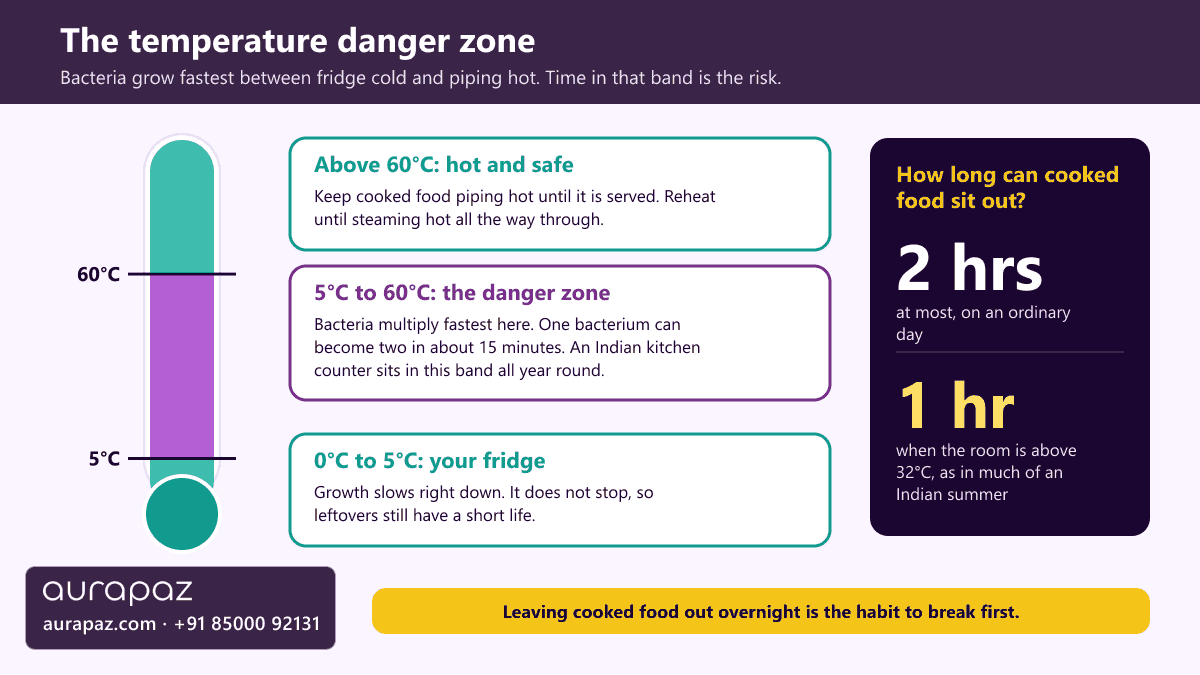
WHO describes 5°C to 60°C as the danger zone, where microorganisms multiply fastest. Below 5°C growth slows right down, and keeping cooked food above 60°C holds it in check. An Indian kitchen sits inside the danger zone all year, and in May or a humid monsoon week it sits near the warm end bacteria like best.
The overnight pot
If I could change one habit in Indian homes, it would be leaving cooked food out overnight. With a lid on, it feels harmless, and the dal often tastes fine in the morning. But WHO advises that cooked food should not be left at room temperature for more than 2 hours, and the CDC says perishable food should not sit out for more than 1 hour when the air is above 90°F, about 32°C. A lid keeps flies out. It does nothing about temperature.
Getting the fridge right
The UK Food Standards Agency recommends setting your fridge between 0°C and 5°C and checking it with a fridge thermometer. Two common habits work against this. One is waiting for food to cool completely on the counter: instead, refrigerate leftovers within one to two hours, dividing a large pot into smaller, shallow containers so the centre cools quickly. The other is packing the fridge so tightly that air cannot circulate, which the FDA advises against. Even in a cold fridge, the FSA suggests eating leftovers within 48 hours, or freezing them.
Leftover rice, and why reheating does not rescue it
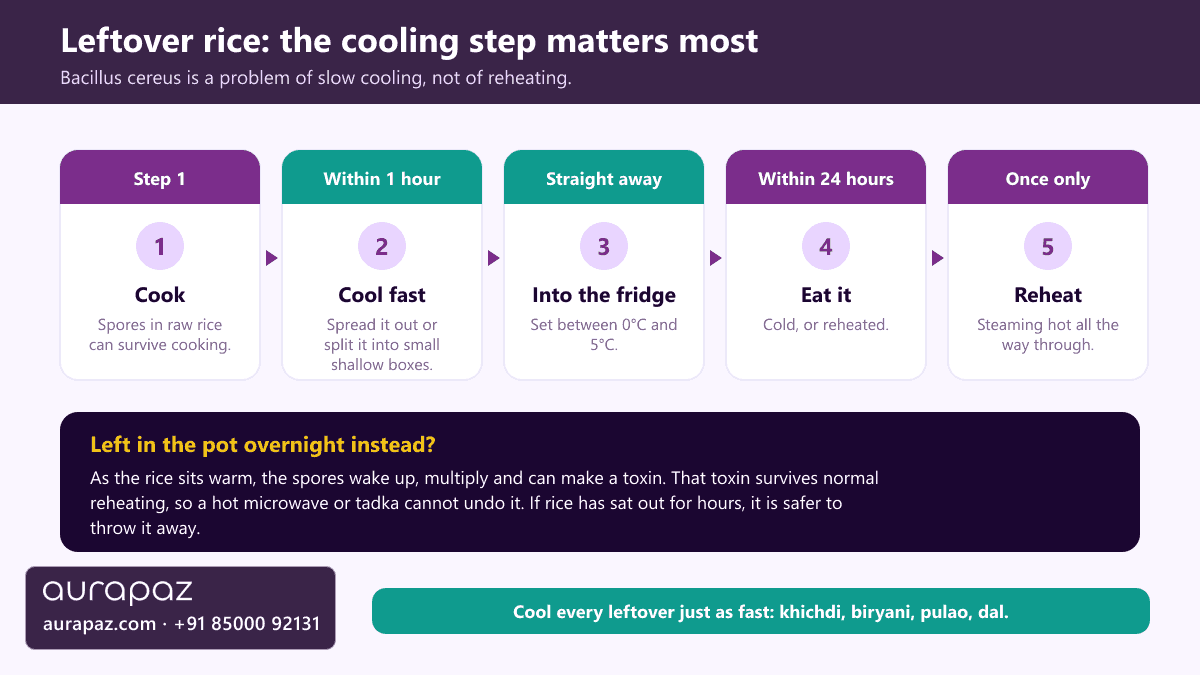
Rice is eaten at almost every Indian meal, and the advice about it is often misunderstood. Uncooked rice can carry spores of Bacillus cereus, and Food Standards Scotland explains that these spores can survive cooking. The longer cooked rice sits at room temperature, the more chance the bacteria have to multiply and produce a toxin that makes it unsafe to eat.
Reheating is neither the danger nor the cure. A University of Florida food safety publication notes that this vomiting toxin is heat-stable up to 121°C, that reheating food until it is steaming does not inactivate it, and that food cannot be made safe once the toxin has formed. A hot tadka, a long microwave or another round in the pressure cooker will kill most bacteria, but it will not undo a toxin that is already there.
So the rice rule is really a cooling rule. The NHS and Food Standards Scotland agree:
- Cool cooked rice as quickly as possible, ideally within 1 hour, by spreading it out or dividing it into smaller portions.
- Refrigerate it as soon as it has cooled, and eat it within 24 hours.
- Reheat it until it is steaming hot all the way through, and never more than once.
The same logic applies to khichdi, biryani, pulao or a big pot of rajma. NHS advice for families is that already-cooked food should only be reheated once, a sensible rule for the whole household. If you are cooking for a little one just starting family food, the early weeks are covered in when to start solids.
Raw chicken, cutting boards and the washing habit
Many of us were taught to wash chicken thoroughly, sometimes with turmeric and salt, before it goes in the pan. It is a habit rooted in care, and one the evidence asks us to drop. The UK Food Standards Agency calls Campylobacter the main cause of bacterial food poisoning in the UK and says washing raw chicken can spread it onto hands, work surfaces, clothing and cooking equipment. The US CDC agrees: raw chicken is ready to cook and does not need washing first.
Cooking is what makes chicken safe. The FSA’s checks are simple: steaming hot all the way through, no pink meat at the thickest part, and juices running clear. Trim stray feathers or fat with a knife on the board, not under a running tap.
The bigger risk is cross-contamination, WHO’s second key. In practice:
- Use one board and knife for raw chicken, meat and fish, and another for vegetables and anything eaten raw, such as salad or kachumber.
- Wash boards, knives and worktops in hot, soapy water after raw meat, as the CDC advises.
- Keep raw meat in sealed, leak-proof containers at the bottom of the fridge, as the FSA recommends, so nothing drips onto cooked food.
- Wash your hands with soap and water before, during and after preparing a meal.
Washing fruit and vegetables: what actually works
Indian households are thorough about washing produce, and rightly so. The question is only what you wash it with. Salt water, vinegar soaks and commercial vegetable washes are popular, but none is part of the official advice. The FDA recommends gently rubbing produce under plain running water, and says there is no need to use soap or a produce wash. It also suggests:
- Rinsing before you peel or cut, so the knife does not carry dirt from the skin inside.
- Scrubbing firm produce such as cucumbers and melons with a clean brush.
- Removing the outer leaves of cabbage and lettuce, and drying produce with a clean cloth.
Washing matters most for anything eaten raw, which is why WHO’s fifth key mentions it specifically.
Traditional habits that help, and the ones that do not
Several long-standing Indian habits line up neatly with modern advice.
- Cooking fresh, in meal-sized amounts. Food that goes from pan to plate spends almost no time in the danger zone, and WHO advises against storing food too long, even in the fridge.
- Boiling loose milk. The CDC explains that raw milk can carry germs such as Campylobacter, Listeria and Salmonella, and that pasteurisation removes them by heating milk for long enough at a high enough temperature. Boiling milk bought loose from a dairy does a similar job at home, and WHO recommends choosing foods processed for safety, such as pasteurised milk.
- Boiling drinking water when the source is uncertain. The CDC calls boiling the best way to kill germs in water: a rolling boil for 1 minute, after filtering cloudy water through a clean cloth. This is especially useful in the monsoon, and I have written separately about eating well through the rainy season.
- Bringing dal and curries back to the boil. WHO advises reheating cooked food thoroughly and bringing soups and stews to boiling.
Three beliefs are worth letting go. The first is that spices make food safe. Turmeric has its own merits, which I cover in my piece on turmeric and black pepper, but a well-spiced curry left out overnight follows the same rules as a plain one. The second is the sniff test: spoilage bacteria change smell and texture, while the bacteria that cause illness often do not, so go by the clock rather than your nose. The third is treating home set curd as everlasting. Once set, it belongs in the fridge like any other dairy, and if you want to know what you are buying in the dairy aisle, see my guide to analogue paneer versus real paneer.
Tiffins, school lunches and the Indian summer
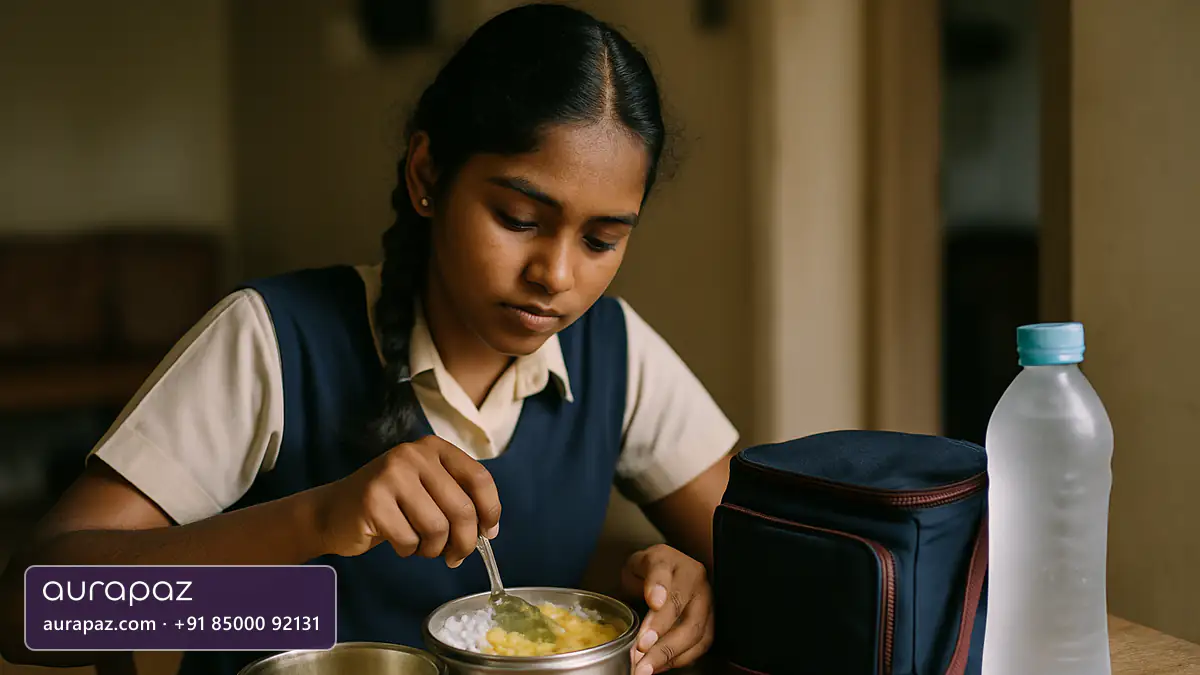
A tiffin packed at 7 in the morning is often opened at lunchtime after hours in a warm bag or classroom. A little planning helps:
- Pack hot food genuinely hot, in an insulated tiffin, and keep the lid closed until lunch.
- Keep cold food cold. A frozen water bottle in an insulated bag works as a simple ice pack.
- Favour foods that travel well, such as rotis, parathas, dry sabzi and roasted chana. If you pack rice and dal, as many families do, cool it quickly after cooking and keep the tiffin cold with an ice pack or a frozen water bottle until lunch. Curd rice and creamy sauces are the riskiest choices on a hot day.
- Ask children to throw away what they did not finish rather than eating it later, and wash the tiffin every day.
For lunchbox ideas that keep protein up without relying on dairy that spoils quickly, see protein for children.
When to see a doctor. Most food poisoning settles within a week. The NHS advises getting medical help for bloody diarrhoea, being unable to keep fluids down, signs of dehydration in a young child, diarrhoea lasting more than 7 days or vomiting lasting more than 2 days. Older adults and anyone with a weakened immune system should seek advice sooner. Once you are recovering, my article on supporting your gut covers gentle ways to eat well again.
Key takeaways
- Cooked food should not sit out for more than 2 hours, or 1 hour above 32°C. Leaving food out overnight is the habit to change first.
- Keep your fridge between 0°C and 5°C, do not overcrowd it, and eat leftovers within 48 hours.
- Cool rice within 1 hour, eat it within 24 hours and reheat it only once. Reheating cannot destroy a toxin that has already formed.
- Do not wash raw chicken. Use a separate board for raw meat and cook it until steaming hot with clear juices.
- Wash produce under plain running water. Salt, vinegar and produce washes are not needed.
- Boiling loose milk and uncertain water are habits worth keeping. Spices and the sniff test are not safety checks.
References & Further Reading
- World Health Organization. Food safety fact sheet. Updated 4 June 2026.
- World Health Organization. Five Keys to Safer Food Manual. 2006.
- Pan American Health Organization and WHO. PAHO/WHO recommends five keys to safer food. 2015.
- Food Standards Agency, GOV.UK. How to chill, freeze and defrost food safely.
- Food Standards Agency, GOV.UK. Campylobacter.
- Food Standards Scotland. Food storage, including cooked rice.
- NHS. Storing and reheating food.
- NHS. Food poisoning.
- Kharel K, Koviack K, Silverberg R, Bertoldi B, Schneider KR. Preventing Foodborne Illness: Bacillus cereus. University of Florida IFAS Extension.
- US Centers for Disease Control and Prevention. Preventing Food Poisoning.
- US Food and Drug Administration. 7 Tips for Cleaning Fruits, Vegetables.
- US Food and Drug Administration. Are You Storing Food Safely?
- US Centers for Disease Control and Prevention. Raw Milk.
- US Centers for Disease Control and Prevention. How to Make Water Safe in an Emergency.