
India has sunshine most of the world would envy, so it surprises a lot of families when a blood report comes back with vitamin D flagged in red. It is not an unusual result. Low vitamin D is common across the country, in cities and villages, in comfortable homes and struggling ones. The reasons have less to do with the sky and more to do with how we live, what we eat and when we actually step outside.
There is a quieter problem alongside it. Some people, worried by a low result, swing the other way and take high-strength sachets for months with no follow-up. So this piece covers both halves: why so many of us run low, and how to bring levels up without overdoing it.
How common is low vitamin D in India?
The best national picture for young people comes from the government’s Comprehensive National Nutrition Survey (CNNS), carried out in 30 states between 2016 and 2018. Using a strict cut-off of below 12 ng/mL, the level linked with genuine deficiency, researchers found low vitamin D in 13.7 per cent of children aged 1 to 4, 18.2 per cent of those aged 5 to 9 and 23.9 per cent of adolescents aged 10 to 19.
The burden was uneven. Adolescent girls were far more likely to be deficient than boys, 34.3 per cent against 13.8 per cent. City children and those tested in winter were at higher risk, and so were older children on vegetarian diets: 26.9 per cent of vegetarian adolescents were deficient, against 20.6 per cent of non-vegetarians.
For adults, a 2021 meta-analysis pooled 65 studies of South Asian adults covering 44,717 people. Using a cut-off of below 20 ng/mL, it estimated that 67 per cent of adults in the Indian studies were deficient, and that across the region women fared worse than men.
Notice that these two sources draw the line in different places, 12 ng/mL and 20 ng/mL. That difference matters when you read your own report, so I will come back to it. If you are vegetarian and already watching your B12, which I covered in vitamin B12 deficiency in Indian women, vitamin D belongs on the same list.
Why all that sunshine is not fixing it
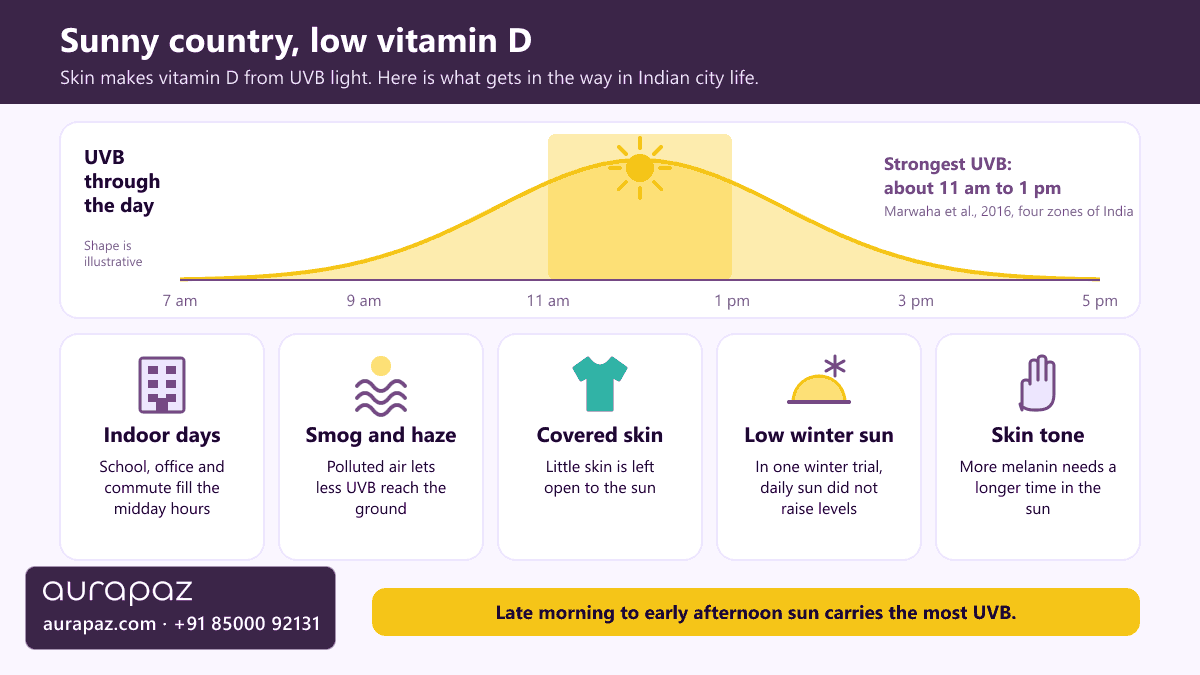
Your skin makes vitamin D when ultraviolet B (UVB) light falls on it. Sunlight is not equally useful for this all day, and modern Indian life puts a lot between skin and useful UVB.
Indoor days, at the wrong hours
Offices, classrooms, coaching centres and cars keep many of us under a roof through the middle of the day. In the CNNS data, children who attended school were more likely to be deficient than those who did not, and adolescents with less than three hours of physical activity a week were at higher risk.
Timing matters because UVB is not constant. A 2016 study measured it every hour from 10 am to 3 pm, every day for a year, in the north, northeast, west and south of India. Everywhere, UVB was highest between 11 am and 1 pm, all year round. An earlier study in Tirupati, using sealed vials of the skin’s vitamin D precursor, found vitamin D production peaked between 11 am and 2 pm in every season. The early morning sun of a walk or a terrace puja is lovely, but it is not doing most of the vitamin D work.
Winter is harder still. In the 2016 study, schoolchildren sat in the sun for 30 minutes a day, between 11 am and noon, with about a tenth of their skin exposed, for four winter weeks. Their levels did not rise at all.
Smog, clothing and skin tone
Air pollution blocks part of the UVB before it reaches the ground. A 2002 Delhi study found that babies and toddlers aged 9 to 24 months in a heavily polluted area averaged 12.4 ng/mL of vitamin D, against 27.1 ng/mL in children of the same age in a cleaner area.
Only uncovered skin makes vitamin D, so clothing that covers most of the body, whether for comfort, modesty or faith, limits how much is made. Melanin, the skin’s own sun protection, also plays a part: skin with more of it needs longer in the sun to make the same amount. That is plain physiology, not a ranking of anyone’s skin. Every skin tone simply has its own sun “dose”.
Sunscreen is often blamed, but a 2019 review found little evidence that it lowers vitamin D levels in real-life use, so please do not give up sun protection over this.
Who is more likely to run low
Anyone can be low, but these groups are at clearly higher risk and worth a conversation with your doctor:
- Older adults. Ageing skin makes less vitamin D. In a 1985 study, skin from people in their late seventies and early eighties made less than half as much of the vitamin D precursor as skin from children and young adults.
- Pregnant and breastfeeding women. The Endocrine Society’s 2024 guideline suggests vitamin D in pregnancy for its potential to lower the risk of pre-eclampsia and other complications. Breast milk contains little vitamin D, so ask your paediatrician what your baby needs.
- People living with obesity. Vitamin D is stored in body fat. In one study, the rise in blood vitamin D after the same UV exposure was 57 per cent lower in people with obesity.
- People with kidney or liver disease, since these organs help convert vitamin D into its usable form.
- People with poor fat absorption, such as coeliac disease, Crohn’s disease or cystic fibrosis, and those who have had weight-loss surgery.
- Anyone housebound or rarely outdoors.
Low vitamin D often causes no symptoms. When it does, tiredness, aching bones and muscle weakness overlap with many other problems, so it is worth reading my guide to the common causes of chronic fatigue before blaming one vitamin.

What your blood test numbers mean
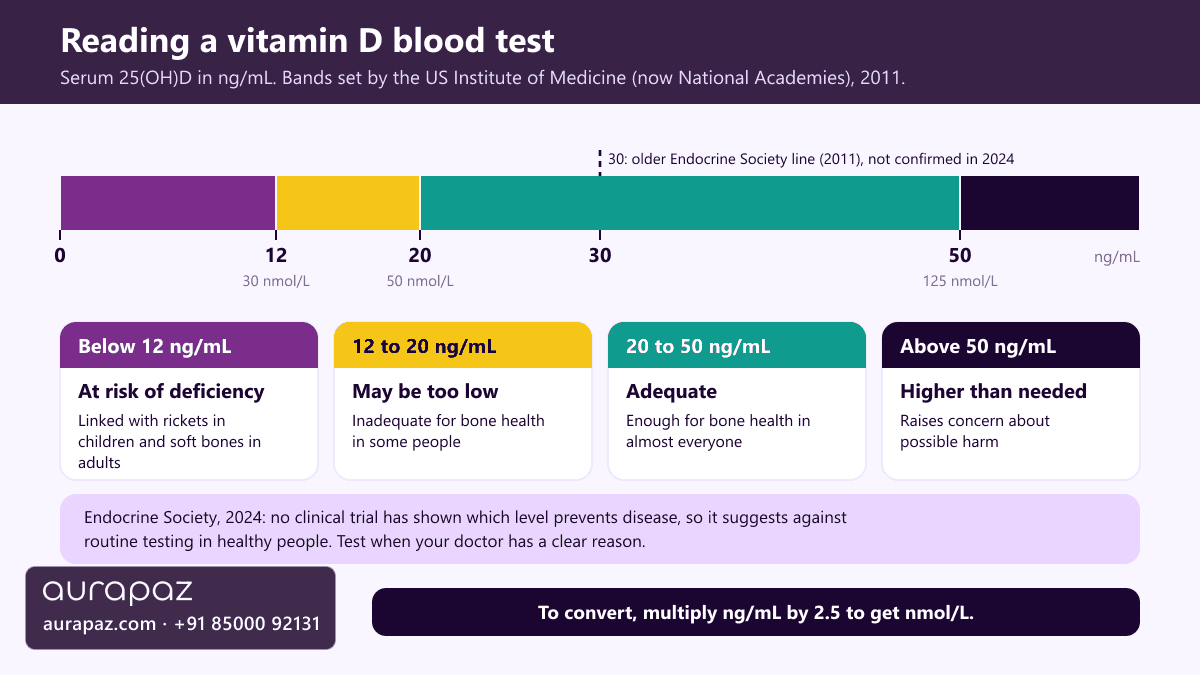
The test that reflects your status is serum 25-hydroxyvitamin D, shown as 25(OH)D. It captures vitamin D from sun, food and supplements together. Results come in ng/mL or nmol/L; multiply ng/mL by 2.5 to convert, so 20 ng/mL is 50 nmol/L.
The Institute of Medicine bands
The most widely used reference points come from the US Institute of Medicine (now the National Academies), whose 2011 report also underpins the NIH fact sheet:
- Below 12 ng/mL: at risk of deficiency, the range linked with rickets in children and softened bones (osteomalacia) in adults.
- 12 to 20 ng/mL: possibly too low for bone health in some people.
- 20 ng/mL and above: enough for bone health in at least 97.5 per cent of people.
- Above 50 ng/mL: high enough to raise concern about possible harm.
What the Endocrine Society changed in 2024
If your report flags anything under 30 ng/mL, that line traces back to the Endocrine Society’s 2011 guideline. In 2024 the Society replaced it. The new panel did not find adequate evidence to confirm those thresholds and set no target level, because trials have not shown which level prevents disease.
It also suggests against routine testing in generally healthy people, in every group it considered, including people with obesity or darker skin and during pregnancy. It does suggest vitamin D without testing for ages 1 to 18, adults 75 and over, pregnant women and adults with high-risk prediabetes, and suggests against going above the standard daily intake to prevent disease in healthy adults under 75.
So testing should have a reason: symptoms that fit, one of the risk conditions above, or high-dose treatment that your doctor needs to monitor.
What actually helps: sun and food
Sensible sun, Indian style
The ICMR National Institute of Nutrition’s Dietary Guidelines for Indians (2024) recommend about 30 minutes of sun, preferably between 11 am and 2 pm, to maintain vitamin D status in children, and, in the advice that accompanies their diet chart for pregnant women, suggest direct sunlight for at least 15 minutes. By direct, I mean outdoors, on bare skin such as the face, forearms and hands.
Fitting midday sun into a busy week: step onto the balcony or terrace at lunch, walk around the office block, let children play outside at lunch break, and roll up your sleeves while you do it. Never let your skin burn. The NHS notes that you cannot overdose on vitamin D from sunlight, but sunburn is its own harm.
Be realistic about north Indian winters and smoggy days, when sun alone may not lift your levels. That is when food and, if your doctor advises it, a supplement matter more.

Food for vegetarian and non-vegetarian plates
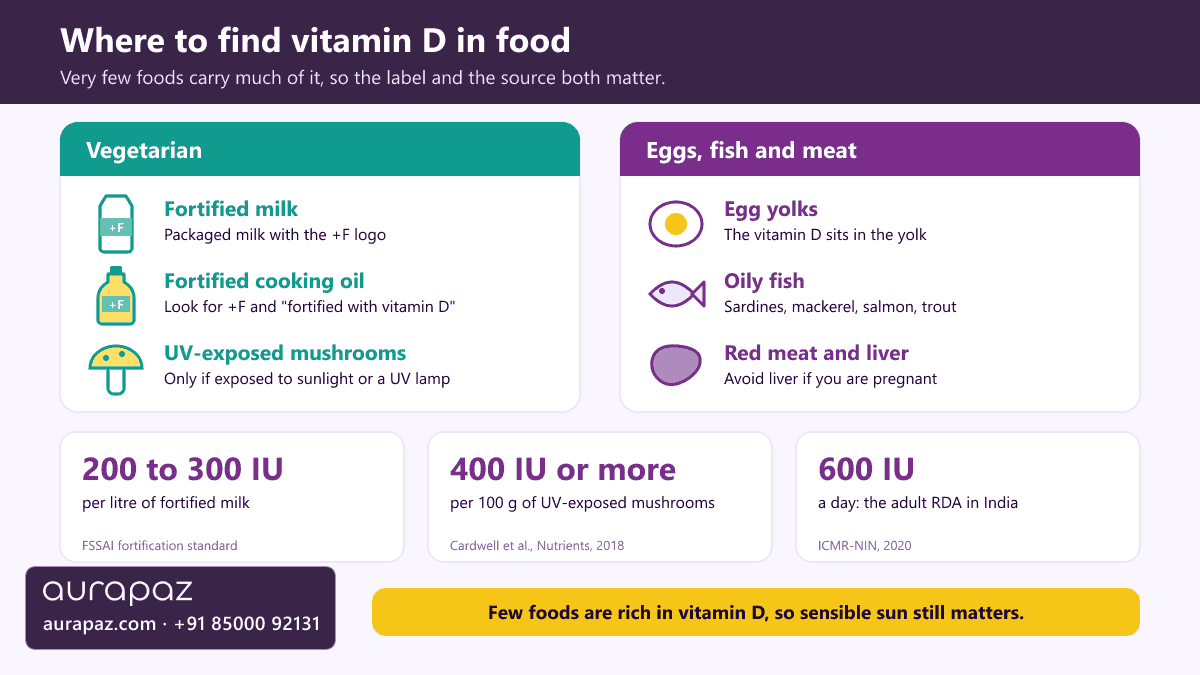
Very few foods are naturally rich in vitamin D, a point the Endocrine Society makes in its own guideline. The NHS lists oily fish such as salmon, sardines, trout and mackerel, along with egg yolks, red meat, liver and fortified foods. Sardines (mathi) and mackerel (bangda or ayala) are familiar in many coastal kitchens. Pregnant women should avoid liver.
For vegetarians, the options narrow quickly:
- Fortified milk. Under FSSAI regulations, fortified milk must carry 5 to 7.5 micrograms of vitamin D per litre, or 200 to 300 IU, so a 250 ml glass gives roughly 50 to 75 IU. Not all milk is fortified, so look for the +F logo.
- Fortified edible oil, again marked +F.
- UV-exposed mushrooms. Mushrooms exposed to sunlight or a UV lamp make vitamin D2. A 2018 review found they are likely to hold above 10 micrograms (400 IU) per 100 g if eaten before their best-before date, even after cooking.
Like iron, vitamin D needs a little planning on a vegetarian plate. If chai sits beside most of your meals, my piece on chai and iron absorption is worth a read too.
Supplements: useful, but more is not better
ICMR-NIN’s 2020 nutrient requirements set the Recommended Dietary Allowance at 600 IU (15 micrograms) a day for adults, up from 400 IU in 2010. The US Institute of Medicine also recommends 600 IU up to age 70 and 800 IU after that, with a Tolerable Upper Intake Level of 4,000 IU a day from age 9. That limit is a ceiling, not a target.
In India, high-strength vitamin D often comes as 60,000 IU sachets or capsules, usually meant to be taken weekly for a limited course. One holds the equivalent of 100 days of the 600 IU allowance. These doses have a proper place when a doctor is correcting a confirmed deficiency and checking your response. Trouble starts when they are repeated with no end date and no follow-up.
A hospital in Delhi-NCR described 16 people treated for vitamin D toxicity between 2011 and 2013, every case caused by prescribed mega-doses. The median total dose was 3.6 million IU, the equivalent of 60 of those sachets. Symptoms included nausea, vomiting, confusion, constipation, pancreatitis and acute kidney injury. The hallmark of toxicity is too much calcium in the blood, called hypercalcaemia. A separate series from Kashmir described ten more adults.
How you take it matters too. For people over 50 who need vitamin D, the Endocrine Society suggests daily doses rather than occasional large ones, and its evidence review found that high intermittent doses may increase falls. As with magnesium supplements, the pack is not a prescription for you.
Please do not start or repeat high-dose vitamin D on your own. Test and dose with your doctor. If you are prescribed weekly sachets, ask how long the course lasts and when your level and calcium should be rechecked. If you develop nausea, vomiting, constipation, unusual thirst, frequent urination or confusion while on high doses, seek medical advice promptly.
Myth vs Reality: vitamin D in a sunny country
| What the trend says | What the science says |
|---|---|
| “We live in a sunny country, so deficiency is rare.” | National survey data show 23.9 per cent of Indian adolescents, and over a third of adolescent girls, below 12 ng/mL. |
| “Early morning sun is best for vitamin D.” | Indian measurements show UVB is strongest between about 11 am and 1 pm. Early sun is pleasant but does much less. |
| “Sunscreen causes vitamin D deficiency.” | A 2019 review found little evidence that sunscreen lowers vitamin D levels in real-life use. |
| “If 600 IU is good, a 60,000 IU sachet every few days is better.” | The adult upper limit is 4,000 IU a day. Repeated mega-doses have caused hypercalcaemia and kidney injury in Indian patients. |
| “Everyone should check their vitamin D every year.” | The Endocrine Society suggests against routine testing in healthy people, because no target level has been proven to prevent disease. |
| “Vitamin D boosts immunity and cures tiredness.” | Evidence beyond bone health is mixed. The Endocrine Society’s review found low-certainty evidence of fewer respiratory infections in children, but no significant effect on the outcomes it examined in healthy adults aged 19 to 74. |
Vitamin D is one part of a healthy immune system, not a shield. For the bigger picture, see my guide to immunity-supporting foods in outbreak season.
Key takeaways
- Low vitamin D is common in India: 23.9 per cent of adolescents were below 12 ng/mL in the national CNNS survey, with girls, city children and vegetarians at higher risk.
- Indoor lives, smog, covered skin and winter all limit what the sun provides. UVB peaks around 11 am to 1 pm.
- On the Institute of Medicine scale, 20 ng/mL and above is enough for bone health in almost everyone. Routine testing is not advised for healthy people.
- Look for +F fortified milk and oil, try UV-exposed mushrooms, and include egg yolks and oily fish if you eat them.
- The adult RDA is 600 IU a day and the upper limit 4,000 IU. Never self-prescribe repeated 60,000 IU sachets; test and dose with your doctor.
References & Further Reading
- Rana G, et al. Prevalence and correlates of vitamin D deficiency among children and adolescents from a nationally representative survey in India. Indian Pediatrics, 2023; 60(3): 202 to 206.
- Siddiqee MH, et al. High prevalence of vitamin D deficiency among the South Asian adults: a systematic review and meta-analysis. BMC Public Health, 2021; 21: 1823.
- Marwaha RK, et al. Regional and seasonal variations in ultraviolet B irradiation and vitamin D synthesis in India. Osteoporosis International, 2016; 27(4): 1611 to 1617.
- Harinarayan CV, et al. Vitamin D status and sun exposure in India. Dermato-Endocrinology, 2013; 5(1): 130 to 141.
- Agarwal KS, et al. The impact of atmospheric pollution on vitamin D status of infants and toddlers in Delhi, India. Archives of Disease in Childhood, 2002; 87(2): 111 to 113.
- Clemens TL, et al. Increased skin pigment reduces the capacity of skin to synthesise vitamin D3. The Lancet, 1982; 1(8263): 74 to 76.
- Neale RE, et al. The effect of sunscreen on vitamin D: a review. British Journal of Dermatology, 2019; 181(5): 907 to 915.
- MacLaughlin J, Holick MF. Aging decreases the capacity of human skin to produce vitamin D3. Journal of Clinical Investigation, 1985; 76(4): 1536 to 1538.
- Wortsman J, et al. Decreased bioavailability of vitamin D in obesity. American Journal of Clinical Nutrition, 2000; 72(3): 690 to 693.
- Ross AC, et al. The 2011 report on dietary reference intakes for calcium and vitamin D from the Institute of Medicine: what clinicians need to know. Journal of Clinical Endocrinology and Metabolism, 2011; 96(1): 53 to 58.
- Demay MB, et al. Vitamin D for the prevention of disease: an Endocrine Society clinical practice guideline. Journal of Clinical Endocrinology and Metabolism, 2024; 109(8): 1907 to 1947.
- Shah VP, et al. A systematic review supporting the Endocrine Society clinical practice guidelines on vitamin D. Journal of Clinical Endocrinology and Metabolism, 2024; 109(8): 1961 to 1974.
- Seaborg E. To D or not to D? What questions does the latest Endocrine Society guideline answer about vitamin D supplements? Endocrine News, 3 June 2024.
- Cardwell G, et al. A review of mushrooms as a potential source of dietary vitamin D. Nutrients, 2018; 10(10): 1498.
- Kaur P, Mishra SK, Mithal A. Vitamin D toxicity resulting from overzealous correction of vitamin D deficiency. Clinical Endocrinology, 2015; 83(3): 327 to 331.
- Koul PA, et al. Vitamin D toxicity in adults: a case series from an area with endemic hypovitaminosis D. Oman Medical Journal, 2011; 26(3): 201 to 204.
- ICMR National Institute of Nutrition. A brief note on nutrient requirements for Indians. 2020.
- ICMR National Institute of Nutrition. Dietary Guidelines for Indians. 2024.
- FSSAI. Food Safety and Standards (Fortification of Foods) Regulations, 2018: compendium. 2021.
- NIH Office of Dietary Supplements. Vitamin D: fact sheet for health professionals.
- NHS. Vitamin D.
- Cleveland Clinic. Vitamin D deficiency.