
On 7 January 2026, the US Department of Health and Human Services and the Department of Agriculture published the Dietary Guidelines for Americans 2025 to 2030. Butter is back on the approved list. The protein target has almost doubled. The drink limits that stood for decades have quietly vanished. And the whole thing now fits in seven pages, down from a hundred and forty nine. If you eat in America, or read anything written for people who do, this is the document sitting underneath the advice you are being given.
I have read it so you do not have to. Here is what genuinely changed, what it means for your plate this week, and the two or three places where I think the confidence outruns the evidence.
The short version
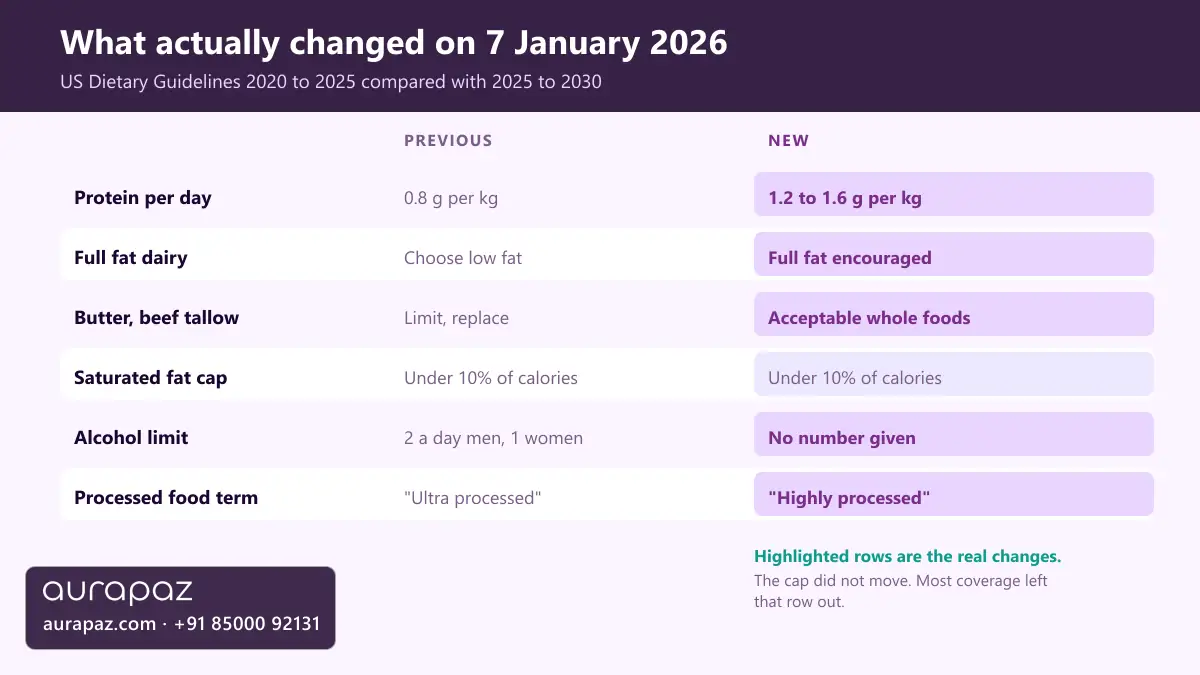
- Protein went up from 0.8 g per kg of body weight to 1.2 to 1.6 g per kg, a change the FDA Commissioner described as 50 to 100 per cent higher.
- Full fat dairy, butter and beef tallow are now treated as acceptable, but the cap on saturated fat did not move.
- The document states that no amount of added sugars or non nutritive sweeteners belongs in a healthy diet. That includes artificial sweeteners.
- “Ultra processed” became “highly processed”, and the term is still not formally defined.
- The numerical alcohol limits were removed entirely. Liver specialists objected. Drinks trade bodies approved.
What these guidelines are, and why they reach far beyond America
The Dietary Guidelines for Americans are rewritten every five years jointly by HHS and the USDA. They are not a leaflet. They set the rules for school meal programmes, military catering, hospital menus and federal food assistance, and they anchor most of the nutrition advice that flows outward from American media into everyone else’s feed.
That last part is why this matters to my clients in Hyderabad and my clients in Houston equally. When the American guidance moves, the supplement marketing moves with it, then the reformulated products, then the reels. You will feel this change long before you read the document.
The 2025 to 2030 edition is startlingly short. Seven pages replaced a hundred and forty nine. Brevity can be a virtue in public health, because nobody was ever going to read a hundred and forty nine pages. It also means the reasoning behind each recommendation is no longer laid out beside it, which makes the guidance harder to argue with and harder to check.
Protein: the biggest number change in decades
The old recommended dietary allowance for protein was 0.8 g per kilogram of body weight per day. The new guidance recommends 1.2 to 1.6 g per kilogram. FDA Commissioner Martin Makary put the increase at 50 to 100 per cent above previous guidance. The document also suggests including a quality protein source at every meal rather than loading it all into dinner.
Run the arithmetic on a 70 kg adult and the daily target moves from about 56 g to somewhere between 84 g and 112 g. That is not a nudge. That is a different shopping list.
I want to be fair to this change, because the direction of travel is defensible. The 0.8 g figure was always a minimum designed to prevent deficiency, not an optimum for health, and it has been criticised for years as too low for older adults losing muscle, for people in a calorie deficit, and for anyone training seriously. Raising it corrects a real problem. I have written before about how much protein you actually need and where to get it, and the honest answer has always sat above the old RDA.
Where I hesitate is the leap to 1.2 to 1.6 g per kg as a blanket floor for every adult, presented without the evidence review beside it. It is also, conveniently, the exact range the protein products industry has been advertising at for a decade. A guideline that doubles demand for the thing a large industry sells deserves to be read slowly.
If you have kidney disease, do not free climb this number. Higher protein intakes change the filtration load on the kidneys, and reduced kidney function is common and often undiagnosed, particularly alongside long standing diabetes or high blood pressure. Ask the doctor managing your kidneys what your ceiling is before you add protein.
For children the picture is different again, and the new adult figures should not be scaled down and applied to them. Most children I see are not short of protein at all, they are short of it at breakfast, which is a pattern problem rather than a quantity problem. I have set that out in detail in my piece on protein for children.
Butter and beef tallow are back, but the cap did not move
This is the change that generated the headlines. The guidelines now encourage full fat dairy with no added sugars, and treat whole food sources of saturated fat such as butter and beef tallow as acceptable parts of a healthy diet. After forty years of being told to choose the low fat version of everything, that is a genuine reversal.
Here is the part the headlines skipped. The cap on saturated fat did not change. It still sits below 10 per cent of daily calories.
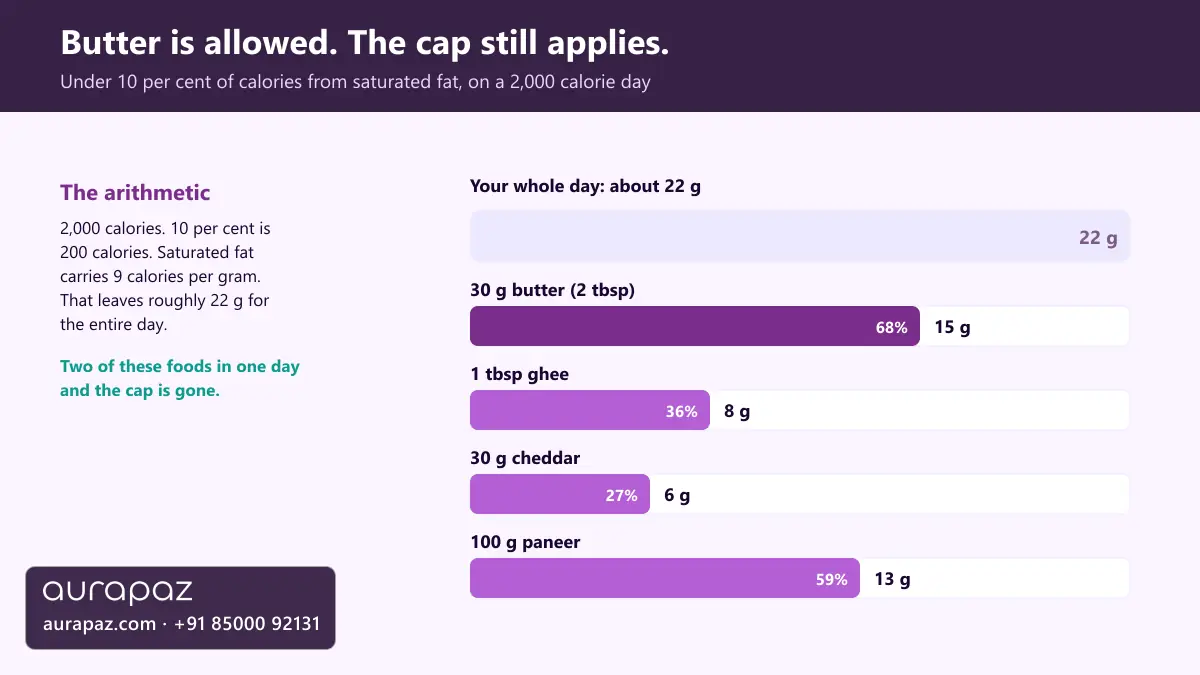
Those two statements are in tension, and nobody is going to resolve it for you at the supermarket. On a 2,000 calorie day, 10 per cent works out at roughly 22 g of saturated fat. Around 30 g of butter, which is two tablespoons and not a lot on toast, uses most of that up before you have eaten any cheese, meat, coconut or ghee. So butter is permitted, inside a limit that a genuinely butter forward day breaches without any drama at all.
Butter was never poison. It also did not become a health food on 7 January. The cap is doing the real work, and the cap did not move.
My practical reading is that this ends a pointless war on ordinary foods, and that the low fat era genuinely did push people towards products where the fat was removed and sugar and starch went in to replace it. It does not mean saturated fat is now unlimited. If you are in India and this reads as vindication for ghee, the same arithmetic applies to ghee. For the wider argument about which cooking fats deserve the fear they attract, I have gone through the evidence in the truth about seed oils.
Added sugars and sweeteners: the strictest line in the document
Tucked into a document being celebrated for relaxing things is the hardest line in it. The guidance states that no amount of added sugars or non nutritive sweeteners is recommended as part of a healthy diet, with particular emphasis on young children. It also sets an expectation that a single meal should contain no more than 10 g of added sugar.
Read that again, because the second half is the surprise. Non nutritive sweeteners means sucralose, aspartame, saccharin and the rest. The default swap that most people reach for, trading the sugary drink for the diet version, is not endorsed here. Neither is the protein bar sweetened to taste like confectionery.
I think this is the most defensible strict line in the whole document, and also the one most likely to be ignored, because it removes the escape hatch. The point is not that one diet drink will harm you. It is that sweetness itself, whatever is producing it, keeps the preference for sweetness alive, and that preference is what drives the next purchase. If you want the physiology of what added sugar actually does to blood glucose, and where the panic about spikes is overstated, that is all in my piece on blood sugar spikes.
“Ultra processed” became “highly processed”, and still nobody has defined it
The new document does not use the phrase ultra processed. It says highly processed, and advises avoiding highly processed foods and beverages, artificial additives and added sugars. The advisory science report treated ultra processed foods as an emerging area still needing a clearer definition, so the terminology was softened to match.
And then the document declines to formally define highly processed either, while highly processed foods make up something in the region of 70 per cent of the American food supply.
An undefined category cannot be regulated, cannot be labelled, and cannot be enforced. The FDA and USDA opened a request for information in July 2025 specifically to build a uniform federal definition, and were still working through the responses when these guidelines published. So the central villain of modern nutrition policy currently has no legal description.
This is not a reason to shrug. You do not need a federal definition to spot the pattern. If a food has a long ingredient list containing things you would never keep in your own kitchen, is engineered to be eaten quickly and in quantity, and does not resemble anything that was grown or reared, you already know what it is. I have written about how to read that pattern in the truth about ultra processed foods.

The alcohol numbers quietly disappeared
The previous edition told Americans that men should have no more than two drinks a day and women no more than one. Those numbers are gone. What remains is guidance to consume less alcohol for better overall health, with no threshold, no definition of a drink, and no accompanying discussion of alcohol related harm.
Removing a number is not the same as discovering that the number was wrong. Nothing in the evidence base shifted to make two drinks a day safer than it was in 2020. What changed is that the guidance stopped saying anything specific enough to act on.
The reaction told its own story. The American Association for the Study of Liver Diseases, whose members treat the consequences, publicly raised concern about the removal of evidence based alcohol guidance. Distilled spirits, beer and wine trade associations publicly welcomed the new guidelines. A peer reviewed response to the change was published under the title “Less than what?”, which is the correct question.
My advice to clients has not changed, because the physiology has not changed. Less is better, zero is better still, and if you want a number to work with, the old one was a reasonable ceiling rather than a target.
What the trend says versus what the science says
The coverage of this document has been noisier than the document itself. Here is where the popular reading and the actual text part company.
| What the trend says | What the science says |
|---|---|
| Butter and tallow are officially healthy now, so eat freely. | They are treated as acceptable whole food sources, inside an unchanged cap of under 10 per cent of calories from saturated fat. That is roughly 22 g a day on 2,000 calories, which butter alone can nearly fill. |
| Everyone should now eat 1.2 to 1.6 g of protein per kg. | That is the new recommendation, and it corrects an old minimum that was too low. It arrived without a published evidence review beside it, and it needs individual adjustment for kidney function, age and activity. |
| Low fat dairy was a scam all along. | The low fat era did drive people towards products where removed fat was replaced with sugar and starch. That is a real criticism of the products, not evidence that saturated fat is unlimited. |
| Diet drinks are the sensible way to cut sugar. | The guidance recommends neither added sugars nor non nutritive sweeteners as part of a healthy diet, and singles out young children. The swap is not endorsed. |
| Nutrition policy finally cracked down on ultra processed food. | It renamed the category to highly processed and did not define it. A federal definition is still being worked out from a July 2025 consultation. |
| The alcohol guidance was relaxed because moderate drinking turned out to be fine. | The numerical limits were deleted without new evidence supporting higher intake. Liver specialists objected to the removal. The direction of the evidence on alcohol has been getting less favourable, not more. |
Who objected, and why that is worth knowing
You can welcome parts of this document and still notice that professional bodies had reservations about how it was produced.
The Obesity Society said the guidelines do not reflect the modern scientific understanding of obesity as a chronic, complex disease. The American Society for Nutrition warned that departing from the established evidence review process risks undermining confidence in the guidelines themselves. Those are not fringe complaints, and they are about process rather than any single nutrient.
This is the part I would hold on to. Guidance is only as trustworthy as the method that produced it, and a seven page document that states conclusions without showing the review behind them asks for more faith than the previous edition did. That does not make the conclusions wrong. It does mean you are entitled to ask where each one came from.

What I would actually change on your plate
Stripped of the noise, here is what I would take from this document if you are eating in America or anywhere else.
- Spread protein across the day rather than chasing the top of the range. Getting 25 to 30 g at breakfast fixes more for most people than adding a shake at 9 pm. Eggs, curd, paneer, dal, fish, chicken, tofu.
- Stop buying the low fat version by reflex. Check what replaced the fat. Full fat curd with nothing added beats low fat fruit yoghurt with 14 g of sugar in it.
- Count saturated fat by the day, not by the meal. Butter and ghee are fine ingredients and poor staples. If you are cooking with them at every meal, you are past the cap.
- Treat sweetness as the thing to reduce, not sugar specifically. Swapping to sweeteners keeps the preference intact. Reducing the overall sweetness of your week is what actually shifts your palate.
- Judge processed food by its ingredient list, not by a label that does not exist yet. You do not need a federal definition to recognise engineered food.
- Keep the old alcohol number even though the document dropped it. No more than one or two, not every day, and less is better.
None of that requires a supplement, a subscription or a new brand of anything, which is usually how you can tell nutrition advice is honest. The guidelines got shorter. The work did not get easier.
References & Further Reading
- US Department of Health and Human Services and US Department of Agriculture. Dietary Guidelines for Americans, 2025 to 2030. Primary source, published 7 January 2026, and hosted at dietaryguidelines.gov. Official overview from the Office of Disease Prevention and Health Promotion: health.gov.
- Healio. “HHS releases 2025 to 2030 Dietary Guidelines for Americans”, 7 January 2026. Protein figures, the FDA Commissioner’s comparison, full fat dairy and added sugar wording, and the responses from professional bodies. healio.com.
- American Association for the Study of Liver Diseases. Statement raising concern over the removal of evidence based alcohol guidance in the 2025 to 2030 Dietary Guidelines. aasld.org.
- American Heart Association. Policy Issue: Regulating Ultraprocessed Foods, fact sheet, 2026. Context on the share of the US food supply that is highly processed and the state of federal definition work. heart.org.
- “The 2025 to 2030 US Dietary Guidelines: an analysis of scientific integrity and global health governance”. Peer reviewed analysis of the process behind the guidelines. PubMed Central.